
Corruption Perceptions Index 2025: Global Trends and India's Governance Paradox
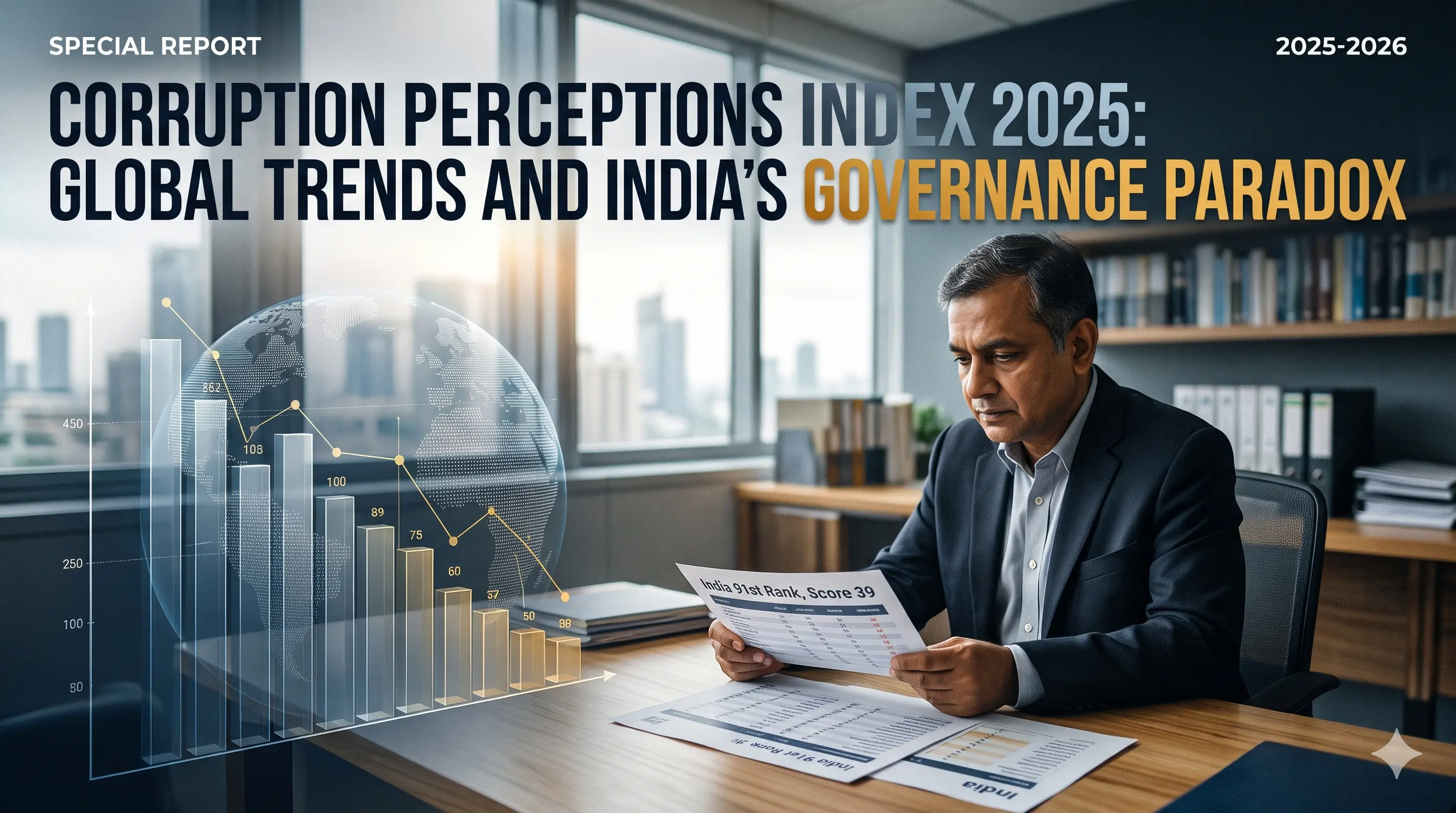
According to the Corruption Perceptions Index (CPI) 2025 released by Transparency International, public sector corruption remains stubbornly high worldwide. India ranks 91st with a score of 39, underscoring an enduring paradox where rapid economic growth has not translated into equivalent gains in institutional integrity and governance quality.
Introduction
Context & Background
Key Points
- •Index Methodology & Overview: The Corruption Perceptions Index (CPI) is published annually by Transparency International. It evaluates perceived levels of public sector corruption across nearly 180 countries on a scale of 0 (highly corrupt) to 100 (very clean), drawing on expert assessments and business surveys rather than recorded crime rates.
- •Global Democratic & Oversight Decline: The global average score dropped to a decade-low of 42, with over two-thirds of nations (122 of 180) scoring below 50. The decline is driven by eroding democratic accountability, curtailed civic freedoms, and weakened oversight bodies (police, judiciary, regulators).
- •India's Governance Paradox: India secured the 91st rank with a score of 39. Despite emerging as one of the fastest-growing major economies, its score has remained range-bound between 38 and 41 for ten years, highlighting a stark disconnect between economic expansion and governance standards.
- •The 'Soft State' Syndrome: Swedish economist Gunnar Myrdal categorized nations like India as 'soft states'—polities with extensive legislative and regulatory volumes but weak, inconsistent enforcement susceptible to widespread corruption.
- •Discretion and Regulatory Burden: Indian businesses face immense regulatory friction; out of roughly 1,000 compliances for start-ups (e.g., in pharmaceuticals), around 49% carry potential criminal liabilities. Excessive discretion among ground-level inspectors promotes systemic rent-seeking.
- •Digital Public Infrastructure as a Bulwark: Targeted reforms such as Direct Benefit Transfers (DBT) enabled via the JAM trinity, the rise of Unified Payments Interface (UPI) and digital transactions, and platforms like GSTN and Government e-Marketplace (GeM) have significantly curtailed human discretion in public procurement and welfare delivery.
Corruption Perceptions Index 2025: Regional & Benchmark Comparison
| Country/Region | Score (0-100) | Rank | Performance Context | Bookmark |
|---|---|---|---|---|
| Global Average | 42 | - | Decade-low; 122 out of 180 countries scored below 50 | |
| China | 42 | - | Ahead of India in regional public-sector perception | |
| India | 39 | 91 | Stagnant performance (scores have hovered between 38-41 for a decade) | |
| Sri Lanka | 38 | - | Marginally behind India in South Asian ranking |
Economic & Structural Cost of Corruption
| Metric/Dimension | Estimated Impact | Key Manifestation | Bookmark |
|---|---|---|---|
| Global GDP Drain | ~5% ($2.6 Trillion annually) | Diverts resources from public goods and slows development | |
| India Direct GDP Loss | ~0.5% of GDP | Direct loss of state revenues and leakages | |
| India Indirect GDP Loss | 1.0% - 1.5% of GDP | Loss of productivity, deterrence to FDI, and stifled innovation | |
| Regulatory Over-criminalisation | 26,000+ imprisonment clauses | Minor procedural lapses carry jail terms, driving rent-seeking |
Related Entities
Impact & Significance
- •Economic Drag: Direct loss of 0.5% of GDP and indirect drag of 1-1.5% weakens macroeconomic efficiency and public welfare allocation.
- •Entrepreneurial Friction: High procedural hurdles and punitive provisions in corporate laws raise risk premiums and disincentivize domestic and foreign start-up investments.
- •Public Trust Deficit: Prolonged stagnation in global perception indices erodes trust in domestic regulatory bodies and judicial mechanisms.
- •Global Competitiveness: Trailing regional peers like China (42) affects India's positioning in global supply chain relocations where institutional transparency is an investment criterion.
Challenges & Criticism
- •Over-Criminalisation: More than 26,000 regulatory imprisonment clauses turn minor technical lapses into criminal liabilities, creating avenues for extortion.
- •Perception vs. Reality Discrepancy: Critics point out that the CPI relies on perception-based expert surveys rather than quantitative improvements delivered via digital service delivery and direct transfers.
- •Enforcement Bottlenecks: Low conviction rates and protracted trials for white-collar corruption cases blunt the deterrent effect of statutory watchdogs.
- •Asymmetrical Regional Progress: Sub-national disparities in administrative modernization mean state-level compliance experiences remain uneven for ordinary citizens and small businesses.
Future Outlook
- •Decriminalisation of Minor Offenses: Accelerate legislative reforms to rationalise over 26,000 business imprisonment clauses into civil penalties, curbing inspector discretion and rent-seeking.
- •Institutional Autonomy: Strengthen statutory autonomy and operational transparency for apex anti-corruption and investigation bodies such as the Lokpal, CBI, and ED.
- •Structural Governance Alignment: Drawing from Chanakya's insights in the Arthashastra, governance architectures must recognise human fallibility and institute robust systemic oversight rather than relying on personal discretion.
- •Expansion of Digital Public Goods: Scale up end-to-end e-procurement (GeM), algorithmic workflow assignments, and faceless assessments to eliminate rent-seeking checkpoints in public service delivery.
- •Judicial and Investigative Fast-Tracking: Establish dedicated anti-corruption benches and fixed timelines for public integrity probes to restore credibility to punitive frameworks.
UPSC Relevance
- • GS-2 (Governance & Accountability): Role of oversight institutions, civil service reforms, transparency indices, and citizens' charters.
- • GS-3 (Indian Economy): Impact of corruption and ease of doing business on capital formation, start-up growth, and public expenditure leakages.
- • GS-4 (Ethics, Integrity, & Aptitude): Foundational ethical values in public administration, probity in governance, and institutional mechanisms to tackle rent-seeking.
- • Essay Topics: 'Economic growth without institutional integrity is an incomplete journey', 'Transparency is the best antidote to discretionary authority'.
Sample Questions
Prelims
Regarding the Corruption Perceptions Index (CPI), consider the following statements: 1. It is published annually by the World Economic Forum. 2. The index measures perceived levels of public sector corruption on a scale of 0 (highly corrupt) to 100 (very clean). 3. It is computed solely based on officially reported criminal cases of bribery in member states. Which of the statements given above is/are correct?
- (a)1 and 3 only
- (b)2 only
- (c)2 and 3 only
- (d)1, 2, and 3
Mains
“India’s persistent stagnation on the Corruption Perceptions Index highlights a structural paradox where rapid economic growth has outpaced governance reforms.” Critically analyze this statement and evaluate how digital public infrastructure and regulatory rationalization can address public sector rent-seeking.
Introduction: Refer to the CPI 2025 findings where India ranks 91st with a score of 39, noting the stagnation between 38-41 over the last decade despite rapid GDP growth.
Body:
• The Governance Paradox: Fast GDP growth vs. lagging institutions; Gunnar Myrdal's 'soft state' thesis; financial drain of 1-1.5% indirect GDP loss due to misallocated capital and hindered innovation.
• Underlying Drivers: Discretionary powers fueled by over-criminalisation (over 26,000 business jail clauses); inspector raj in MSME/pharma compliances; delays in judicial outcomes.
• Reforms & Way Forward: Success of DPI (DBT via JAM, GeM portal, faceless tax assessments); decriminalisation of minor procedural defaults; strengthening whistleblower protection and institutional independence of watchdog agencies.
Conclusion: Conclude by quoting Chanakya or the Second Administrative Reforms Commission (2nd ARC), stating that institutionalizing transparency and eliminating unguided discretion are essential for sustainable, ethical economic expansion.