
India’s CSR Framework: Why the Environment Remains a Neglected Priority?
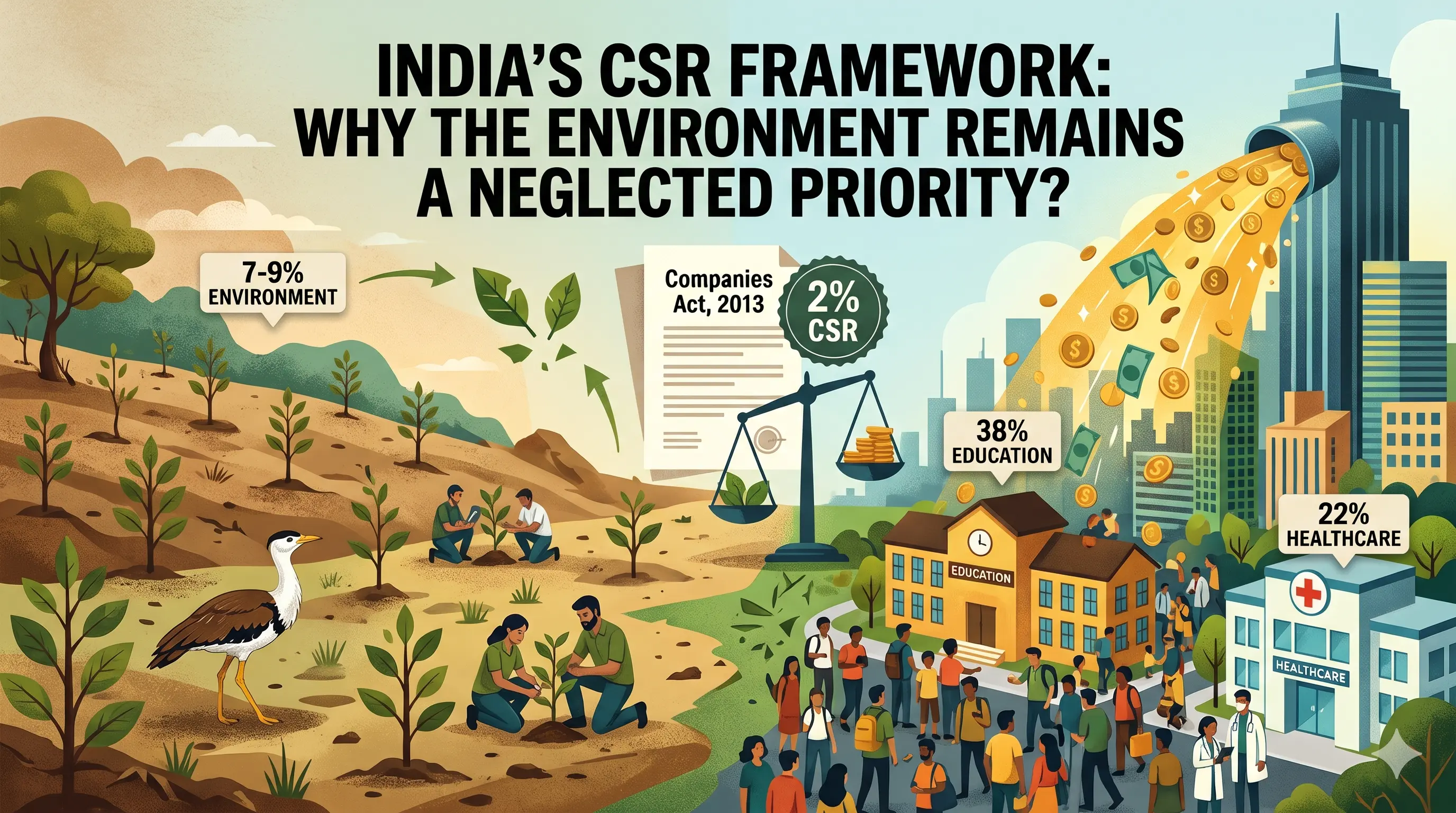
Despite India being a global pioneer in mandating Corporate Social Responsibility (CSR) under the Companies Act, 2013, the environmental sector receives only a fraction of funding. This article highlights the structural gaps, execution constraints, and the urgent need to shift from optics-driven charity to ecosystem-centric governance.
Introduction
Context & Background
Key Points
- •Low Environmental Allocation: While education gets ~38% and healthcare ~22% of CSR funds, the environment receives a dismal 7–9%.
- •Bonn Challenge Shortfall: India committed to restoring 26 million hectares of degraded land by 2030. Out of the 9.8 million hectares restored so far, the private sector's contribution is a negligible 2%.
- •Article 51A(g) Invocation: The judiciary has reinforced the Fundamental Duty to protect the environment, linking the right to do business directly with ecological responsibility.
- •Constitutional Obligation: Judicial intervention has transformed environmental protection from a voluntary act of 'charity' into a binding constitutional duty.
CSR Eligibility Criteria (Section 135, Companies Act, 2013)
| Parameter | Threshold / Requirement | Bookmark |
|---|---|---|
| Net Worth | ≥ ₹500 crore | |
| Turnover | ≥ ₹1,000 crore | |
| Net Profit | ≥ ₹5 crore (in preceding financial year) | |
| Spending Norm | At least 2% of the average net profits of the previous three financial years |
Related Entities
Impact & Significance
- •Intergenerational Equity: Ensures the needs of future generations are not compromised by present-day corporate activities.
- •Constitutional Alignment: The judiciary has linked the fundamental right to do business with ecological responsibility through Article 51A(g).
- •Landmark GIB Case: The Supreme Court of India established a precedent by highlighting severe ecological damage caused by energy and infrastructure projects in Great Indian Bustard habitats.
Challenges & Criticism
- •Optics-Driven Interventions: Corporates prioritize high-profile awareness campaigns or renewable energy projects that offer immediate branding value rather than deep ecological impact.
- •Technical Constraints: Most CSR implementing agencies lack the scientific capacity to execute specialized environmental interventions effectively.
- •The Miyawaki Pitfall: The emphasis on rapid growth and corporate visibility often overlooks native biodiversity, resulting in superficial greening that disrupts local ecosystems.
- •Urban Bias: CSR projects are heavily concentrated near corporate offices in urban or peri-urban areas, ignoring vast degraded rural or forest landscapes.
Future Outlook
- •Redefining Success Metrics: Shift from merely counting planted saplings to tracking ecological outcomes like soil carbon sequestration, groundwater recharge, and biodiversity recovery.
- •Strengthening Institutional Collaboration: Form multi-stakeholder alliances involving Forest Departments, universities, NGOs, and local committees for scientifically rigorous projects.
- •Long-Term Financial Mechanisms: Establish Restoration Trusts or Escrow Funds to ensure multi-year financing for landscape-scale ecological recovery that exceeds standard annual CSR cycles.
- •Shift to Ecosystem-Centric Governance: Transition corporate strategy from a shareholder-centric model to an ecosystem-centric approach by integrating Natural Capital accounting and Nature-Based Solutions.
UPSC Relevance
- • GS-3 (Environment): Conservation, environmental pollution, degradation, and environmental impact assessment.
- • GS-2 (Governance): Government policies, interventions, and corporate governance frameworks.
- • GS-4 (Ethics): Corporate Governance and Corporate Social Responsibility.
- • Essay Topics: 'Corporate capitalism vs. Ecological sustainability' or 'Nature-Based Solutions in India'.
Sample Questions
Prelims
Consider the following statements regarding the Corporate Social Responsibility (CSR) framework in India: 1. CSR provisions apply to companies having a net worth of ₹500 crore or more, or turnover of ₹1,000 crore or more. 2. Eligible companies must spend at least 2% of the average net profits of the previous three financial years. 3. The environmental sector receives the highest allocation of CSR funds in India. Which of the statements given above are correct?
- (a)Only 1 and 2
- (b)Only 2 and 3
- (c)Only 1 and 3
- (d)1, 2, and 3
Mains
“In India, environmental protection has transformed from a voluntary corporate charity into a binding constitutional obligation.” Discuss this statement in the context of India's CSR framework and highlight the systemic gaps in environmental CSR funding.
Introduction: Define CSR under Section 135 of the Companies Act, 2013. Highlight the disparity in funding where environment receives only 7-9% compared to 38% for education.
Body:
• Systemic Gaps: Human-centric bias (health/education prioritize over environment); Optics-driven CSR; Lack of technical capacity in NGOs; Urban bias; Flawed execution like the Miyawaki pitfall disrupting local ecosystems.
• Judicial Interventions: Shift from charity to obligation; Mention the GIB case; Supreme Court invoking Article 51A(g) linking the right to do business with ecological responsibility.
• Way Forward: Ecosystem-centric governance; Multi-stakeholder alliances; Establishing Restoration Trusts for long-term funding beyond annual CSR cycles.
Conclusion: Conclude by emphasizing the need to align CSR spending with India's global commitments like the Bonn Challenge to ensure sustainable intergenerational equity.