
Decline of Maoism and Future Challenges: Navigating the Post-Conflict Transition
Following the Union Home Minister's announcement in the Lok Sabha regarding the substantial elimination of Naxalism from Chhattisgarh's Bastar region ahead of the March 2026 deadline, this article examines the multi-pronged state strategy, the challenges of filling the resulting governance vacuum, and the potential risks of revival.
Introduction
Context & Background
Key Points
- •The 2026 Milestone: The Union Home Ministry set a target to end Left Wing Extremism (LWE) nationwide by March 2026, driven by continuous tactical gains across southern Chhattisgarh.
- •Clear–Hold–Develop Doctrine: Security forces clear hostile terrain, establish sustained area domination via forward bases, and secure the operational perimeter for administrative entry.
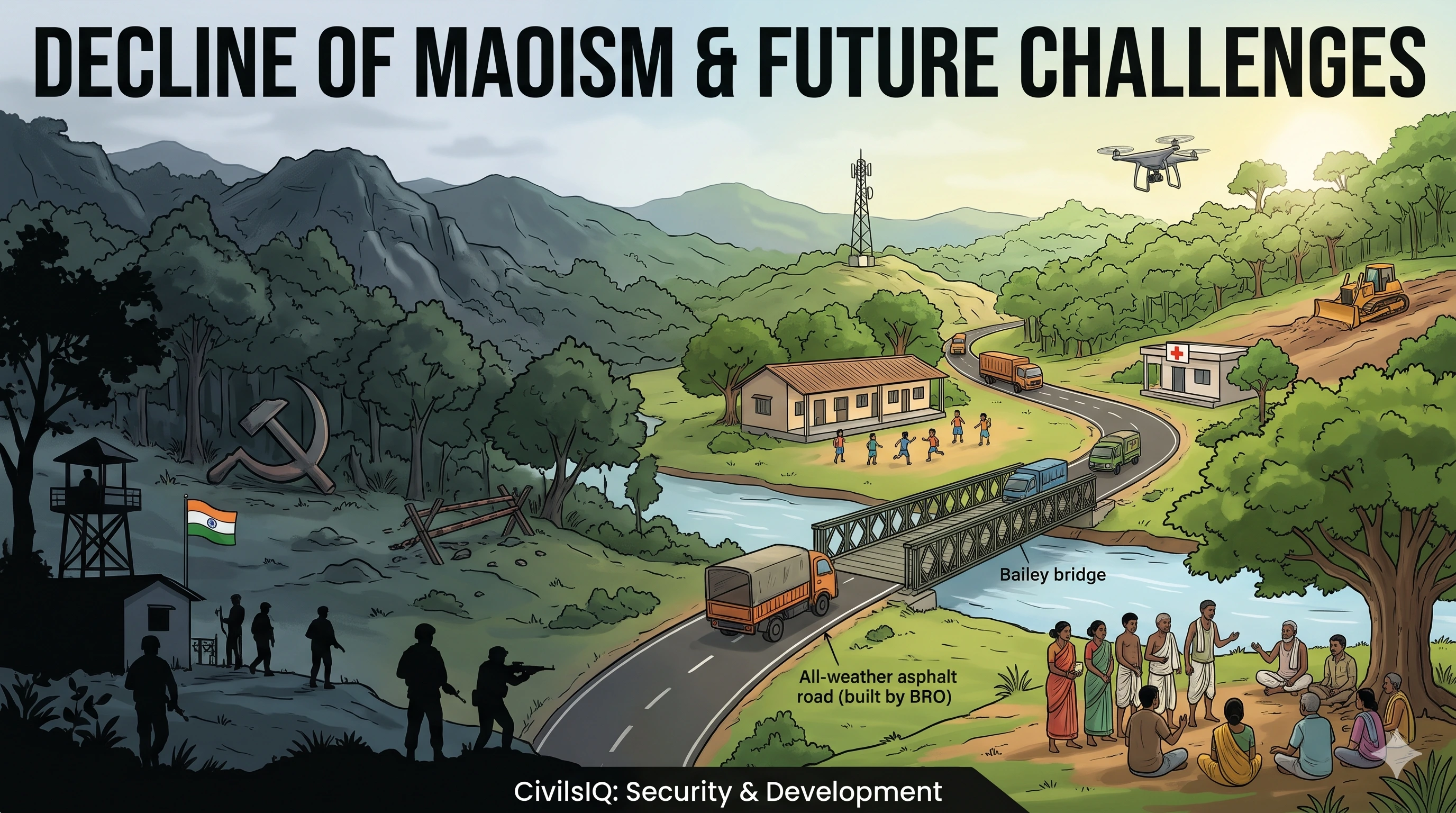
- •Infrastructure as a Game Changer: Enhanced road infrastructure in deep Maoist belts (such as 75 km of roads and 20 Bailey bridges by BRO in Sukma–Bijapur) has ended seasonal isolation for over 25 interior villages and shifted logistics from vulnerable helicopters to rapid ground troop deployment.
- •Inter-State Border Domination: Establishing forward security bases along the Chhattisgarh–Telangana and Chhattisgarh–Odisha boundaries has severed traditional Maoist inter-state transit corridors.
- •Modern Surveillance Capabilities: Integration of drone reconnaissance, satellite monitoring, and AI-enabled data analytics has limited traditional guerilla tactical advantages in dense forests.
- •Managing the Administrative Vacuum: Kinetic victory requires rapid civil administrative expansion; without institutionalizing local hiring and timely grievance redressal, extremist narratives find fertile ground to re-emerge.
Key Pillars of the Anti-Maoist Operational Framework
| Strategic Pillar | Operational Focus | Key Outcomes & Mechanisms | Bookmark |
|---|---|---|---|
| Clear–Hold–Develop | Joint security operations and stabilization | CRPF and State Police clear insurgent strongholds, secure areas with forward operating bases, and hand over territory to civil administration. | |
| Strategic Connectivity | Road and bridge infrastructure in core conflict zones | Border Roads Organisation (BRO) completed 75 km of all-weather roads and 20 Bailey bridges in the Bijapur–Sukma corridor, replacing helicopter-reliant logistics. | |
| Civic Integration & Surrender | Rehabilitation policy and community outreach | Incentivized surrender packages, financial assistance, vocational training, and social reintegration of former armed cadres. | |
| Technological Force Multipliers | Modern tactical surveillance | Deployment of unmanned aerial vehicles (UAVs), AI-based movement pattern analysis, and real-time electronic intelligence in dense canopy terrains. |
Post-Conflict Transition: Vacuum Management vs. Resurgence Vulnerabilities
| Domain | Immediate State Priority (Vacuum Management) | Latent Risk Factors (Resurgence Vectors) | Bookmark |
|---|---|---|---|
| Governance & Administration | Restore permanent schools, primary health centers, and welfare delivery mechanisms. | Persistent governance deficits in deep interior zones like Abujhmad. | |
| Security Architecture | Maintain tactical forward camps to prevent criminalization or extremist resurgence. | Premature drawdown of central forces leading to regrouping in inter-state corridors. | |
| Socio-Economic Development | Expand rural connectivity, telecom networks, and local livelihood options. | Unaddressed tribal land alienation, mining-induced displacement, and youth unemployment. | |
| Ideological Landscape | Build administrative legitimacy and address local grievances transparently. | Ideological adaptation shifting toward urban issue-based activism and legal-front agitations. |
Related Entities
Impact & Significance
- •Internal Security Consolidation: Sharp reductions in insurgent ambushes, casualty numbers, and arms proliferation help stabilize the central Indian security corridor.
- •Democratic & Electoral Re-engagement: Reclaimed areas enable free voter turnout, lower the risk of boycott calls, and support normal panchayat-level democratic functioning.
- •Economic Integration: Improved road connectivity and supply corridors allow local agricultural produce and Minor Forest Produce (MFP) to reach broader markets.
- •Delivery of Public Services: Re-establishing state authority enables the safe delivery of schools, healthcare personnel, electricity, and banking infrastructure to previously cut-off populations.
Challenges & Criticism
- •Vulnerable Interior Pockets: Difficult, unmapped terrains like Abujhmad and remote parts of the Bastar forest remain tough to access, leaving gaps where splinter groups can shelter.
- •Socio-Economic Triggers: Lingering challenges such as rural unemployment, mining-related displacement, and delayed land title settlements under FRA can fuel renewed community grievances.
- •Ideological Diversification: With traditional rural armed squads under heavy pressure, extremist networks may pivot toward urban front organizations and legal activist spaces.
- •Administrative Capacity Deficit: Establishing civil administrative bodies in remote areas often lags behind the pace of security operations, creating delays in service delivery.
Future Outlook
- •Institutionalizing Local Representation: Proactively recruit local tribal youth into local policing, administrative machinery, and civil governance to build community trust.
- •Deep-Belt Administrative Penetration: Move beyond roadside development by establishing primary administrative units, courts, and banks in deep forest tracts like Abujhmad.
- •Sustained Calibrated Security: Keep strategic forward security bases active during the transition to ensure regional stability until local civil police are fully established.
- •Resolving Structural Tribal Grievances: Strictly enforce the Panchayats (Extension to Scheduled Areas) Act (PESA), 1996, and the Forest Rights Act (FRA), 2006, to address historical friction around land, mining, and forest resources.
UPSC Relevance
- • GS-3 (Internal Security): Linkages between development and spread of extremism; role of external state and non-state actors in creating challenges to internal security; challenges to internal security through communication networks.
- • GS-2 (Governance): Devolution of powers to local levels in Fifth Schedule areas (PESA, FRA), welfare delivery in tribal belts, and inter-state administrative coordination.
- • Essay Topics: 'Security and Development: Two Sides of the Same Coin', 'Winning Hearts and Minds: The Transition from Conflict to Peace'.
- • Mains Focus: Critical analysis of the security-development nexus, assessment of the SAMADHAN doctrine, and policy solutions for post-conflict institution building.
Sample Questions
Prelims
Consider the following statements regarding the institutional and operational framework against Left Wing Extremism (LWE) in India: 1. The 'Clear–Hold–Develop' strategy focuses on clearing areas of armed groups, holding them with security presence, and facilitating the entry of civil governance. 2. In areas covered under the Panchayats (Extension to Scheduled Areas) Act (PESA), 1996, the Gram Sabha possesses mandatory consultation rights regarding land acquisition for development projects. 3. Left Wing Extremism operations are exclusively managed by the Union Government under Entry 1 of the Union List (Defence of India). Which of the statements given above are correct?
- (a)1 and 2 only
- (b)2 and 3 only
- (c)1 and 3 only
- (d)1, 2, and 3
Mains
“While the kinetic elimination of Maoist strongholds marks a major tactical achievement, the long-term victory against Left Wing Extremism depends on filling the administrative and institutional vacuum.” Critically examine the strategies required for long-term peace in post-conflict tribal belts.
Introduction: Acknowledge the major decline in Left Wing Extremism across central India and Bastar leading up to the March 2026 deadline, noting the transition from active counter-insurgency to peace consolidation.
Body:
• Tactical Achievements: Coordinated operations under the Clear–Hold–Develop framework, BRO-led critical infrastructure, drone surveillance, and inter-state border containment.
• Post-Conflict Vulnerabilities: Risk of resurgence due to unresolved tribal grievances (land rights, displacement), inadequate state presence in isolated areas like Abujhmad, and urban issue-based ideological mobilization.
• Institutional Way Forward: Comprehensive governance expansion (PESA, FRA compliance), inducting local youth into civil institutions, sustained forward base presence, and transparent grievance redressal mechanisms.
Conclusion: Emphasize that lasting victory requires converting temporary security gains into sustainable democratic governance and shared economic progress for tribal communities.