
Demand for Distinct Enumeration of DNT Communities in the 2027 Census
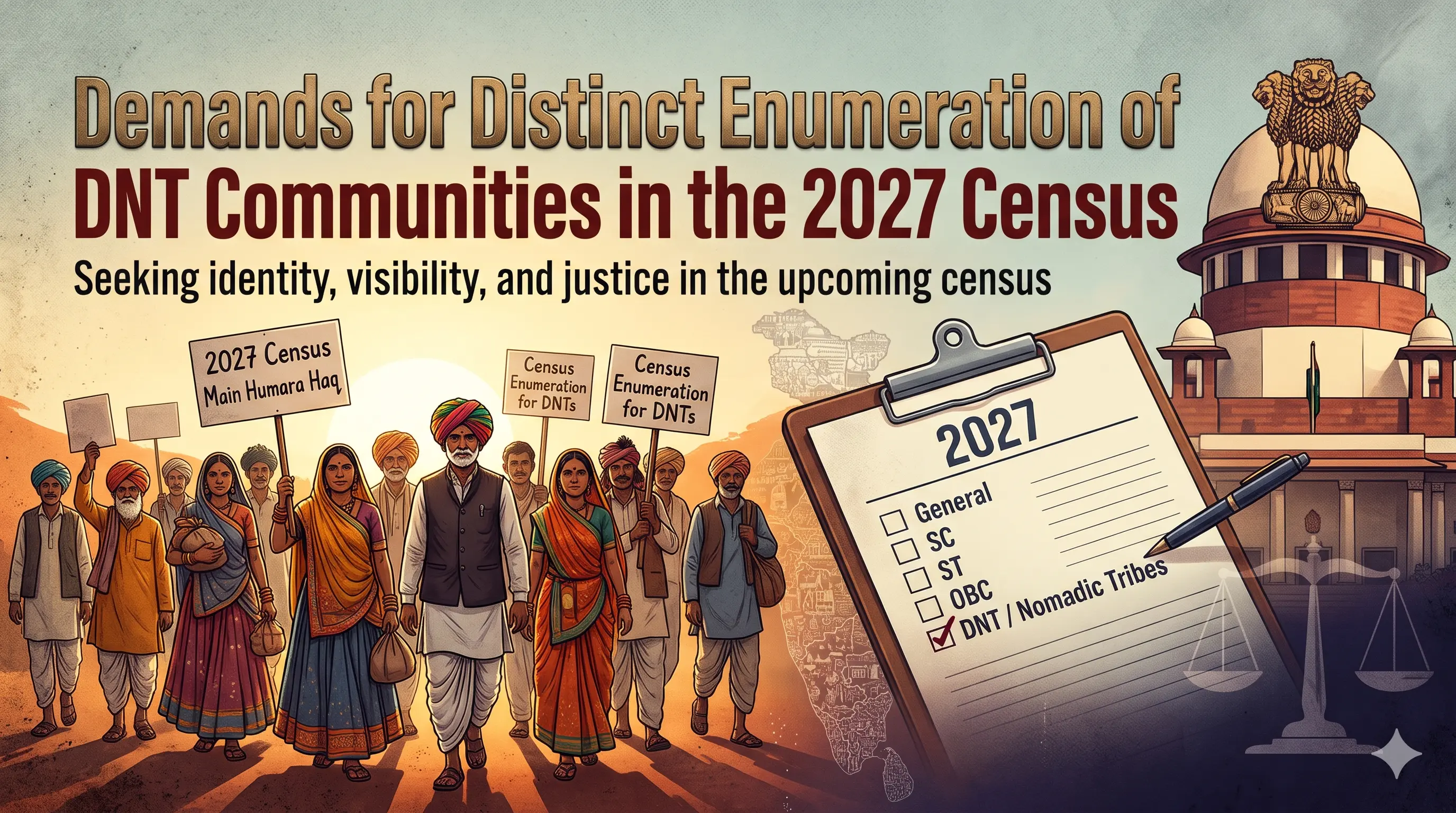
Leaders from Denotified, Nomadic and Semi-Nomadic Tribes (DNTs) have approached the Supreme Court seeking distinct identification in the 2027 census. Proper enumeration is critical for designing targeted welfare policies and addressing the long-standing historical marginalization of these communities.
Introduction
Context & Background
Key Points
- •Historical Stigma: DNTs suffer from the legacy of the Criminal Tribes Act, 1871. Communities like Pardhis and Sansis still face police surveillance and stereotypes.
- •Identity Crisis: A nomadic lifestyle results in a lack of basic identity documents (such as Aadhaar, Voter IDs, or caste certificates), heavily restricting their access to welfare schemes.
- •Educational Deprivation: Frequent migration and severe poverty lead to low enrolment and high dropout rates among DNT children.
- •Economic Marginalisation: Traditional livelihoods (e.g., snake charming, acrobatics) are declining due to modernisation and legal constraints like wildlife trade bans.
- •Exclusion from Affirmative Action: Many DNT groups are not classified under SC/ST/OBC categories, cutting them off from constitutional reservation benefits.
- •SEED Scheme Framework: The Scheme for Economic Empowerment of DNTs provides a holistic approach to address structural deprivation through education, health, and housing support.
Institutional Measures for DNT Welfare
| Initiative / Body | Year | Key Objective | Bookmark |
|---|---|---|---|
| National Commission for DNTs (Idate Commission) | 2014 | Formally recognise DNT challenges and identify communities. | |
| Development and Welfare Board for DNTs | 2019 | Provide a dedicated institutional mechanism to implement welfare schemes. | |
| SEED Scheme | Ongoing | Provide multi-dimensional support covering education, health, housing, and livelihoods. |
Related Entities
Impact & Significance
- •Data-Driven Policymaking: A distinct enumeration will provide critical demographic insights necessary to allocate funds and design schemes accurately.
- •Constitutional Inclusion: Proper identification clears the path for marginalized sub-groups to be formally integrated into SC/ST/OBC frameworks.
- •Cultural Preservation: Formal recognition helps provide institutional support and market linkages to protect declining traditional art forms, languages, and cultural practices.
Challenges & Criticism
- •Invisibility in Data: Current frameworks often fail to capture nomadic populations, causing them to miss out on broad welfare programs.
- •Administrative Fragmentation: The lack of coordination between Central and State authorities has hampered the effective, uniform rollout of DNT-focused schemes.
- •Human Rights Abuses: Deep-rooted stereotyping leads to routine harassment, custodial violence, and false implications in local crimes.
Future Outlook
- •Nationwide Socio-Economic Survey: Conducting a comprehensive survey to estimate the exact population and socio-economic conditions of DNTs for evidence-based policymaking.
- •Statutory Safeguards: Creating a permanent statutory body to ensure sustained policy attention and accountability for DNT welfare at both the central and state levels.
- •Housing & Settlement Security: Expanding financial assistance for housing to resolve chronic homelessness and insecure settlements, particularly for purely nomadic groups.
- •Category Inclusion: Integrating unclassified DNT sub-groups into SC/ST/OBC categories to extend educational and employment reservations.
UPSC Relevance
- • GS-II (Social Justice): Welfare schemes for vulnerable sections of the population by the Centre and States and the performance of these schemes.
- • GS-II (Governance): Mechanisms, laws, institutions, and Bodies constituted for the protection and betterment of vulnerable sections.
- • Essay Topics: 'The invisible citizens: Nomadic tribes in modern India' or 'Historical injustices and the path to social equity'.
Sample Questions
Prelims
With reference to Denotified, Nomadic and Semi-Nomadic Tribes (DNTs) in India, consider the following statements: 1. The Idate Commission was constituted to identify and prepare a comprehensive list of DNT communities. 2. The Scheme for Economic Empowerment of DNTs (SEED) exclusively provides housing security to nomadic groups. Which of the statements given above is/are correct?
- (a)1 only
- (b)2 only
- (c)Both 1 and 2
- (d)Neither 1 nor 2
Mains
Examine the historical and contemporary challenges faced by Denotified, Nomadic and Semi-Nomadic Tribes (DNTs) in India. Discuss the institutional measures required for their socio-economic mainstreaming.
Introduction: Introduce DNTs, tracing their historical marginalization to the colonial Criminal Tribes Act, 1871, and mention the recent Supreme Court petition for their distinct census enumeration.
Body:
• Challenges: Highlight social stigma (police surveillance), lack of identity documentation, exclusion from SC/ST/OBC quotas, educational deprivation, and loss of traditional livelihoods.
• Institutional Measures Taken: Mention the Idate Commission (2014), the Development and Welfare Board (2019), and the SEED scheme.
• Measures Required: Argue for a nationwide socio-economic survey, distinct census enumeration, permanent statutory status for welfare boards, and targeted housing schemes.
Conclusion: Conclude that ensuring data visibility through the upcoming census is the crucial first step toward rectifying historical injustices and achieving true inclusive growth.