
Electric Cooking in India: Energy Transition, Import Resilience, and Grid Dynamics
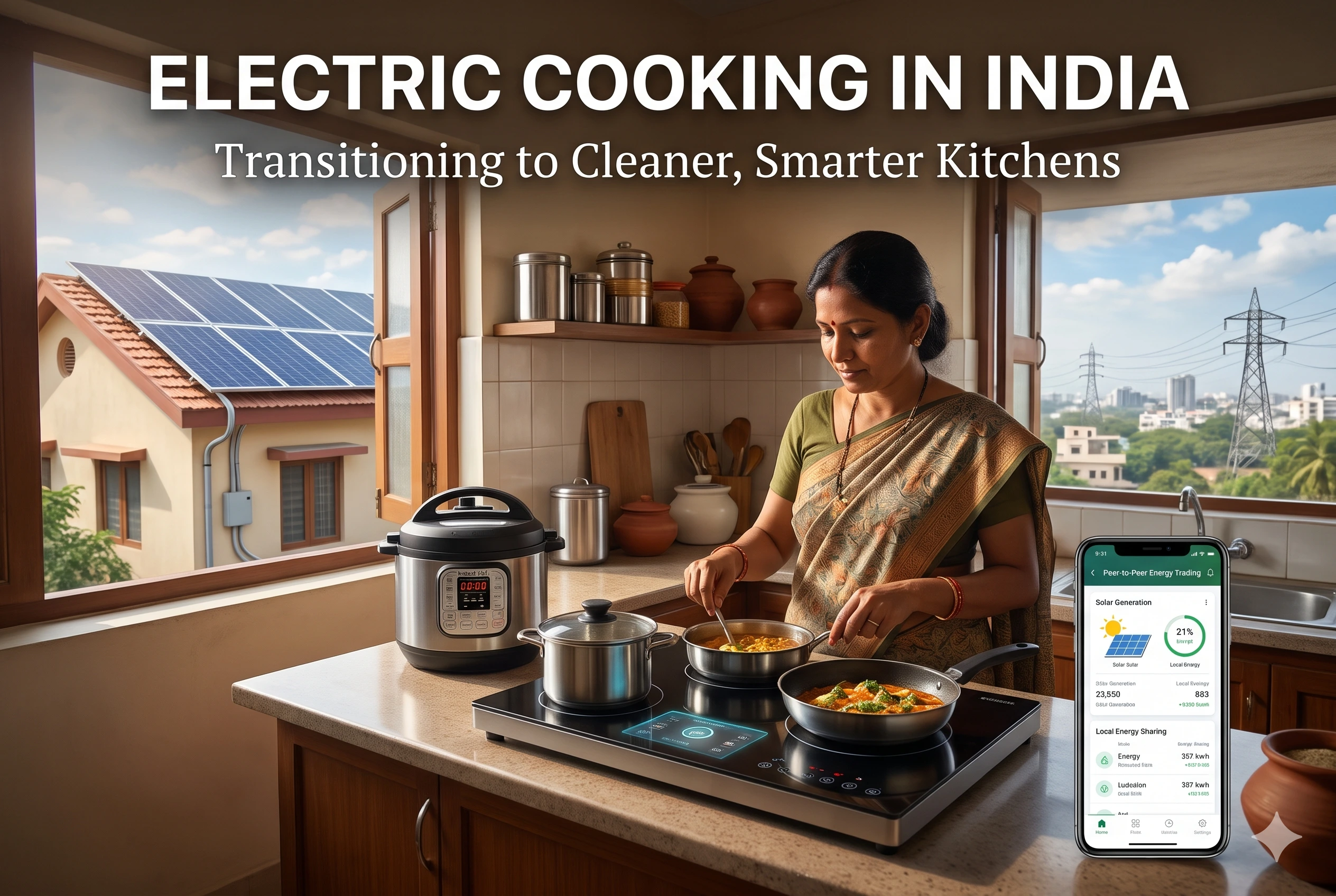
With India spending $26.4 billion annually on LPG and natural gas imports amid growing geopolitical exposure, electric cooking has emerged as a cost-effective and energy-efficient alternative. However, large-scale domestic adoption hinges on managing peak grid stress through rooftop solar integration, automated demand response, and localized energy trading.
Introduction
Context & Background
Key Points
- •Import Vulnerability & Macroeconomic Drag: India imported approximately 60% of its LPG and 50% of its natural gas in FY 2024–25, amassing a $26.4 billion import bill primarily routed through the Strait of Hormuz. This heavily exposes clean-cooking access to West Asian geopolitical shocks.
- •Energy Efficiency and Operating Economics: Induction cooking demonstrates ~85% energy transfer efficiency compared to ~40% for conventional LPG burners. According to IEEFA, electric cooking is 37% cheaper than non-subsidised LPG and 14% cheaper than PNG for urban households.
- •Grid Infrastructure Pressures: Peak power demand rose from 148 GW in 2014 to 242.5 GW in December 2025. Unmanaged mass adoption of electric cooking during evening hours threatens grid stability and elevates spot-market power procurement costs.
- •Automated Demand Response & Solar-Plus-Storage: Coupling rooftop solar with Battery Energy Storage Systems (BESS) allows households to store cheap daytime solar power and discharge it during evening peak cooking periods, functioning as localized virtual power plants.
- •Peer-to-Peer (P2P) Blockchain Trading: Decentralized blockchain platforms enable direct energy exchanges among neighbours, as piloted in Lucknow (achieving ~43% cost savings), flattening localized peak curves and easing distribution company financial distress.
- •Existing Policy Frameworks: The transition is supported by the Go Electric campaign, National Efficient Cooking Programme (NECP), Bureau of Energy Efficiency (BEE) star-labelling for induction stoves, and decentralized solar incentives under PM-Surya Ghar Muft Bijli Yojana.
Cooking Technologies: Cost & Energy Efficiency Comparison
| Technology / Fuel Type | Thermal / Energy Efficiency | Relative Economics (IEEFA) | Key Constraints | Bookmark |
|---|---|---|---|---|
| Electric Induction | ~85% | 37% cheaper than unsubsidised LPG; 14% cheaper than PNG | Simultaneous preparation constraints; increases evening peak grid load | |
| Liquefied Petroleum Gas (LPG) | ~40% | Higher running cost; exposed to global crude volatility | 60% import dependence; fiscal burden and supply chain risks via Strait of Hormuz | |
| Piped Natural Gas (PNG) | Moderate (~40-50%) | Cheaper than LPG, more expensive than induction | 50% import dependence; capital-intensive pipeline distribution network |
Grid Dynamics & Distributed Energy Interventions
| Component / Measure | Current / Projected Metric | Role in Grid Stability | Bookmark |
|---|---|---|---|
| National Peak Electricity Demand | 242.5 GW (Dec 2025) | Creates extreme spot-market procurement costs during evening cooking surges | |
| Rooftop Solar Expansion (PM-Surya Ghar) | 24 GW (2026) to >41 GW (2030) | Decentralized power generation; mitigates midday transmission strain | |
| BESS & Peer-to-Peer (P2P) Trading | 43% cost reduction demonstrated in Lucknow pilot | Converts consumers into prosumers; creates micro-level virtual power plants |
Related Entities
Impact & Significance
- •Macroeconomic Resilience: Reduces reliance on imported LPG and LNG transported through volatile maritime corridors like the Strait of Hormuz.
- •Fiscal Space Optimization: Enables the rationalization and phased redirection of fossil fuel subsidies toward capital assets in electrification and solar storage.
- •Public Health & Equity: Drastically curtails household exposure to particulate matter ($PM_{2.5}$) and carbon monoxide, particularly improving respiratory outcomes for rural women and children.
- •Decarbonization of Kitchens: Aligns residential energy consumption with India's long-term net-zero goals by shifting primary energy sources toward renewable-powered electricity.
Challenges & Criticism
- •Culinary Compatibility: Standard single-burner induction units fail to support simultaneous dish preparations, flatbread roasting, or heavy round-bottomed vessels commonly used in regional cuisines.
- •Evening Peak Load Surges: Cooking hours align with domestic lighting and cooling peaks, risking transformer overloads and elevated power procurement costs for DISCOMs.
- •Reliability Divide: Rural distribution feeders often experience voltage fluctuations and scheduled outages during peak evening periods, forcing households back to biomass.
- •Upfront Capital Cost: Specialized induction-compatible cookware and higher-ampere kitchen wiring pose a non-trivial entry cost for low-income families.
Future Outlook
- •Phased Geographical Electrification: Prioritize urban kitchen electrification to unlock spare domestic LPG allocations for rural communities lacking reliable multi-phase power.
- •Subsidy Rationalization & Bulk Procurement: Repurpose part of existing fiscal subsidies on fossil LPG toward upfront capital subsidies for induction cooktops and electric pressure cookers, leveraging Energy Efficiency Services Limited (EESL) for economies of scale.
- •Cookware & Appliance Innovation: Promote R&D into multi-hob induction stoves and flame-replicating heat profiles tailored to traditional multi-pot Indian culinary habits.
- •Time-of-Use (ToU) Tariffs & Smart Metering: Roll out dynamic pricing structures alongside automated demand-response systems to disincentivize non-essential energy usage during peak cooking hours.
UPSC Relevance
- • GS-3 (Energy & Economy): Energy transition, import bill reduction, fiscal burden of subsidies, and supply security via the Strait of Hormuz.
- • GS-3 (Infrastructure): Power transmission constraints, peak load management, DISCOM viability, and smart grid innovations.
- • GS-3 (Environment): Indoor air pollution abatement, decarbonization commitments under COP, and sustainable lifestyle practices (Mission LiFE).
- • Mains Focus: Strategic implications of shifting from imported hydrocarbon-based cooking fuels to domestically generated decentralized renewable power.
Sample Questions
Prelims
Consider the following statements regarding clean cooking and energy infrastructure in India: 1. Induction cooktops demonstrate higher thermal efficiency than conventional LPG burners. 2. Peer-to-Peer (P2P) energy trading allows solar prosumers to trade surplus energy directly without relying solely on traditional distribution utilities. 3. Peak electricity demand in India has historically remained under 150 GW up to 2025. Which of the statements given above are correct?
- (a)1 and 2 only
- (b)2 and 3 only
- (c)1 and 3 only
- (d)1, 2 and 3
Mains
“Transitioning from LPG-based cooking to electric cooking is vital for India's energy security, but its success depends on mitigating peak load stresses on distribution grids.” Analyze the statement and evaluate the role of decentralized renewable energy in this transition.
Introduction: Highlight India's $26.4 billion hydrocarbon import bill and note that despite 332 million LPG connections, recurring costs and geopolitical vulnerabilities limit sustainable clean cooking access.
Body:
• Economic & Environmental Drivers: Induction cooking is ~85% efficient and 37% cheaper than unsubsidised LPG; curtails foreign exchange outflow from West Asian chokepoints (Strait of Hormuz); reduces indoor air pollution.
• Grid & Behavioral Impediments: Surging peak demand (242.5 GW in Dec 2025) risk grid instability during evening peaks; single-plate induction is ill-suited to multi-pot Indian cooking; rural grid reliability issues.
• Role of Decentralized Clean Energy: Pairing rooftop solar (PM-Surya Ghar) with BESS; Blockchain-enabled peer-to-peer (P2P) trading (Lucknow model); Time-of-Use tariffs and EESL-driven bulk procurement.
Conclusion: Conclude that an integrated approach linking appliance standardization, tariff reforms, and distributed solar can achieve the dual goals of energy independence and clean air.