
GDP Growth vs Employment Reality: The Debate Over Jobless Growth
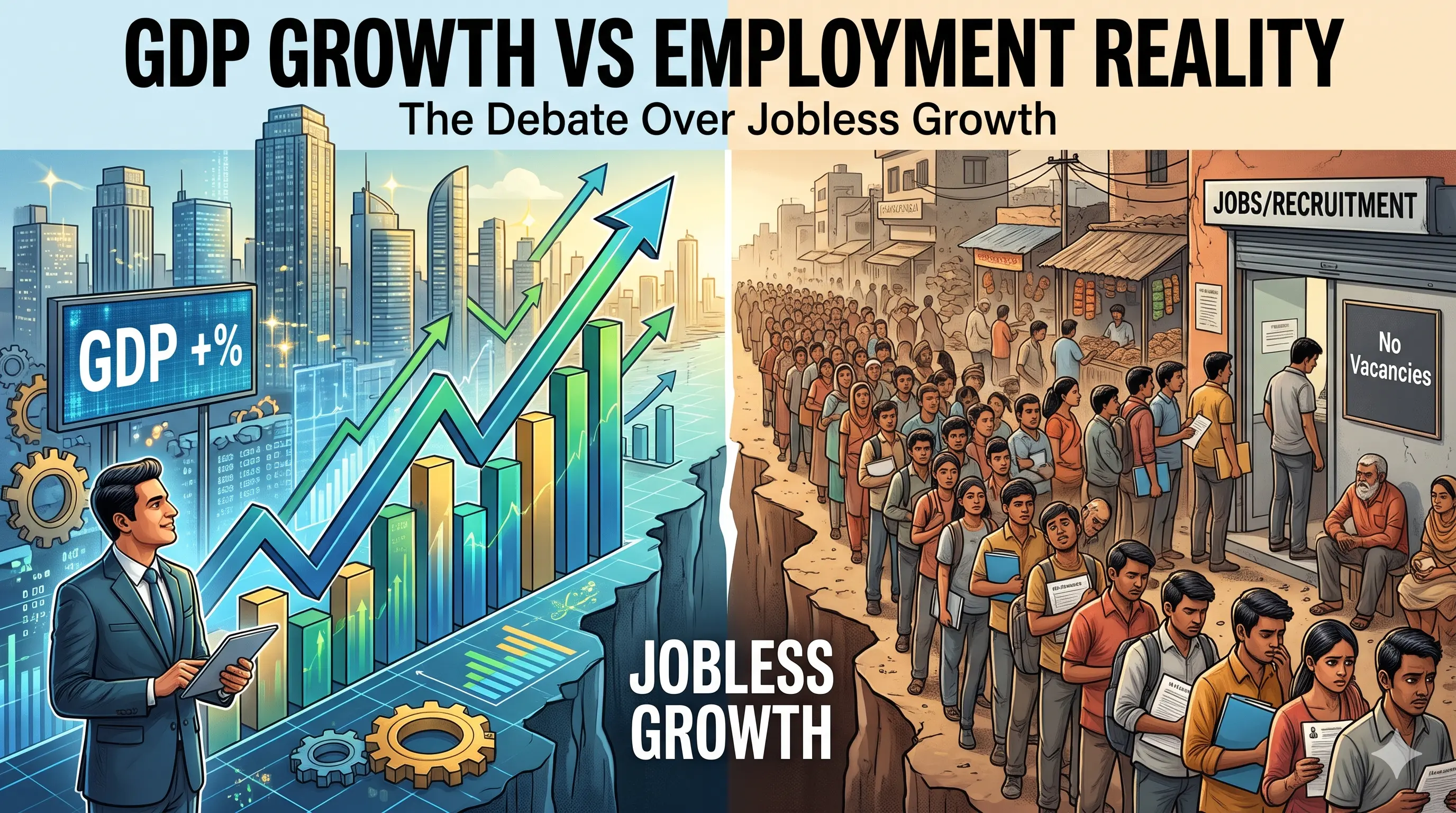
The release of a new GDP series using the double-deflation method reinforces India's status as a fast-growing economy. However, economists warn that an overemphasis on GDP numbers masks a persistent unemployment crisis, particularly among the youth, highlighting the phenomenon of 'jobless growth'.
Introduction
Context & Background
Key Points
- •New GDP Series & Double-Deflation: The latest GDP estimates adopt the double-deflation method for calculating Gross Value Added (GVA). By separately deflating output and input prices, it provides a more accurate measure of real production.
- •The 'Jobless Growth' Phenomenon: Despite rapid GDP growth, job creation has lagged. The youth unemployment rate (Usual Status) surged from 7.7% in 2011-12 to 10.2% in 2023-24.
- •Selective Presentation of Indicators: Official communications, such as the Economic Survey, frequently highlight favourable data (like declining inflation since 2011) while downplaying persistently high unemployment figures for the same period.
- •Methodological Puzzle in PLFS Data: During the 2020-21 COVID-19 pandemic, India's GDP contracted by roughly 7%, yet official data surprisingly showed a decline in unemployment—an anomaly that contradicts global trends (e.g., the US, where unemployment surged).
Key Challenges and Proposed Solutions
| Challenge | Description | Way Forward | Bookmark |
|---|---|---|---|
| Overemphasis on GDP Growth | Viewed as the primary economic indicator at the expense of employment data. | Shift focus from growth-centric policy to employment-intensive growth. | |
| Persistent Unemployment | High unemployment rates, especially among youth (15–29 years). | Promote labour-intensive sectors (MSMEs, construction, agro-processing, textiles). | |
| Jobless Growth | Production increases without a proportional generation of jobs. | Strengthen agricultural productivity to support rural employment and control inflation. | |
| Selective Narrative | Highlighting favourable indicators (inflation) while downplaying negative ones. | Adopt balanced economic monitoring giving equal weight to GDP, inflation, and jobs. | |
| Data Credibility | Unexplained statistical patterns in labour market data during economic shocks. | Improve PLFS methodology transparency and clarify data anomalies. |
Related Entities
Impact & Significance
- •Youth Disillusionment: With youth unemployment exceeding 10%, a large segment of India's demographic dividend remains unutilized, leading to lost economic potential.
- •Income Inequality: Jobless growth implies that the financial benefits of GDP expansion are concentrated among capital owners and highly skilled workers, widening the wealth gap.
- •Policy Misdirection: An exclusive focus on positive GDP numbers can lead to complacency, delaying crucial interventions needed in struggling, labour-heavy sectors.
Challenges & Criticism
- •Data Anomalies: A major criticism is the unusual pattern in PLFS data, which showed unemployment declining during the severe 7% economic contraction of the 2020-21 COVID-19 pandemic, contradicting global trends.
- •Asymmetry in Official Communication: Favorable metrics, such as controlled inflation, are heavily publicized, while concerning employment statistics are sidelined, creating a skewed national economic narrative.
Future Outlook
- •Shift to Employment-Intensive Growth: Economic policy must pivot from a purely production-centric approach to one that explicitly targets job creation.
- •Boosting Labour-Intensive Sectors: Urgent investments and policy support are needed in manufacturing (especially MSMEs), construction, agro-processing, textiles, and footwear.
- •Agricultural Strengthening: Sustained agricultural growth is vital to control food inflation and support rural employment, preventing distress migration.
- •Data Transparency: The National Statistical Office (NSO) must clarify anomalies in the Periodic Labour Force Survey (PLFS) to enhance the credibility of unemployment data.
UPSC Relevance
- • GS-3 (Indian Economy): Growth and Development, Employment, Inclusive Growth, and issues arising from it.
- • Essay Topics: 'Jobless Growth in India: Myth or Reality?', 'Beyond GDP: Measuring True Economic Progress'.
- • Mains Focus: Analyzing the disparity between macroeconomic growth figures and micro-level employment realities.
Sample Questions
Prelims
Consider the following statements regarding the measurement of economic growth and employment in India: 1. The double-deflation method calculates real Gross Value Added (GVA) by separately deflating the prices of output and intermediate inputs. 2. The Periodic Labour Force Survey (PLFS) is conducted annually by the NITI Aayog. Which of the statements given above is/are correct?
- (a)1 only
- (b)2 only
- (c)Both 1 and 2
- (d)Neither 1 nor 2
Mains
India's strong GDP growth narrative does not fully capture the realities of the labour market. Analyze the phenomenon of 'jobless growth' in India and suggest structural reforms to make economic growth more employment-intensive.
Introduction: Define 'jobless growth'. Introduce the context of the new GDP series adopting the double-deflation method, which upgraded growth estimates but masked the underlying employment crisis.
Body:
• The Reality of Jobless Growth: Explain the disconnect between high GDP growth and low job creation. Cite youth unemployment rising to 10.2% in 2023-24 (from 7.7% in 2011-12) despite India being the fastest-growing major economy.
• Issues in Data and Policy: Discuss the overemphasis on GDP over employment, selective narrative in official documents (focusing on inflation drops but ignoring unemployment), and data anomalies (unemployment dropping during the 2020 COVID GDP contraction).
• Reforms Needed: Suggest boosting labour-intensive sectors (MSMEs, textiles, construction), improving agricultural productivity, and aligning policy with employment generation rather than just output.
Conclusion: Conclude by emphasizing that sustainable development requires moving beyond celebrating GDP figures to prioritizing transparent data and inclusive, job-rich growth.