
Gender, Agriculture, and Climate Change
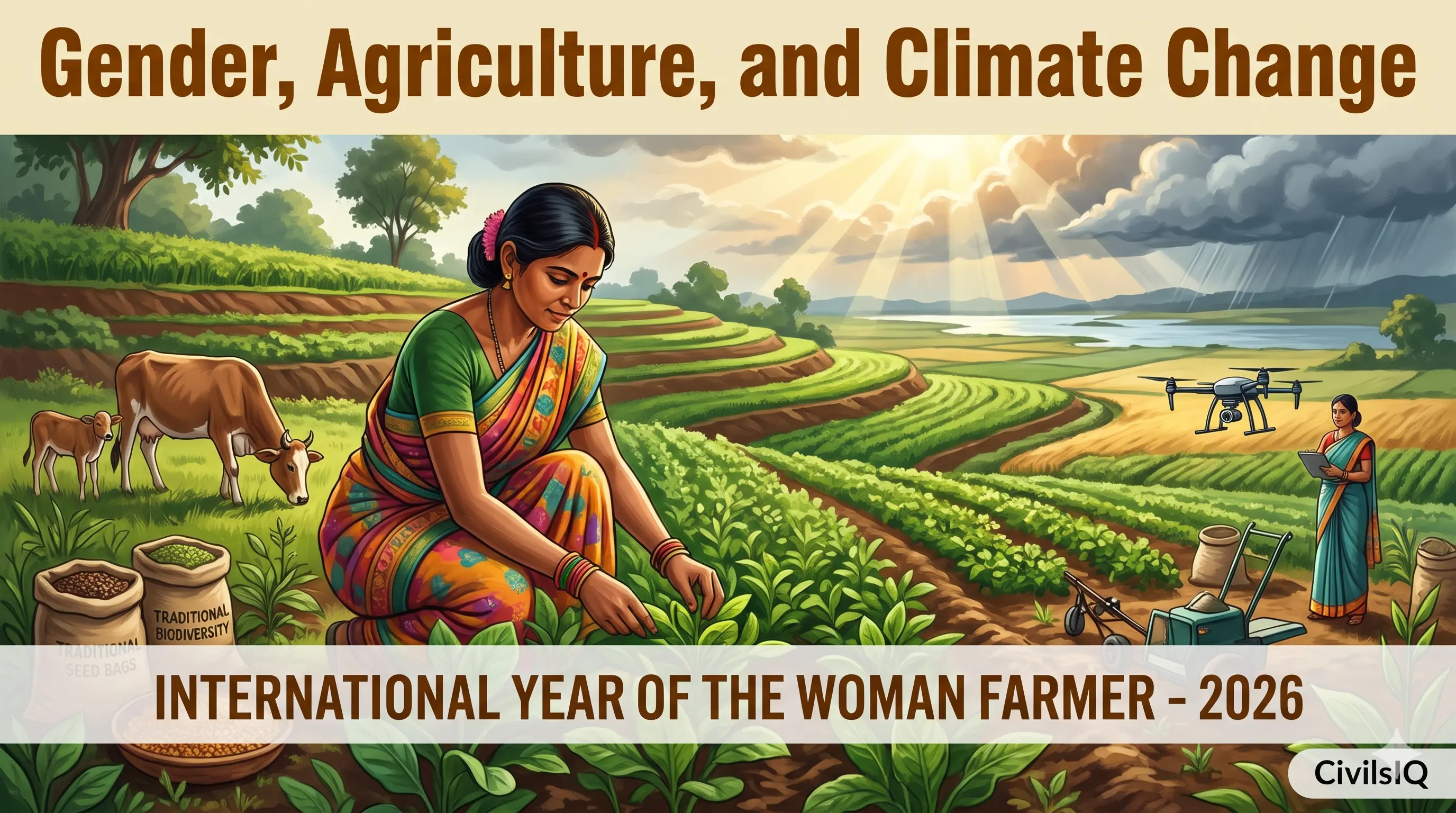
With 2026 declared the 'International Year of the Woman Farmer' by the FAO, the intersection of gender, climate change, and agriculture is in sharp focus. While women form the backbone of India's rural economy and agriculture, they face severe challenges including a lack of land rights, wage inequality, and high vulnerability to climate-induced shocks.
Introduction
Context & Background
Key Points
- •The Feminization of Agriculture: Increasing male out-migration to cities (33.7% of rural males as per 2011 Census) and a shift of men towards industry/services have left women to manage farms independently, yet without formal 'farmer' status.
- •Role as Primary Cultivators & Resource Managers: Women perform the most labor-intensive tasks like sowing, weeding, and manual harvesting. They act as 'Seed Guardians' preserving indigenous climate-resilient seeds and lead community efforts in water conservation.
- •The Counting Challenge: Measuring women's agricultural participation is difficult because much of their labor is home-based, seasonal, and closely interlinked with unpaid domestic care, leading to massive underreporting of their actual economic contribution.
- •Wage Inequality: In many rural pockets, average daily rates for essential tasks hover around ₹384, but women's daily earnings often fall below ₹300, sometimes receiving less than 50% of the compensation provided to their male counterparts.
- •Livestock Sector Dependency: With nearly 40 million rural households owning milch animals, millions of women spend hours daily performing tasks like feeding, cleaning, and milking, usually without direct financial recognition.
Current Facts and Data on Women in Agriculture
| Indicator | Data | Context/Source | Bookmark |
|---|---|---|---|
| Female Labor Force Participation Rate (FLPR) | Rose to 47.6% (2023-24) from 41.5% (2022-23) | Largely driven by male out-migration. | |
| Rural Women in Agriculture | 76.95% engaged in agriculture | Handling over 70% of all farm tasks (PLFS 2023-24). | |
| Sector-Specific Contribution | Crop: 75%, Horticulture: 79%, Animal Husbandry/Fisheries: 95% | Agriculture Census 2015-16. | |
| Land Ownership | 12.8% of operational land holdings | Constitutes only 10.34% of total holding area. |
Key Government Initiatives for Women's Security in Agriculture
| Scheme/Initiative | Objective & Impact | Bookmark |
|---|---|---|
| DAY-NRLM | Mobilized 10 crore women into 91 lakh SHGs for financial inclusion and livelihood support. | |
| Namo Drone Didi Scheme | Equipping 15,000 women SHGs with drones for precision agriculture to reduce drudgery. | |
| Mahila Kisan Sashaktikaran Pariyojana (MKSP) | A sub-scheme under DAY-NRLM that recognizes women as 'Kisan' and provides training in agroecology. | |
| Lakhpati Didi Scheme | Aims to scale up the annual income of 6 crore women SHG members through entrepreneurship. |
Related Entities
Impact & Significance
- •Income Vulnerability to Climate Change: Female-led households in low-income regions lose significantly more income to climate phenomena like heat stress because they lack the capital and technology to adapt.
- •Systemic Dependency: Because institutional credit requires land as collateral, women are locked out of formal banking. This forces reliance on high-interest informal lenders and strips women of bargaining power.
- •Stagnation of Real Wages: Even where nominal wages have increased, inflation-adjusted earnings show negligible growth. Women are working harder, but their actual purchasing power has failed to improve.
- •Food Security at Risk: Since women contribute to 75% of crop production, ignoring their needs for modern, climate-resilient tools directly threatens national food production and biodiversity preservation.
Challenges & Criticism
- •Asset-Ownership Paradox: Women provide nearly 50% of all agricultural labor, yet hold titles to only about 10% of the land. This massive disconnect locks them out of subsidies, co-op memberships, and tech-driven schemes.
- •Lack of Legal Recognition: Without land titles, the state does not formally recognize these women as 'farmers', heavily restricting their access to flagship schemes like PM-KISAN.
- •Gendered Drudgery: Most agricultural machinery is ergonomically and weight-wise designed for men, thereby increasing the physical strain and risk of injury for female laborers.
- •Digital and Technology Divide: Crucial modern tools, climate advisories, and digital market platforms remain inaccessible to many rural women due to lower literacy rates and lack of personal mobile phone ownership.
Future Outlook
- •Recognize 'Farmer' by Activity: Shift the legal definition of a farmer from 'landowner' to 'tiller' to ensure landless women gain access to insurance, credit, and schemes like PM-KISAN.
- •Strengthen Land Rights: Promote joint land titling as a mandatory requirement for housing schemes and implement reduced stamp duties for women.
- •Climate-Smart Drudgery Reduction: Distribute gender-sensitive farm tools (like cono-weeders and solar dryers) through Custom Hiring Centres (CHCs) to reduce physical strain.
- •Advanced Financial Products: Introduce parametric (weather-based) insurance and dedicated credit lines specifically tailored for women-led Farmer Producer Organisations (FPOs).
- •Hyper-Local Value Addition: Set up processing units (e.g., spice grinding, flour mills) within villages to accommodate women's limited mobility and boost local incomes.
UPSC Relevance
- • GS-3 (Indian Economy & Agriculture): Feminization of agriculture, land reforms, agricultural marketing, and climate adaptation.
- • GS-1 (Society & Role of Women): Impact of male out-migration on rural women, patriarchal challenges in asset ownership.
- • Essay Topics: 'The invisible hands that feed the nation: Women in Indian Agriculture', 'Climate Change: A gendered crisis'.
- • Mains Focus: Analyzing the 'Asset-Ownership Paradox' and suggesting policy reforms to legally recognize women as farmers.
Sample Questions
Prelims
Consider the following statements regarding the role and initiatives for women in Indian agriculture:
- (a)Mahila Kisan Sashaktikaran Pariyojana (MKSP) is a sub-scheme under DAY-NRLM to empower women in agriculture.
- (b)According to recent Agriculture Census data, women own more than 30% of the operational land holdings in India.
- (c)The Namo Drone Didi scheme exclusively targets individual male farmers for precision agriculture.
Mains
The 'feminization of agriculture' in India has highlighted the critical role of women in the primary sector, yet they remain disproportionately vulnerable to economic and climate shocks. Discuss the challenges faced by women farmers and suggest measures to make Indian agriculture more gender-responsive.
Introduction: Define feminization of agriculture using PLFS (76.95% rural women engaged) and Census data. State the paradox of women doing the majority of farm work but lacking recognition.
Body:
• Drivers & Role: Explain male out-migration and rural distress leading to feminization. Highlight their 75%+ contribution in crop/horticulture and role as primary cultivators and seed guardians.
• Key Challenges: Asset-ownership paradox (12.8% land ownership despite massive labor); Lack of legal recognition denying access to PM-KISAN and formal credit; Wage inequality and stagnation of real wages; Gendered drudgery of male-designed machinery.
• Measures/Way Forward: Redefining 'farmer' from landowner to tiller; Encouraging joint land titling; Promoting gender-sensitive equipment via CHCs; Introducing hyper-local value addition and parametric insurance for women-led FPOs.
Conclusion: Conclude by mentioning the FAO's declaration of 2026 as the 'International Year of the Woman Farmer', emphasizing that empowering women in agriculture is not just a social justice issue, but a core necessity for India's food security and climate resilience.