
The Himalayan Ecocide: Balancing Development and Environment
In 2025, climate-related extreme events claimed over 4,000 lives in India, with Himalayan states facing a disproportionately high impact. This article examines the ecological fragility of the Indian Himalayan Region (IHR), the environmental impacts of unchecked development, and the urgent need for carrying-capacity based planning and judicial interventions.
Introduction
Context & Background
Key Points
- •The Geographical Expanse: The Indian Himalayan Region (IHR) spans 13 states/UTs covering over 5.3 lakh sq. km. It ranges from the Siwalik foothills to the Trans-Himalaya Tibetan plateau.
- •India's 'Water Tower': The region feeds major rivers (Ganga, Yamuna, Brahmaputra). Almost 33% of the country’s thermal electricity and 52% of its hydropower depends on Himalayan river waters.
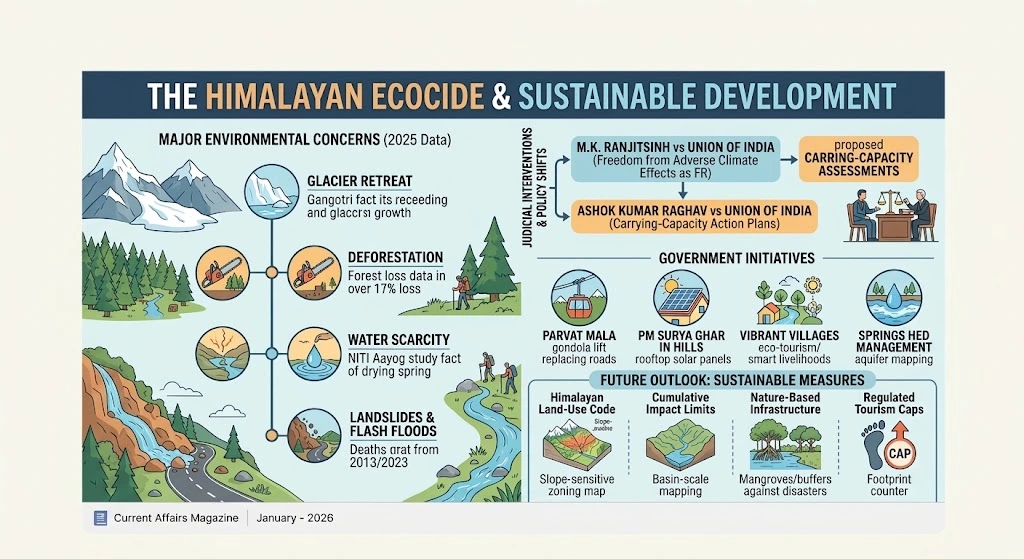
- •Judicial Interventions (Climate Rights): In the landmark M.K. Ranjitsinh vs Union of India case, the Supreme Court recognised freedom from adverse climate effects as a fundamental right, challenging the 'unlimited growth' model.
- •Carrying-Capacity Mandate: In Ashok Kumar Raghav vs Union of India, the SC directed the preparation of action plans for the IHR based on carrying-capacity principles to regulate development pressure.
- •Policy Shifts Needed: The MoEFCC is proposing scientific carrying-capacity assessments for all 13 states to cap infrastructure density and prevent valley-scale destabilisation.
Major Environmental Concerns in the IHR
| Concern | Impact/Evidence | Primary Cause | Bookmark |
|---|---|---|---|
| Climate Change | Retreating glaciers (e.g., Gangotri retreated >1,500m in 70 years) | Global warming and climate shifts | |
| Deforestation | Loss of >24,000 sq km of forest cover (2000-2014) | Population growth, industrialization | |
| Water Scarcity | >50% of springs in the Indian Himalayas are drying up | Population boom, unsustainable development | |
| Landslides | Over 220 deaths in HP and Uttarakhand (2022-2023) | Deforestation, hydropower projects, road/tunnel construction | |
| Biodiversity Loss | 43% decline in vertebrate populations over 50 years | Habitat loss and fragmentation |
Government Initiatives for IHR
| Initiative | Description | Focus Area | Bookmark |
|---|---|---|---|
| Parvat Mala (National Ropeways) | Develop 1,200 km of ropeways to replace ecologically damaging road expansion. | Transportation / Infrastructure | |
| PM Surya Ghar in Hills | Promotes decentralised rooftop solar micro-grids to cut transmission lines and diesel use. | Renewable Energy | |
| Springshed (Dhara Vikas) | NITI Aayog’s approach to map and rejuvenate drying springs (dharas). | Water Management | |
| Vibrant Villages Programme | Reverses out-migration via climate-smart livelihoods without damaging military infrastructure. | Border Security / Livelihoods |
Related Entities
Impact & Significance
- •Economic & Energy Backbone: The IHR is indispensable for India's energy security, supporting over 50% of the nation's hydropower and 33% of thermal power via its river systems.
- •Biodiversity Conservation: It is a global biodiversity hotspot sheltering over 300 mammal species, including rare endemic and threatened species like the Snow Leopard.
- •Socio-Cultural Value: Deeply embedded in India's cultural fabric, the region hosts major pilgrimage sites and supports a massive tourism industry.
- •Ecological Services: The forests and alpine meadows act as crucial carbon sinks, prevent soil erosion, and regulate microclimates for the entire Indian subcontinent.
Challenges & Criticism
- •Fragmented Governance: Approvals for infrastructure are often given on a project-by-project basis, ignoring the cumulative and valley-scale ecological impacts.
- •Ignoring Geological Realities: Heavy construction and tunneling are frequently undertaken without strict adherence to micro-zonation and carrying-capacity limits, triggering landslides.
- •Tourism Overload: Uncapped tourist footfalls lead to severe waste management crises, air pollution (exceeding WHO PM2.5 guidelines), and depletion of local water tables.
- •Implementation Gaps: Despite progressive judicial orders (like carrying-capacity mandates), action plans at the state and panchayat levels remain sluggish and poorly enforced.
Future Outlook
- •Himalayan-Specific Land-Use Code: Enact a legally binding, slope- and geology-sensitive code to strictly regulate construction, roads, and seismic-zone development based on micro-zonation.
- •Nature-Based Solutions: Treat forests, wetlands, and alpine meadows as core disaster-risk-reduction infrastructure, prioritizing ecosystem restoration over concrete retrofitting.
- •Cumulative & Basin-Scale Assessments: Shift away from isolated project clearances to river-basin level planning with absolute caps on infrastructure density.
- •Regulating Tourism: Implement capacity-regulated, spatially zoned, and seasonally staggered tourism with strict caps on footfalls and vehicles in fragile ecological zones.
UPSC Relevance
- • GS-1 (Geography): Important geophysical phenomena (landslides, earthquakes), geographical features, and flora/fauna changes.
- • GS-3 (Environment & Disaster Management): Conservation, environmental pollution and degradation, EIA, and Disaster Management strategies.
- • Essay Topics: 'Development vs. Environment in Fragile Ecosystems', 'The Cost of Unchecked Urbanization in the Himalayas'.
- • Mains Focus: Judicial activism in environmental protection (Carrying Capacity) and policy initiatives (Parvat Mala, Vibrant Villages).
Sample Questions
Prelims
Consider the following statements regarding the Indian Himalayan Region (IHR) and related government initiatives:
1. The Indian Himalayan Region spans across exactly five Indian states and union territories.
2. The 'Parvat Mala' programme aims to develop ropeways to replace ecologically damaging road expansion.
3. The Vibrant Villages Programme focuses on building extensive military infrastructure in fragile border zones.
Answer: Option 2
Explanation: Statement 1 is incorrect; the IHR spans 13 states and UTs. Statement 3 is incorrect; the Vibrant Villages Programme focuses on climate-smart livelihoods to reverse out-migration without ecologically damaging military infrastructure. Statement 2 is correct.
Mains
“The recurring disasters in the Indian Himalayan Region are not merely natural calamities but the result of an unsustainable development model.” Analyze this statement and suggest measures for resilience-led planning in the region.
Introduction: Highlight the significance of the IHR as India's 'Water Tower' and mention the recent 2025 context where extreme climate events caused severe casualties in Himalayan states.
Body:
• Drivers of the Crisis (Anthropogenic): Rampant deforestation (24,000 sq km lost 2000-2014); unscientific road and tunnel construction exacerbating landslides; hydropower projects altering river basin ecology; unregulated tourism.
• Impacts: Drying of over 50% of springs (water scarcity), retreating glaciers (Gangotri), fatal flash floods, and biodiversity loss.
• Resilience-Led Measures: Implementation of a Himalayan-Specific Land-Use Code; SC-mandated carrying-capacity assessments; transitioning to Nature-Based Solutions; integrating community-centric disaster governance.
Conclusion: Conclude by highlighting that protecting the IHR requires shifting from 'unlimited growth' to 'sustainable coexistence,' utilizing frameworks like basin-scale assessments and indigenous knowledge.