
Homemaking as Real Labour: Recognizing Unpaid Work and Financial Rights
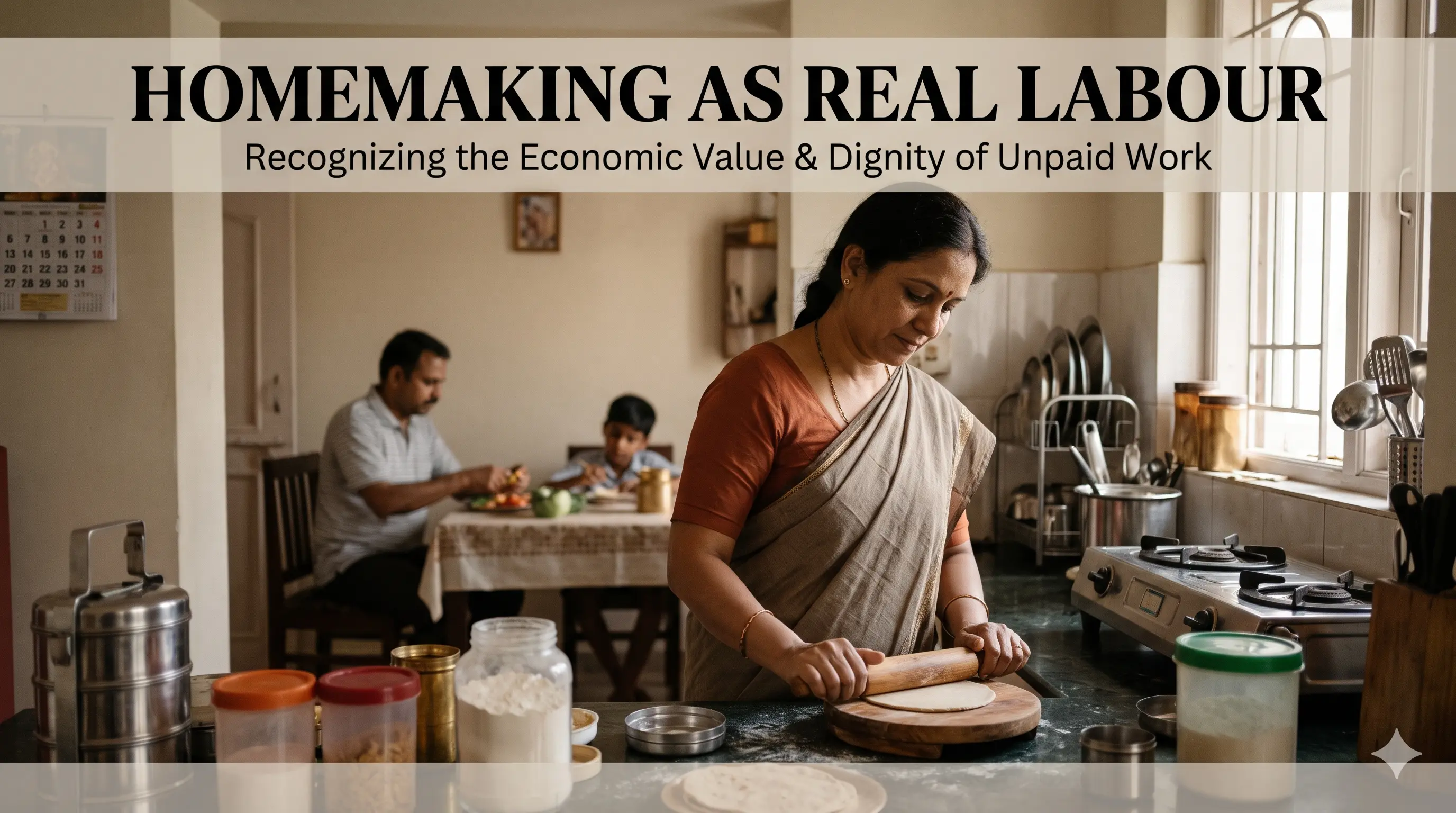
A recent ruling by the Delhi High Court (February 2026) recognizes homemaking as productive work that shapes financial rights within marriage, rejecting the notion of an 'idle spouse.' This shift addresses historical gender inequalities and highlights the need for statutory recognition of unpaid domestic labour, which contributes significantly to India's GDP.
Introduction
Context & Background
Key Points
- •Imputed Income Recognition: The Supreme Court has established that, for compensation claims, a homemaker's assumed income must not be assessed below the minimum wages applicable to skilled labour.
- •Exclusion from National Accounts: The System of National Accounts (SNA) fails to include homemaking in GDP estimates because these activities do not involve traditional market-based transactions.
- •Legal Vacuum in Labour Codes: Current Indian Labour Codes do not classify homemakers as 'workers,' leaving a massive demographic entirely outside the ambit of formal social security protections.
- •Historical Shift in Maintenance Law: Earlier maintenance provisions under Section 125 CrPC (now Section 144 of the Bharatiya Nyaya Suraksha Sanhita) aimed merely to prevent destitution. Modern doctrine views marriage as a collaborative enterprise.
- •Opportunity Cost of Caregiving: Time dedicated to household work often results in lost income, stalled careers, and outdated skills, creating immense barriers to workforce re-entry for women.
Key Judicial Pronouncements on Homemaking
| Case / Ruling | Year | Court | Significance | Bookmark |
|---|---|---|---|---|
| Kirti v. Oriental Insurance Co. Ltd. | 2021 | Supreme Court | Recognized the economic value of homemakers in motor accident compensation claims. | |
| Rajnesh v. Neha | - | Supreme Court | Emphasized fair maintenance norms to ensure dignity and correct post-separation economic imbalance. | |
| Kannaian Naidu v. Kamsala Ammal | - | Madras High Court | Recognized property accumulation within a marriage as a shared endeavor. | |
| Delhi High Court Ruling | Feb 2026 | Delhi High Court | Recognized homemaking as productive work, rejecting the concept of the economically inactive 'idle spouse'. |
Data Highlighting the Impact of Unpaid Domestic Work
| Source | Data / Metric | Significance | Bookmark |
|---|---|---|---|
| Economic Survey 2025–26 | 363 minutes (women) vs 123 minutes (men) | Highlights the disproportionate daily burden of unpaid work. | |
| NITI Aayog Gender Index | 15–17% of GDP | Estimated economic contribution of unpaid domestic labour to the Indian economy. | |
| Second All-India Time Use Survey | 305 minutes daily (women 15–59 yrs) | Women spend approximately 3.5 times more time on household work than men. | |
| Union Budget 2026–27 | ₹5.01 lakh crore (9.37% of Budget) | Allocation towards the Gender Budget to support women's welfare. |
Related Entities
Impact & Significance
- •Shift in Maintenance Focus: Financial support in matrimonial disputes is no longer just for subsistence; it is a mechanism for economic balancing that compensates for shared contributions and career opportunity costs.
- •Evolution of Property Rights: Although India lacks a formal community-of-property regime, courts are progressively treating marital assets as the outcome of joint effort rather than the sole property of the earning spouse.
- •Curbing the Feminisation of Poverty: Equitable financial rights act as a vital safety net, reducing the severe downward economic mobility and financial instability that women disproportionately face post-separation.
- •Normative Transformation: Elevating homemaking from a 'moral duty' to legally recognizable and valuable labour disrupts deeply entrenched patriarchal stereotypes and empowers homemakers as equal stakeholders.
Challenges & Criticism
- •Valuation Ambiguity: There is no uniform, universally accepted method (such as replacement cost vs. opportunity cost) to accurately quantify and assign a monetary value to domestic labour across diverse socio-economic contexts.
- •Legislative Vacuum: Judicial pronouncements remain inconsistent because formal statutory amendments to overarching matrimonial laws like the Hindu Marriage Act, 1955, or the Special Marriage Act have not yet been made.
- •Risk of Reinforcing Stereotypes: There is a valid feminist critique that financially valuing a woman's domestic work without societal behavioral shifts might inadvertently cement the patriarchal expectation that caregiving is strictly a woman's responsibility.
Future Outlook
- •Introduce Statutory Provisions: Parliament must amend existing matrimonial laws (such as the Hindu Marriage Act, 1955, and Special Marriage Act) to formally recognise and mandate the valuation of a homemaker's contributions.
- •Standardised Valuation Frameworks: Family courts need standardized methodologies—such as the replacement-cost or opportunity-cost methods—to calculate the monetary value of domestic labour uniformly.
- •Gender Budgeting Initiatives: The government must leverage the ₹5.01 lakh crore Gender Budget for targeted programmes focusing on skill development, workforce re-entry, and pension benefits tailored for homemakers.
UPSC Relevance
- • GS-1 (Indian Society): Role of women, salient features of Indian society, effects of patriarchy, and the social dynamics of the family system.
- • GS-2 (Social Justice & Polity): Welfare schemes for vulnerable sections, mechanisms and laws for the protection of women, and Constitutional provisions (Articles 14, 15(3), 21).
- • GS-3 (Economy): Inclusive growth, challenges in GDP estimation (SNA exclusions), and the economics of female labour force participation.
- • Essay Topics: 'The invisible engine of the Indian economy: Unpaid care work', 'From destitution to dignity: The evolution of matrimonial rights'.
Sample Questions
Prelims
Consider the following statements regarding the legal and economic status of homemakers in India:
- (a)The System of National Accounts (SNA) includes unpaid domestic work while calculating India's GDP.
- (b)Maintenance provisions are covered under Section 144 of the newly enacted Bharatiya Nyaya Suraksha Sanhita.
- (c)Existing Labour Codes in India explicitly classify homemakers as informal workers to provide them with state-sponsored pensions.
Mains
“The judicial recognition of homemaking as real labour marks a paradigm shift from viewing wives as dependents to equal stakeholders in a marriage.” Discuss the socio-economic implications of this shift and the challenges that remain in formalizing this recognition.
Introduction: Highlight the recent Delhi High Court ruling (Feb 2026) and Supreme Court precedents (Kirti v. Oriental Insurance) that rejected the 'idle spouse' concept. Cite data from the Economic Survey (363 mins/day) to quantify the burden.
Body:
• Socio-Economic Implications: Shifts maintenance from mere subsistence to economic balancing; treats property accumulation as a shared endeavor (e.g., Madras HC ruling); prevents the feminisation of poverty post-divorce; challenges patriarchal norms.
• Constitutional Basis: Upholds Article 14 (Equality), Article 15(3) (Affirmative action for women), and Article 21 (Dignity and fair maintenance as seen in Rajnesh v. Neha).
• Challenges Remaining: Lack of statutory backing in the Hindu Marriage Act; ambiguity in valuation methods (opportunity vs. replacement cost); the risk of reinforcing the stereotype that caregiving is exclusively a woman's duty.
Conclusion: Conclude by emphasizing that while progressive judicial interpretations are a positive step, achieving true gender justice requires robust legislative amendments and the inclusion of unpaid labour in formal economic metrics like the GDP.