
Impact of West Asia Conflict on India
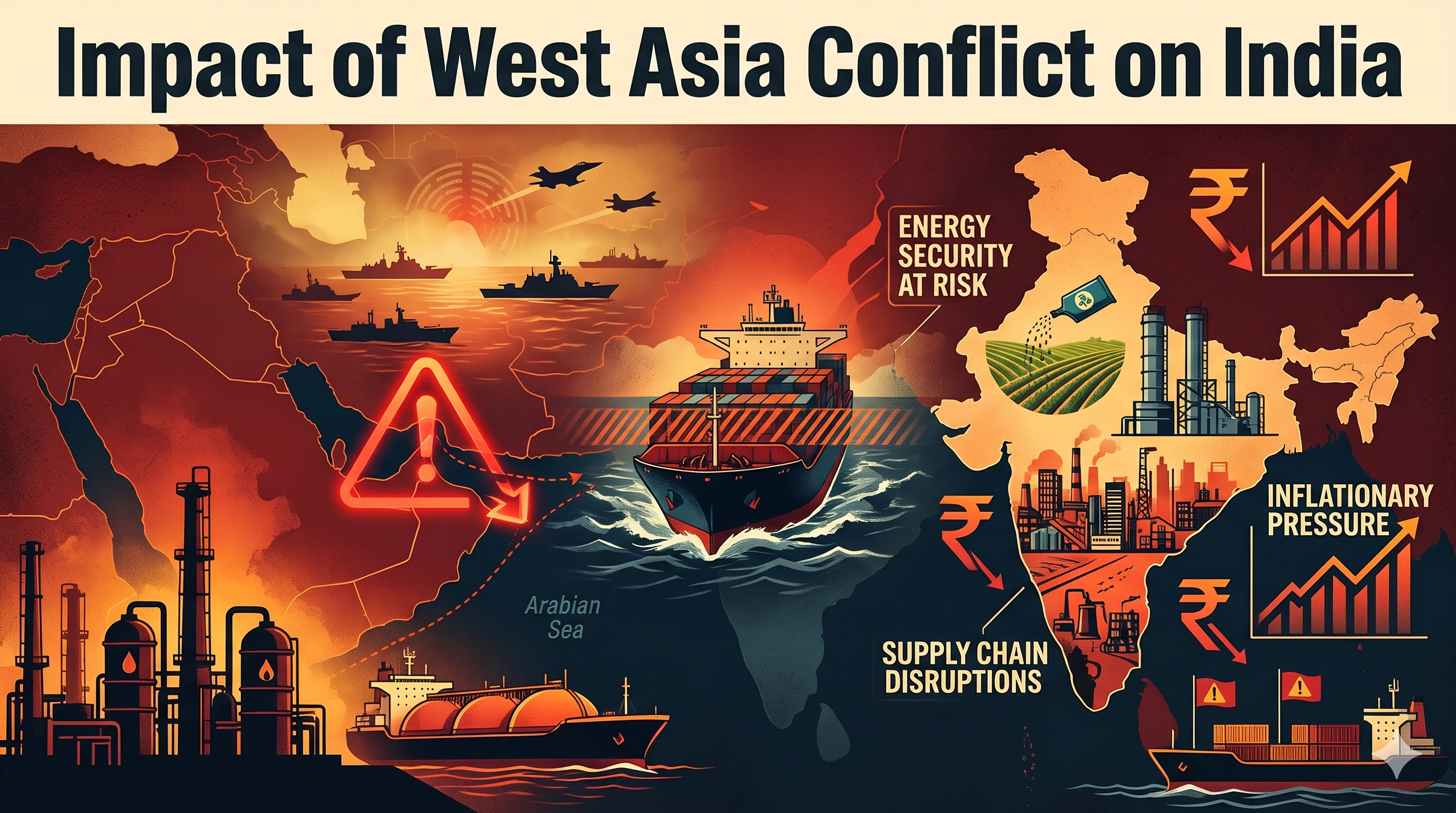
The ongoing conflict in West Asia is disrupting global energy markets and critical industrial supply chains. This article analyzes the macroeconomic risks for India, including a widening Current Account Deficit and inflation, along with specific vulnerabilities in sectors like fertilisers, cement, steel, and medical tourism.
Introduction
Context & Background
Key Points
- •Immediate Economic Risks: A $10 increase in oil prices could widen India’s Current Account Deficit (CAD) by 0.4–0.5% of GDP. This increases inflationary pressure, depreciates the Indian Rupee, and may force the RBI to tighten monetary policy, slowing growth.
- •Shipping and Trade Disruptions: War-risk insurance premiums for vessels in the Gulf have surged by 40–50%. Major shipping companies have added emergency conflict surcharges ($2,000–$4,000 per container), reducing the competitiveness of Indian exports.
- •Dual Dependency in Fertilisers: India faces a unique double threat: it heavily imports Natural Gas (LNG) to produce urea domestically, while simultaneously importing 71% of finished urea from West Asia.
- •Government Mitigation Measures: To secure agriculture, the government enacted the Natural Gas (Supply Regulation) Order, 2026, assuring ~70% gas supply for fertilisers, and increased urea buffer stocks to ~61.5 lakh tonnes.
- •Medical Tourism Setback: Hospitals report a 30–75% drop in patients from West Asia due to airspace restrictions, rising travel costs, and visa hurdles, heavily impacting North Indian healthcare facilities.
Key Indian Industries at Risk
| Sector | Critical Raw Material | West Asia Import Dependency | Impact of Disruption | Bookmark |
|---|---|---|---|---|
| Cement and Construction | Limestone & Gypsum | 68% (Limestone), 62% (Gypsum) | Increased cement prices; delayed infrastructure expansion. | |
| Steel Industry | Direct Reduced Iron (DRI) | Nearly 59% | Increased production costs due to material shortages and energy volatility. | |
| Power Transmission | Copper Wire | Over 50% | Vulnerability in electrical equipment and renewable energy infrastructure. | |
| Diamond Processing | Rough Diamonds | Over 40% | Impacts Surat's global diamond cutting and polishing industry. |
Energy & Fertiliser Supply Vulnerability
| Commodity | Dependency Status | Risk/Challenge | Bookmark |
|---|---|---|---|
| Crude Oil & LNG | ~50% transits via Strait of Hormuz. | Core threat to national energy security and transport costs. | |
| LPG | Nearly 80% from Gulf countries. | Prolonged disruptions could lead to domestic rationing due to low strategic storage. | |
| Urea (Output) | ~71% imported from West Asia. | Directly threatens agricultural supply chains. | |
| Natural Gas (Input) | ~40% from Qatar. | Impacts domestic production of ammonia and urea. | |
| Sulphur | ~65% from West Asia. | Essential for sulphuric acid and fertiliser manufacturing. |
Related Entities
Impact & Significance
- •Current Account Deficit (CAD): A mere $10 rise in global oil prices can widen India's CAD by 0.4–0.5% of GDP, depleting foreign exchange reserves.
- •Agricultural Security: The fertiliser sector's heavy reliance on West Asian urea and LNG directly links Middle Eastern stability to Indian agricultural yields and food prices.
- •Infrastructure Delays: Shortages in limestone, gypsum, and copper wire can stall domestic construction and renewable energy projects, increasing capital costs.
- •Healthcare Economy: A 30–75% drop in medical tourists from West Asia impacts the revenue of major Indian hospital chains, particularly in North India.
Challenges & Criticism
- •Lack of Strategic Reserves for LPG: Unlike crude oil, India lacks sufficient strategic storage for LPG, leaving the population vulnerable to immediate rationing during supply shocks.
- •Export Competitiveness: Indian exporters in textiles, chemicals, and engineering goods are losing their competitive edge due to massive emergency freight surcharges ($2,000–$4,000) and surging maritime insurance rates.
- •Over-reliance on a Single Route: The heavy concentration of trade passing through the Strait of Hormuz highlights a critical failure in supply route diversification.
- •Logistical Hurdles in Medical Tourism: The inability to swiftly provide alternative travel corridors or ease visa challenges during airspace closures exposes the fragility of India's medical tourism sector.
Future Outlook
- •Strategic Diversification: Accelerating efforts to find alternative global import sources for energy, critical minerals, and industrial inputs to reduce over-reliance on the Gulf region.
- •Strengthening Strategic Reserves: Expanding domestic storage capacities, particularly for highly dependent fuels like LPG, to prevent domestic rationing during geopolitical crises.
- •Boosting Domestic Capacity: Scaling up domestic manufacturing and extraction capabilities to support sectors like steel, cement, and fertilisers.
- •Long-Term Shift in Medical Tourism: Addressing immediate logistical and aviation challenges to position India as a resilient and preferred medical destination in a post-conflict landscape.
UPSC Relevance
- • GS-2 (International Relations): India's Extended Neighbourhood; Effect of policies and politics of developed and developing countries on India's interests.
- • GS-3 (Economy & Energy Security): Macroeconomic impacts (Inflation, CAD, Forex), supply chain resilience, and energy infrastructure.
- • Mains Focus: Analyzing India's strategic vulnerability to West Asian instability and evaluating the steps taken to secure critical supply chains.
Sample Questions
Prelims
Consider the following statements regarding India's trade and energy dependencies on West Asia: 1. Approximately 50% of India's crude oil imports transit through the Strait of Hormuz. 2. India is self-sufficient in LPG and relies on West Asia only for Natural Gas (LNG). 3. Natural gas is the preferred input over naphtha for producing ammonia and urea fertilizers due to higher efficiency.
- (a)1 and 2 only
- (b)1 and 3 only
- (c)2 and 3 only
- (d)1, 2, and 3
Mains
“The ongoing conflict in West Asia threatens not just India’s energy security, but its broader industrial and macroeconomic stability.” Discuss this statement, highlighting India's import dependencies and the measures required to mitigate these vulnerabilities.
Introduction: Introduce the geopolitical context of the Iran-Israel-US conflict and state the immediate vulnerability: 50% of India's crude and LNG passing through the Strait of Hormuz.
Body:
• Macroeconomic Impact: Widening of Current Account Deficit (CAD), inflationary pressures due to rising oil prices, rupee depreciation, and increased freight/insurance costs reducing export competitiveness.
• Industrial & Energy Vulnerabilities: Dual dependency in the fertiliser sector (LNG inputs and Urea imports); heavy reliance on West Asia for LPG, limestone, gypsum, DRI (steel), and rough diamonds.
• Mitigation Measures: Priority gas allocation for fertilisers, maintaining buffer stocks, diversifying import partners, and building strategic reserves for energy components like LPG.
Conclusion: Conclude by emphasizing the need for a shift from reactive crisis management to proactive strategic autonomy, focusing on domestic capacity building and supply chain diversification.