
India’s 2035 NDCs: Strategic Restraint or Missed Climate Leadership?
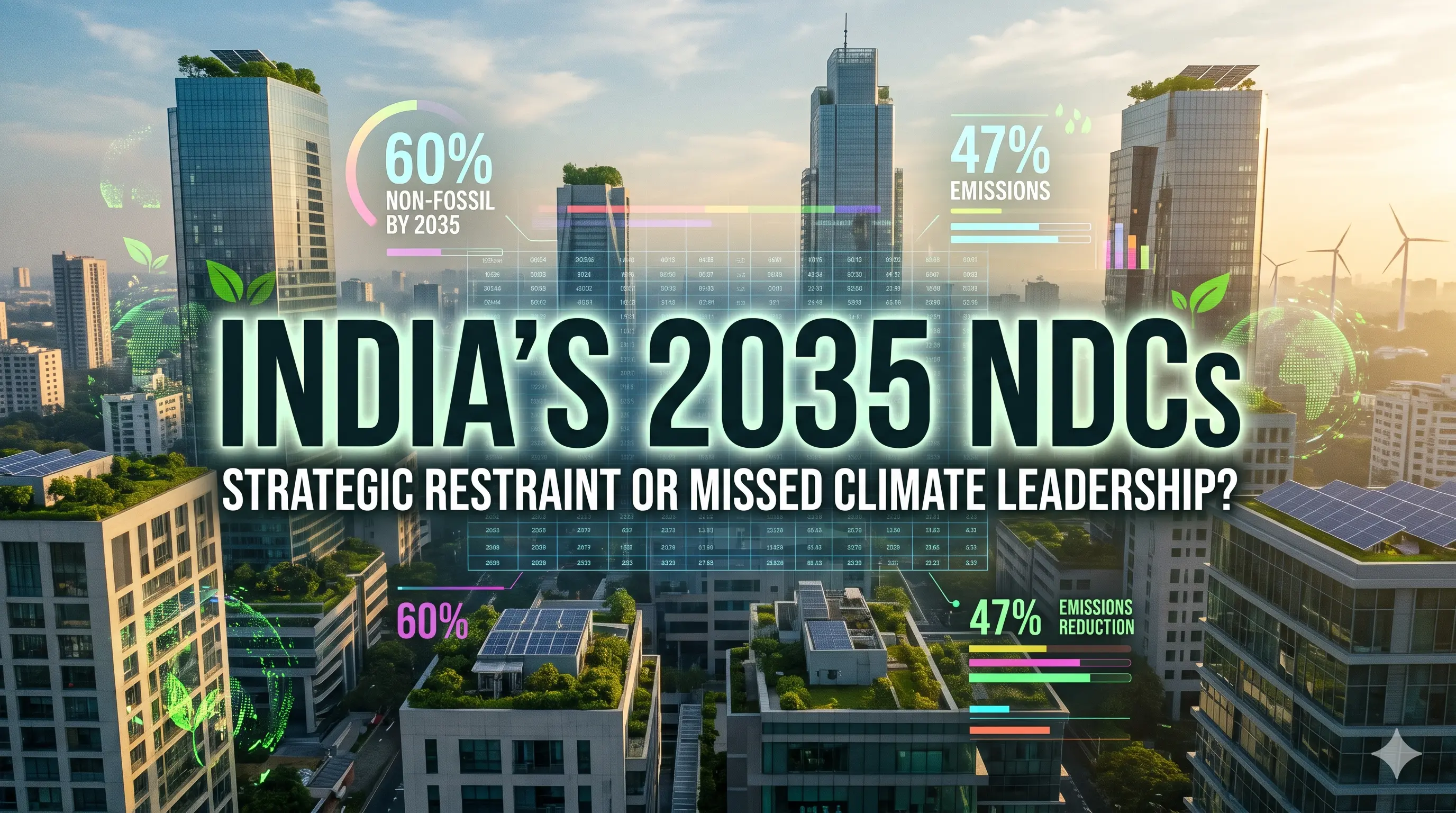
India has announced its third set of Nationally Determined Contributions (NDCs) for 2031–2035. Responding to the First Global Stocktake, the updated targets aim for 60% non-fossil capacity and a 47% reduction in emissions intensity, showcasing a careful balance between economic growth and climate action.
Introduction
Context & Background
Key Points
- •Early Achievement of 2030 Targets: India has demonstrated 'strong resolve' by meeting its 50% non-fossil capacity target four years ahead of schedule (reaching 52.5% by early 2026), creating a credible foundation for the 60% target for 2035.
- •Decoupling Growth from Emissions: Achieving a 36% reduction in emissions intensity by 2020 proves India can maintain high GDP growth while slowing its carbon output. The new 47% target signals a commitment to further 'green' the industrial sector.
- •Nuclear and Hydrogen Pivot: The SHANTI Act (2025) is a major positive, opening the nuclear sector to 49% FDI. This enables the deployment of Small Modular Reactors (SMRs) of 200–250 MW for decentralized, carbon-free baseload power.
- •Focus on Adaptation: The NDC rightly prioritizes Heat Action Plans and Himalayan glacier monitoring, acknowledging that for a tropical country, adaptation is just as critical as mitigation for national security.
The New 2035 Targets vs. 2030 Commitments
| Goal Category | 2030 Target (Updated Aug 2022) | 2035 Target (Announced Mar 2026) | Bookmark |
|---|---|---|---|
| Non-Fossil Fuel-Based Power Capacity | 50% of installed electricity capacity from non-fossil sources | 60% of installed electricity capacity from non-fossil sources | |
| Emissions Intensity of GDP | Reduce by 44% from 2005 levels | Reduce by 47% from 2005 levels | |
| Carbon Sink (Forests & Tree Cover) | Create additional sink of 2.5–3 billion tonnes of CO2 equivalent | Enhance sink to 3.5–4 billion tonnes of CO2 equivalent |
Related Entities
Impact & Significance
- •Global South Climate Evangelism: While developed nations retreat from commitments, India’s reaffirmation of a clean energy pathway reinforces its role as a principled leader emphasizing Common but Differentiated Responsibilities (CBDR).
- •Proving the Green Growth Model: Achieving early 2030 targets demonstrates that a major developing economy can successfully decouple high GDP growth from its emissions intensity.
- •Pioneering Climate Finance Models: The targets signal vast market opportunities in green tech, mandating immense flows of FDI into sectors like Small Modular Reactors and battery energy storage systems.
Challenges & Criticism
- •The 'Slack' Argument & Strategic Underselling: By reaching 52.5% non-fossil capacity early, critics view the 60% target as overly cautious. It is seen as a strategic move to avoid international legal pressure if promised Western financial support fails.
- •The 1.5°C Alignment Gap: Raising the emissions intensity target by only 2% prioritizes 'energy security' over aggressive decarbonization, falling short of climate models required to meet the 1.5°C limit.
- •The 'Finance Vacuum': The severe lack of the demanded $1.3 trillion annual climate finance from the developed world (NCQG) poses a massive implementation barrier.
- •Capacity vs. Actual Generation: Although non-fossil sources make up over 50% of capacity, they only contribute 20–25% of actual electricity generation, highlighting the urgent need for battery storage and grid stabilization.
- •Hard-to-Abate Sectors & Trade Barriers: Further reducing emissions intensity is exponentially harder and costlier. Simultaneously, Indian exports face external threats from 'green protectionism' and carbon border taxes.
Future Outlook
- •Grid Resilience: India must prioritize the National Energy Storage Services Policy, investing in BESS and Pumped Hydro to stabilize the grid as intermittent renewable capacity scales toward 60%.
- •Nuclear-Hydrogen Synergy: Leveraging the SHANTI Act (2025), the deployment of Small Modular Reactors (SMRs) should be expedited to provide the carbon-free baseload power required for Green Hydrogen production.
- •Ecological Restoration: Focus should shift from monoculture plantations to biodiversity-led restoration under the Green Credit Programme to ensure the 4-billion-tonne carbon sink target supports local ecosystems.
- •Carbon Markets: Maturing the domestic Carbon Credit Trading Scheme (CCTS) is essential to keep Indian industries competitive and counter 'green protectionism' like the Carbon Border Adjustment Mechanism (CBAM).
- •Climate Justice: India should lead the Global South by linking its NDC 'ratcheting' to the delivery of the $1.3 trillion annual New Collective Quantified Goal (NCQG) to ensure a fair and funded transition.
UPSC Relevance
- • GS-3 (Environment): Conservation, environmental pollution and degradation, environmental impact assessment, climate change targets.
- • GS-2 (International Relations): Global climate agreements, Global South leadership, climate justice, and unilateral trade barriers.
- • Essay Topics: 'Economic Growth vs. Climate Realities', 'The Role of the Global South in Climate Action'.
Sample Questions
Prelims
Consider the following statements regarding India's 2035 Nationally Determined Contributions (NDCs): 1. The target for non-fossil fuel-based electricity capacity has been increased to 60%. 2. The SHANTI Act allows 100% FDI in the nuclear sector to deploy Small Modular Reactors. 3. The new NDCs were announced in response to the First Global Stocktake (GST). Which of the statements given above is/are correct?
- (a)1 and 2 only
- (b)1 and 3 only
- (c)2 and 3 only
- (d)1, 2, and 3
Mains
“India's 2035 NDCs reflect a pragmatic balance between energy security and climate commitments.” Critically analyze this statement in the context of the First Global Stocktake and the challenges in achieving these targets.
Introduction: Define NDCs and mention India’s updated 2035 targets (60% non-fossil capacity, 47% emissions intensity reduction). Link it to the First Global Stocktake (GST).
Body:
• Pragmatic Balance (Positives): Decoupling growth from emissions; leveraging nuclear/hydrogen through the SHANTI Act (2025); leading the Global South by emphasizing CBDR; prioritizing adaptation (Heat Action Plans).
• Challenges & Criticisms: The 1.5°C alignment gap (only a 2% hike in emissions intensity target); the 'Finance Vacuum' ($1.3T NCQG unmet); gap between installed capacity (52.5%) and actual generation (20-25%); threat of 'green protectionism' (CBAM).
Conclusion: Conclude that while the targets may appear conservative to some, they represent a realistic trajectory. Emphasize the need for grid resilience (BESS), robust carbon markets (CCTS), and demanding climate justice for successful implementation.