
India-Arab League: Bridging Cultures, Creating Opportunities
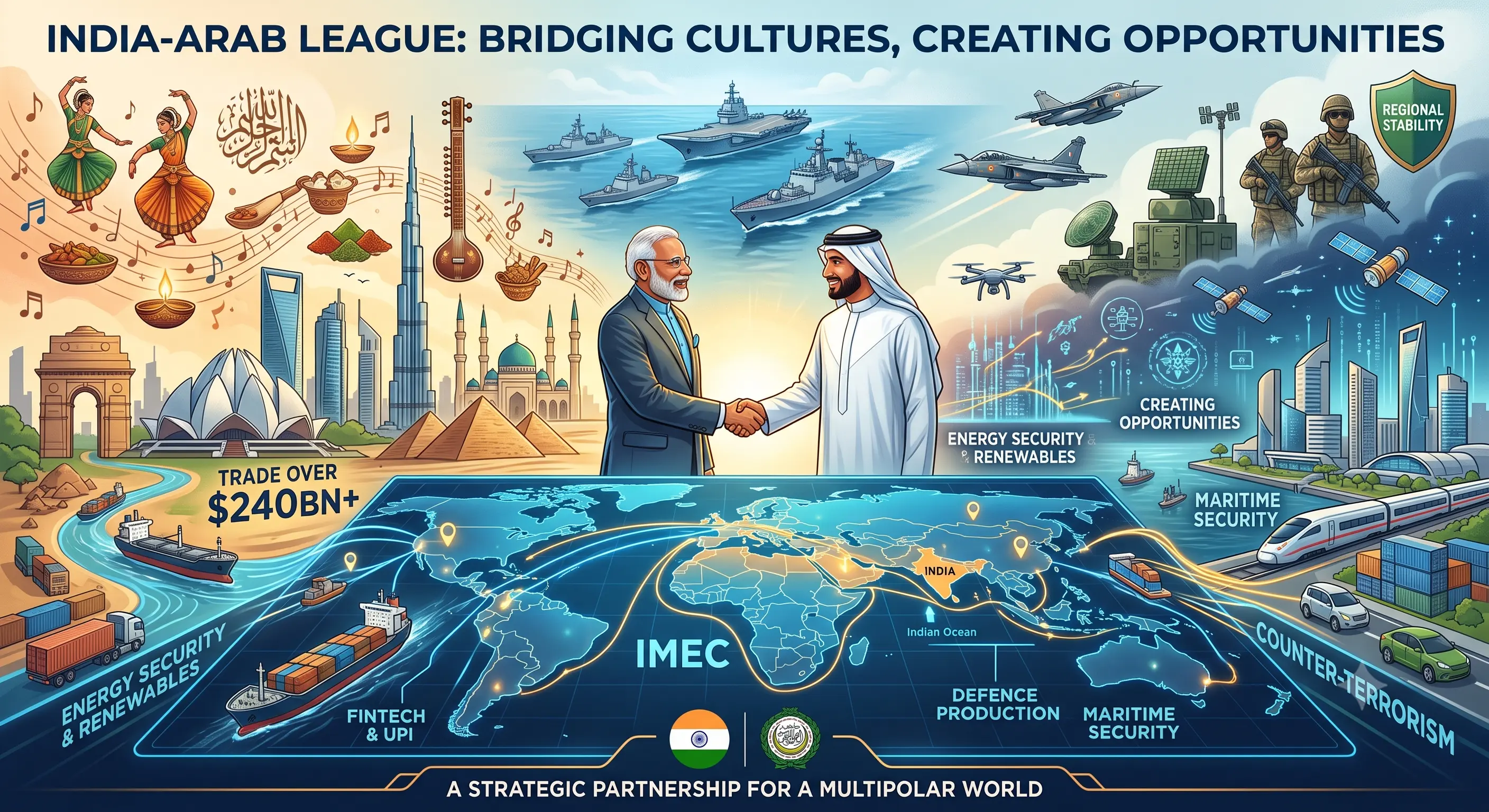
India recently hosted the 2nd India–Arab Foreign Ministers’ Meeting, signalling its deepening engagement with West Asia and North Africa. Amidst regional conflicts and shifting power alignments, this partnership aims to secure energy needs, enhance trade via corridors like IMEC, and foster strategic stability.
Introduction
Context & Background
Key Points
- •Strategic Outreach: Reinforces India’s role as a credible, stable, and non-interventionist partner in West Asia.
- •Energy Security: Arab League countries are critical to India's energy needs, supplying nearly 60% of India’s crude oil and 70% of natural gas.
- •Fintech and Digital Integration: Expansion of digital public infrastructure through the adoption of UPI (Bahrain, Saudi Arabia, Qatar, UAE) and operationalisation of the rupee–dirham settlement system.
- •Economic Corridors: Enhanced focus on multimodal connectivity, specifically advancing discussions on the India–Middle East–Europe Economic Corridor (IMEC).
- •Defence Collaboration: Transitioning from standard defence agreements towards maritime security collaboration (MAHASAGAR vision) and joint defence production/exports (BrahMos, Tejas, Aakash).
Institutional Framework of India–Arab League Engagement
| Platform / Initiative | Year / Frequency | Objective | Bookmark |
|---|---|---|---|
| Arab–India Cooperation Forum (AICF) | 2008 | Deepen sectoral cooperation | |
| First India–Arab Foreign Ministers’ Meeting | 2023 | Institutionalise regular political engagement | |
| India–LAS Partnership and Investment Summit | Biennial | Flagship economic platform | |
| India–Arab Chambers of Commerce | Ongoing | Boost private-sector ties |
Arab League Regional Membership
| Region | Member Countries | Bookmark |
|---|---|---|
| Gulf | Bahrain, Kuwait, Oman, Qatar, Saudi Arabia, UAE, Yemen | |
| Levant | Iraq, Jordan, Lebanon, Palestinian territories, Syria | |
| Africa | Algeria, Comoros, Djibouti, Egypt, Libya, Morocco, Mauritania, Somalia, Sudan, Tunisia |
Related Entities
Impact & Significance
- •Trade and Investment: Protects and promotes a massive bilateral trade volume exceeding $240 billion and encourages FDI into Indian infrastructure.
- •Supply Chain Resilience: Securing vital sea lanes through cooperation minimizes insurance costs and shipping delays for Indian trade.
- •Diaspora Interests: Deepening diplomatic ties ensures a safer and more protected environment for the vast Indian workforce residing in the Gulf.
Challenges & Criticism
- •Institutional Weakness: The Arab League has weak enforcement mechanisms and relies on consensus-based decision-making, limiting collective action.
- •Geopolitical Balancing: China’s growing economic footprint and entrenched US security roles present tough competition for Indian influence in the region.
- •Intra-Arab Differences: Strategic differences between major players (like Saudi Arabia and the UAE) complicate India's unified engagement with the bloc.
- •Implementation Gaps: Despite signing multiple MoUs and establishing forums, delays in execution frequently limit tangible outcomes.
Future Outlook
- •Deepen Institutional Engagement: Move beyond bilateral ties by strengthening structured dialogue with the League of Arab States to enhance collective cooperation.
- •Diversify Cooperation Areas: Expand the partnership into future-oriented sectors such as green energy, hydrogen, climate action, and the digital economy.
- •Promote Defence Industrial Collaboration: Move beyond basic agreements towards joint production, technology transfer, and co-development of defence platforms.
- •Protect Diaspora Welfare: Strengthen labour agreements and grievance redressal mechanisms to ensure the safety and rights of Indian workers in Arab nations.
UPSC Relevance
- • GS-2 (International Relations): Bilateral, regional and global groupings and agreements involving India.
- • GS-2 (Effect of Policies): Effect of policies and politics of developed and developing countries on India’s interests, Indian diaspora.
- • Mains Focus: Evaluating the strategic, economic, and energy significance of West Asia for India, and navigating geopolitical instability.
Sample Questions
Prelims
Consider the following statements regarding the Arab League and its relations with India:
1. All member states of the Arab League are geographically located in the Asian continent.
2. India formalised its engagement with the Arab League through an MoU in 2002.
3. The first India-Arab Foreign Ministers’ Meeting was held simultaneously with the establishment of the Arab-India Cooperation Forum (AICF) in 2008.
Answer: Option 2
Explanation: Statement 1 is incorrect; the Arab League includes 10 African countries (e.g., Egypt, Libya, Morocco). Statement 2 is correct. Statement 3 is incorrect; the AICF was established in 2008, but the first Foreign Ministers' meeting took place in 2023.
Mains
“The India-Arab League partnership has evolved from transactional engagements to a comprehensive, future-oriented strategic alliance.” Discuss the significance of this relationship for India’s energy security and geopolitical interests.
Introduction: Introduce the context of the 2nd India-Arab Foreign Ministers’ Meeting and the mandate of the 22-member Arab League.
Body:
• Economic & Energy Security: High dependency on Arab nations for crude oil (60%) and gas (70%). Bilateral trade exceeding $240 billion, driven by CEPAs and strategic investments.
• Geopolitical Interests: Navigating the Gaza conflict, Red Sea disruptions, and intra-Arab differences. Counter-terrorism alignment and maritime security in the Indian Ocean Region.
• Emerging Avenues: Fintech integration (UPI, Rupee-Dirham settlement), technological cooperation, IMEC, and green energy transitions.
Conclusion: Conclude by highlighting that sustained institutional engagement and diversification of cooperation will solidify India’s role as an indispensable pole in a multipolar world order.