
From Paper to Platform: The Evolution of India’s Census System
The upcoming Population Census 2027 in India marks a monumental shift from traditional paper-based data collection to a comprehensive digital exercise. This article details the constitutional framework, the rollout of specialized digital platforms, the challenges of the digital divide, and the roadmap for conducting the world's largest administrative data collection.
Introduction
Context & Background
Key Points
- •Constitutional & Legal Backing: The Census is conducted under the Census Act, 1948 and falls under the exclusive jurisdiction of the Union Government (Entry 69 of the Union List in the Seventh Schedule).
- •Administrative Authority: The entire exercise is carried out under the supervision of the Ministry of Home Affairs, officially beginning only after formal notification in the Official Gazette.
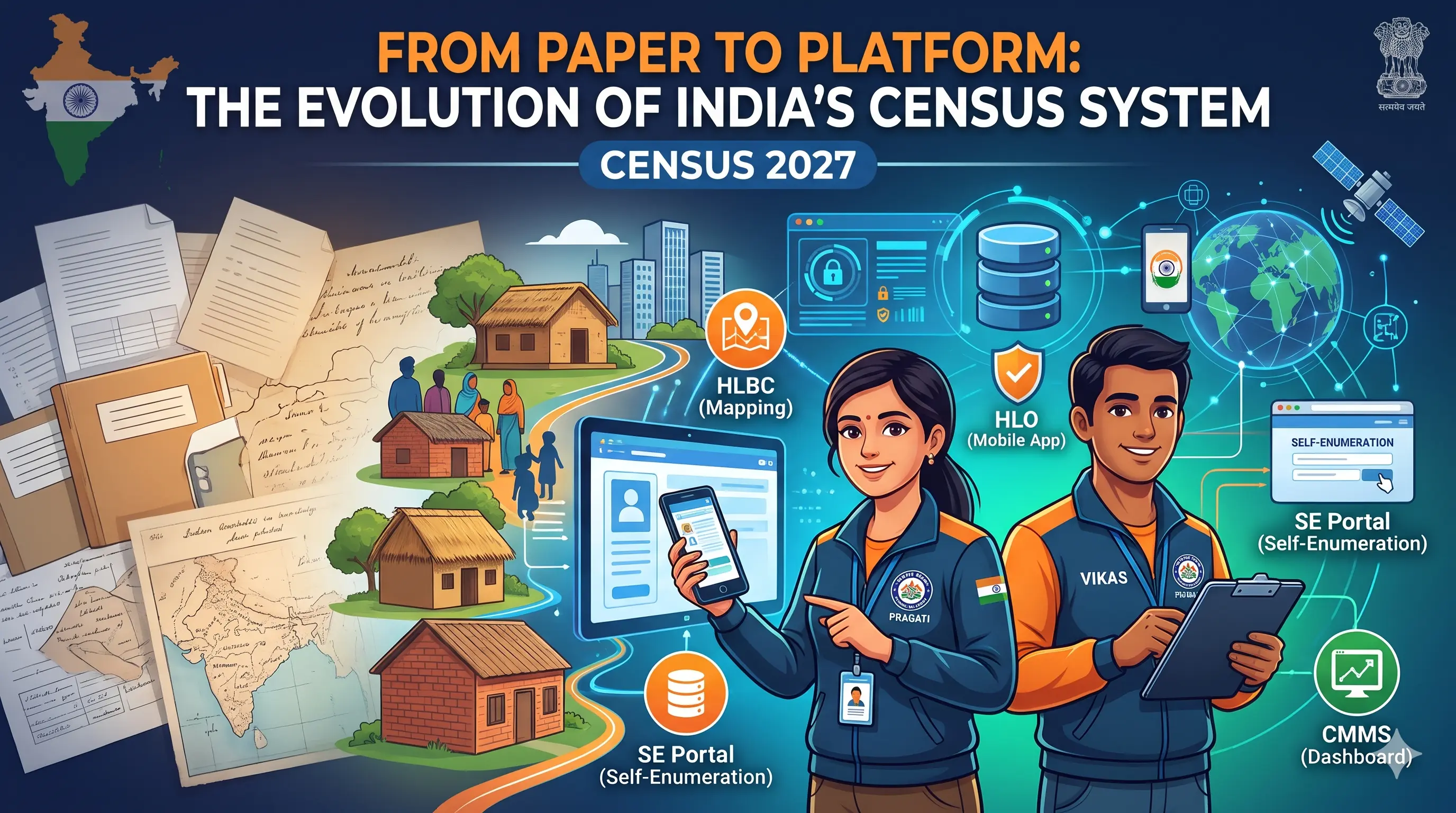
- •Digital Shift: Traditional paper questionnaires are being replaced by the HLO mobile application. This enables GPS-based location tagging, real-time uploads, and automatic error detection to improve data accuracy.
- •Self-Enumeration First: For the first time, an online Self-Enumeration (SE) portal will let citizens fill in their household details independently using OTP authentication prior to the enumerator's physical visit.
- •Public Outreach: Authorities have launched the mascots 'Pragati' (female enumerator) and 'Vikas' (male enumerator) to symbolise inclusive participation across all regions.
- •Comprehensive Data Scope: Beyond basic demographics, the census will track detailed migration patterns (place of birth, last residence, reasons for migrating) and housing conditions to aid deep policy planning.
Key Digital Platforms for Census 2027
| Platform | Type | Primary Function | Bookmark |
|---|---|---|---|
| Houselisting Block Creator (HLBC) | Web-based mapping tool | Uses satellite imagery to create uniform houselisting blocks for geographic coverage. | |
| Houselisting Operations (HLO) App | Secure mobile application | Used by enumerators for real-time data collection, GPS tagging, and direct uploads. | |
| Self-Enumeration (SE) Portal | Online platform | Allows households to voluntarily submit data online using OTP/unique ID authentication. | |
| Census Management & Monitoring System (CMMS) | Centralised digital dashboard | Monitors census activities, tracks progress across blocks, and manages field operations. |
Phases of Census 2027
| Phase | Timeline | Focus / Exceptions | Bookmark |
|---|---|---|---|
| Houselisting and Housing Census | April to September 2026 | Collects data on housing types, amenities, and duration of residence. | |
| Population Enumeration | February 2027 | Demographics and migration data. (Note: Mountainous regions like Ladakh, J&K, HP, UK are covered earlier due to winter). |
Related Entities
Challenges & Criticism
- •The Digital Divide: Limited smartphone penetration and patchy internet connectivity in rural or difficult terrains threaten the seamless execution of mobile-based data collection.
- •Cybersecurity Risks: Gathering intimate demographic, financial, and spatial data for over a billion people creates a massive, centralized target for cyberattacks and data breaches.
- •Data Privacy Concerns: Despite legal frameworks, the shift to digital platforms raises fears about how citizen data will be anonymised, accessed, and secured against misuse.
- •Personnel Training: Transitioning millions of temporary field enumerators from familiar paper forms to specialized apps (HLBC/HLO) requires intensive training that is difficult to scale and monitor.
Future Outlook
- •Bridging the Digital Divide: Ensuring that remote areas have offline data collection options, and providing field workers with reliable devices and connectivity support.
- •Hybrid Enumeration Model: Using a pragmatic combination of digital tools backed by limited paper-based alternatives to prevent exclusion errors in regions with poor digital access.
- •Robust Cybersecurity: Implementing strict encryption, anonymisation of personal data, and regular security audits to protect citizens' confidential information from breaches.
- •Intensive Capacity Building: Rolling out large-scale training programs and mock drills for millions of enumerators, alongside real-time technical support during the field phases.
UPSC Relevance
- • GS-2 (Polity & Governance): Constitutional provisions (Seventh Schedule), statutory backing (Census Act, 1948), and e-governance initiatives.
- • GS-1 (Society & Demographics): Population issues, urbanization trends, and migration tracking.
- • Mains Focus: Analyzing the transition to a digital census—its benefits, data privacy concerns, and logistical hurdles in rural India.
Sample Questions
Prelims
Consider the following statements regarding the Census in India: 1. The Census is placed under the Union List of the Seventh Schedule of the Constitution. 2. The entire census operation is conducted by the Ministry of Statistics and Programme Implementation (MoSPI).
- (a)Only statement 1 is correct.
- (b)Only statement 2 is correct.
- (c)Both statements 1 and 2 are correct.
- (d)Neither statement 1 nor 2 is correct.
Mains
The transition to a digital Population Census in India offers unprecedented efficiency but brings unique administrative and security challenges. Discuss in the context of the upcoming Census 2027.
Introduction: Define the significance of the Census under the Census Act 1948. Introduce the 2027 digital overhaul as a leap toward e-governance.
Body:
• Efficiency & Innovations: HLO mobile apps for real-time tracking, GPS tagging for accuracy, Self-Enumeration portals reducing enumerator workload, and centralized dashboard (CMMS).
• Challenges: Digital divide in remote areas, cybersecurity risks with massive personal data storage, and the logistical nightmare of training millions of field staff.
• Way Forward: Adopting a hybrid model (digital + paper backup), stringent data anonymisation, offline sync capabilities, and widespread awareness campaigns.
Conclusion: Conclude by stating that a digital census will modernize Indian policymaking with faster data turnaround, provided privacy safeguards and inclusivity are prioritized.