
India-EU FTA Restores Trust in Rules-Based Trade Order
The conclusion of the India-EU Free Trade Agreement (FTA) reaffirms the relevance of a rules-based trade order amidst unprecedented strain on the global trading system. This article analyzes how the FTA anchors trade in predictable rules, counters the weakening of multilateralism, and sets a resilient template for future international commerce.
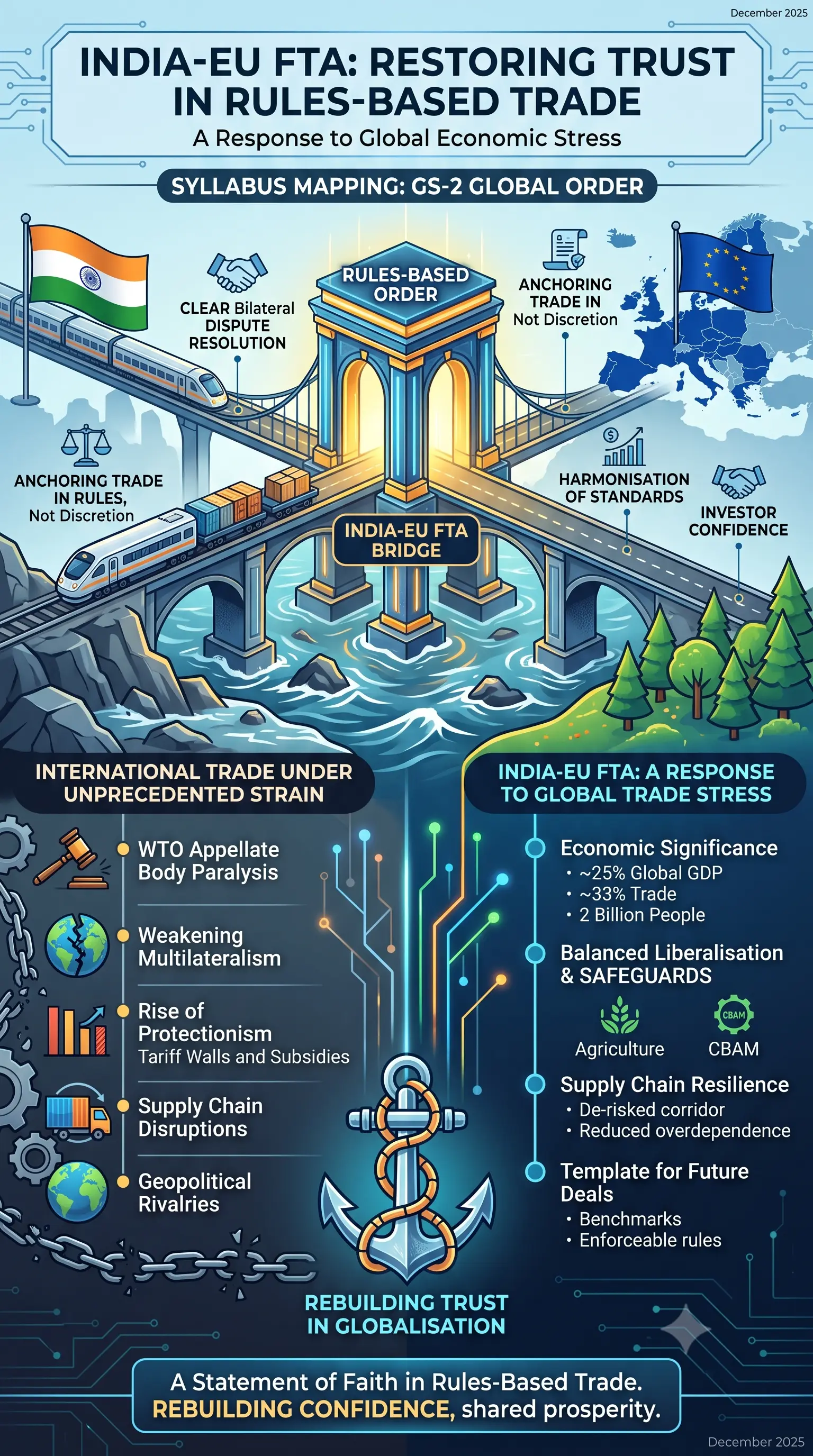
Introduction
Context & Background
Key Points
- •Reaffirmation of the Rules-Based Trade Order: The India-EU FTA is more than a bilateral deal; it reasserts faith in predictability, fairness, and constructive engagement in a fractured global environment.
- •Massive Economic Scale: Together, India and the EU account for approximately 25% of global GDP and 33% of global trade, creating a combined market of nearly 2 billion people.
- •Balanced Liberalisation: The agreement successfully balances domestic sensitivities with openness. India safeguarded its agricultural and developmental red lines, while the EU maintained its stance on climate-linked measures like the CBAM.
- •Complementing WTO Reform: Arriving ahead of the WTO’s 14th Ministerial Conference (MC14), the FTA demonstrates that bilateral accords can sustain trade rules even during periods of multilateral gridlock.
- •Supply Chain Resilience: The deal establishes a de-risked $136 billion trade corridor between two reform-oriented economies, drastically reducing overdependence on single trade routes.
- •Template for Future Trade Agreements: Described as the “mother of all deals”, it sets modern benchmarks for integrating sustainability with market access, balancing openness with sovereignty, and embedding enforceable rules.
How the FTA Restores Trust in the Rules-Based Order
| Key Area | Mechanism | Impact | Bookmark |
|---|---|---|---|
| Anchoring Trade in Rules | Reduces the scope for arbitrary tariffs and regulatory actions. | Provides predictability essential for investment and long-term planning. | |
| Harmonisation of Standards | Aligns product safety, environmental, and technical standards. | Ensures trade is governed by clear rules rather than opaque, non-tariff barriers. | |
| Strengthening Dispute Settlement | Embeds clear bilateral dispute-resolution mechanisms. | Treats dispute settlement as a core pillar of trust, reducing the risks of trade retaliation. |
International Trade Under Unprecedented Strain
| Challenge | Description | Bookmark |
|---|---|---|
| Weakening of Multilateralism | The global trading system is facing a crisis of credibility with the WTO under strain. | |
| Paralysis of Dispute Settlement | Paralysis of the WTO Appellate Body has eroded trust, leading to unilateral trade measures. | |
| Rise of Protectionism | Countries are using tariffs, subsidies, and regulatory standards as strategic tools, bypassing norms. | |
| Geopolitical Entanglements | Trade has become heavily entangled with rivalries, sanctions, and strategic decoupling. | |
| Supply Chain Disruptions | Conflicts, economic nationalism, and pandemics have disrupted global supply predictability. |
Related Entities
Impact & Significance
- •Global Economic Anchor: Connects two massive blocs that jointly represent a quarter of the global GDP and a third of global trade, creating an unprecedented zone of economic stability.
- •Predictability for Business: By embedding clear rules and harmonizing standards, it eradicates opaque market barriers, granting businesses the certainty required for long-term investments.
- •Strategic De-risking: Creates a robust, $136 billion bilateral trade corridor that shields both economies from overreliance on volatile singular supply chains.
- •Policy Coexistence: Proves that deep economic integration can successfully coexist with sovereign regulatory autonomy, as seen with India's agricultural protections and the EU's environmental regulations.
Challenges & Criticism
- •Executing Harmonization: While standards are aligned on paper, the practical implementation and mutual recognition of technical and environmental standards will require sustained bureaucratic cooperation.
- •Navigating CBAM: The EU's Carbon Border Adjustment Mechanism (CBAM) remains a complex regulatory hurdle that Indian exporters must adapt to, demanding significant domestic green transitions.
- •Maintaining Bilateral Dispute Resolution: The efficacy of the FTA relies heavily on how swiftly and fairly the newly established bilateral dispute-resolution mechanisms function in practice when real trade friction arises.
Future Outlook
- •Restoring Globalization's Appeal: At a time when globalization is heavily questioned, the effective implementation of this FTA proves that international integration can still be rules-based, inclusive, and resilient.
- •Blueprint for Future Accords: If replicated globally, the benchmark standards set by this FTA—particularly in integrating sustainability and enforceable rules—could shape the next generation of global trade agreements.
- •Strengthening Multilateralism: The bilateral success ahead of the WTO's MC14 may provide much-needed momentum and a viable template to help unblock the current gridlock in global multilateral frameworks.
UPSC Relevance
- • GS-2 (International Relations): Bilateral, regional, and global groupings and agreements involving India and/or affecting India's interests; Global Order.
- • GS-3 (Economy): Effects of liberalization on the economy; changes in industrial policy and their effects on industrial growth.
- • Essay Topics: 'Is globalization retreating, or just reshaping?', 'The relevance of the WTO in a multipolar world'.
- • Mains Focus: Analyzing the strategic significance of the India-EU FTA as a counterweight to global protectionism and a paralyzed WTO dispute settlement mechanism.
Sample Questions
Prelims
Consider the following statements regarding the recently concluded India-EU Free Trade Agreement:
1. The agreement forces India to compromise its agricultural safeguards to access European markets.
2. It establishes a de-risked trade corridor and embeds clear bilateral dispute-resolution mechanisms.
3. The FTA solely focuses on tariff reduction, avoiding complex issues like technical standards and climate-linked measures.
Answer: Option 2
Explanation: Option 2 is correct. The agreement establishes a de-risked $136 billion trade corridor and focuses heavily on dispute resolution. Option 1 is incorrect because India successfully safeguarded agricultural and developmental red lines. Option 3 is incorrect because harmonizing standards (non-tariff barriers) and addressing climate-linked measures like CBAM are core components of the deal.
Mains
“The India-EU Free Trade Agreement is more than a bilateral deal; it is a statement of faith in the rules-based global trading system.” Discuss this statement in light of the current unprecedented strains on international trade.
Introduction: Introduce the context of the recently concluded India-EU FTA, framing it as a critical stabilizer amidst global trade fragmentation and rising protectionism.
Body:
• Strains on Global Trade: Discuss the weakening of multilateralism, WTO Appellate Body paralysis, rise of protectionism, and supply chain disruptions driven by geopolitical rivalries and economic nationalism.
• Restoring Trust (The FTA's Role): Explain how the FTA anchors trade in rules rather than discretion, harmonizes standards (curbing opaque non-tariff barriers), and establishes robust bilateral dispute settlement mechanisms.
• Economic & Strategic Significance: Highlight the scale (25% global GDP, 2 billion people), balanced liberalization (protecting agriculture for India, maintaining CBAM for EU), and the creation of a de-risked $136 billion trade corridor.
Conclusion: Conclude by stating that the FTA acts as a 'template' for future agreements, proving that during periods of WTO gridlock, balanced bilateral accords can sustain and revitalize globalization and shared prosperity.