
India-Germany Relationship: Renewed Momentum During 75 Years of Diplomatic Ties
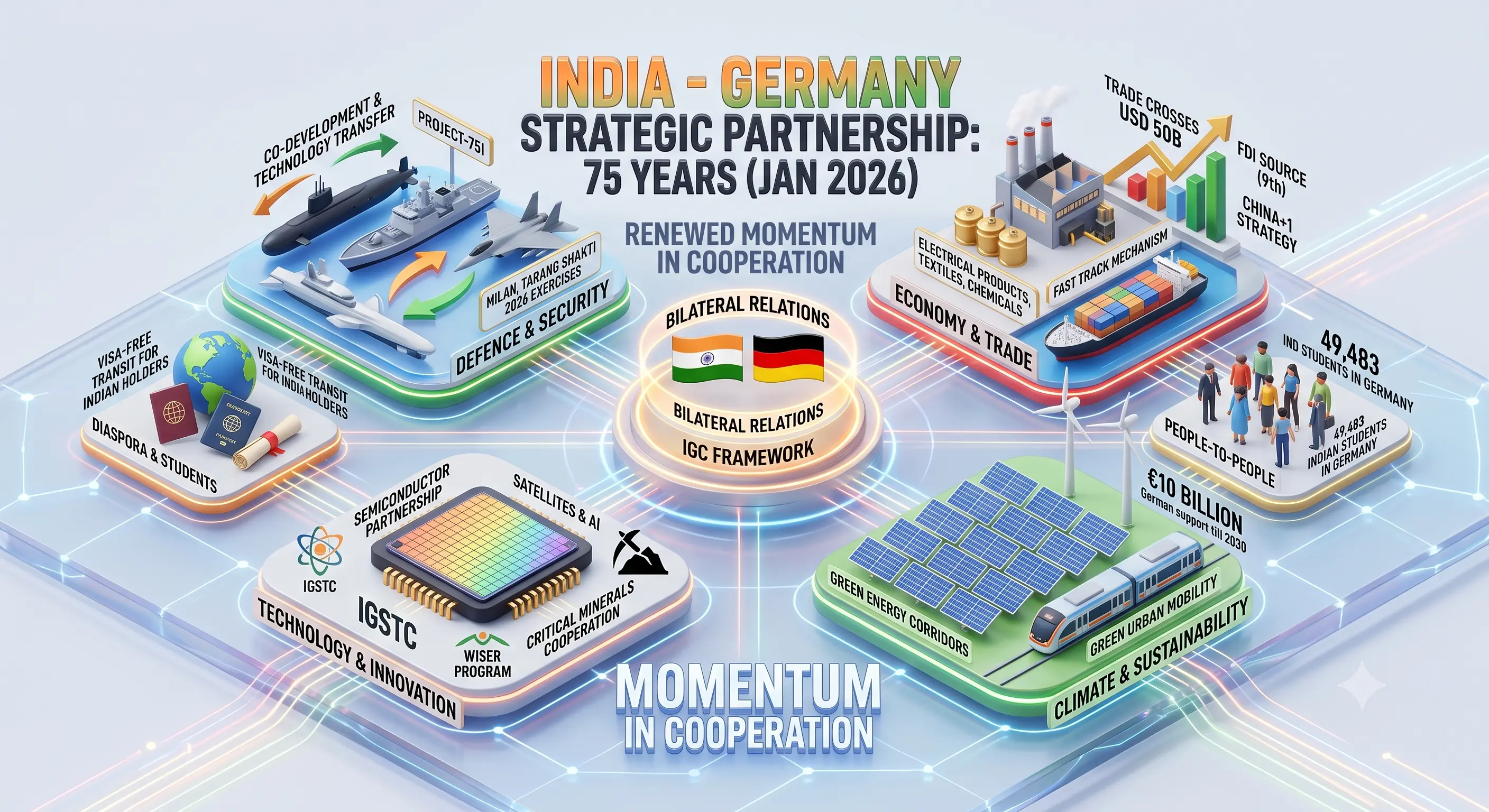
German Chancellor Friedrich Merz’s official visit to India in January 2026 coincided with the milestone of 75 years of diplomatic relations. The visit resulted in a new Defence Industrial Cooperation Roadmap, a semiconductor partnership, and further commitments to expanding bilateral trade and green development initiatives.
Introduction
Context & Background
Key Points
- •Diplomatic Milestone: German Chancellor H.E. Mr. Friedrich Merz’s official visit to India in January 2026 marks 75 years of diplomatic relations, underscoring a shared vision for a stable, peaceful, and rules-based global order.
- •Defence Integration: The nations signed a Defence Industrial Cooperation Roadmap emphasizing co-development and technology transfer. Notably, Germany will actively participate in Indian military exercises including MILAN, the IONS Conclave 2026, and TARANG SHAKTI 2026.
- •Economic Resilience: Bilateral trade crossed the USD 50 billion mark in 2024. Germany remains the 9th largest source of FDI for India, supported by a Fast Track Mechanism (FTM) that resolves operational issues for German investors.
- •Tech and Critical Minerals: A new Joint Declaration of Intent facilitates a Semiconductor Ecosystem Partnership. The countries are also joining forces on the exploration, processing, and recycling of critical minerals.
- •China+1 Strategy: Amidst rising EU-China tensions, India offers Germany a strategic and viable 'China+1' alternative to diversify and secure its global supply chains.
- •Growing Diaspora: People-to-people ties are stronger than ever, with approximately 2.46 lakh Indian-origin individuals in Germany and around 49,483 Indian students studying there as of 2024 (a number that has doubled in four years).
Key Outcomes of Chancellor Merz's Visit (Jan 2026)
| Focus Area | Key Outcome / Agreement | Bookmark |
|---|---|---|
| Defence & Security | Defence Industrial Cooperation Roadmap signed for co-production; Germany to join exercises like MILAN and TARANG SHAKTI. | |
| Trade & Investment | Commitment to expand beyond the USD 50 billion bilateral trade mark reached in 2024. | |
| Technology & Minerals | Semiconductor Ecosystem Partnership agreed upon, along with cooperation for critical minerals exploration and recycling. | |
| Climate & Sustainability | Green & Sustainable Development Partnership (GSDP) reaffirmed, backed by €10 billion German support till 2030. | |
| Mobility | Visa-free transit facility announced for Indian passport holders passing through Germany. |
Ongoing Strategic Areas of Bilateral Cooperation
| Area of Cooperation | Details | Flagship Initiatives | Bookmark |
|---|---|---|---|
| Trade and Investment | Germany is India’s top trading partner in Europe (USD 33.33 billion in 2023) and 9th largest FDI source. | Fast Track Mechanism (FTM) | |
| Technology and Innovation | Joint funding for priority scientific projects and support for female researchers. | Indo-German Science and Technology Centre (IGSTC); WISER program | |
| Development Cooperation | Financial and technical support for renewable energy and urban transport infrastructure. | Green Energy Corridor; Nagpur Metro Rail project; Kochi Water Transport |
Related Entities
Impact & Significance
- •Manufacturing and 'Make in India': Through the Fast Track Mechanism, cumulative German FDI of US$ 14.5 billion bolsters India's auto-components and electrical manufacturing sectors.
- •Defense Self-Reliance: Technology transfers embedded in the new defense roadmap directly support India's objective of indigenizing military hardware production.
- •Climate Action Acceleration: German funding in Green Energy Corridors and urban transit directly accelerates India's fulfillment of its Nationally Determined Contributions (NDCs).
- •Demographic Dividend Utilization: Increasing numbers of Indian students and professionals in Germany, aided by visa-free transit and educational frameworks, benefit both the German labor market and Indian diaspora remittances.
Challenges & Criticism
- •Trade Barriers and Standards: While Indian exports to Germany are growing, they frequently encounter stringent EU environmental and quality standards that can act as non-tariff barriers.
- •Geopolitical Nuances: Despite deep economic integration, India and Germany occasionally hold divergent geopolitical stances, particularly concerning the tactical approach to the Russia-Ukraine conflict.
- •Bureaucratic Hurdles: Although mechanisms like the FTM exist, German businesses still sporadically cite red tape and varying state-level regulations in India as impediments to swift investment scaling.
Future Outlook
- •Submarine Co-Development: Germany’s keen interest in joining India’s Project-75I for building conventional submarines could lead to long-term defense manufacturing alignment.
- •Green Urban Mobility Expansion: Continued German financial support for India's sustainable infrastructure will likely see the expansion of modern, green public transit systems mirroring the successes of the Nagpur Metro Rail project.
- •Deepened Tech Collaboration: Through institutions like the IGSTC, ongoing investments in priority scientific areas are expected to spur innovation, particularly in green energy and semiconductor design.
UPSC Relevance
- • GS-2 (International Relations): Bilateral, regional and global groupings; effect of policies and politics of developed countries on India's interests (EU-China dynamics).
- • GS-3 (Economy & Technology): Foreign Direct Investment, critical minerals, semiconductor ecosystems, and defense indigenization.
- • Mains Focus: Analyzing India's strategic positioning as a 'China+1' alternative for European economies and the role of the Green and Sustainable Development Partnership.
Sample Questions
Prelims
Consider the following statements regarding India-Germany relations: 1. Germany is India's largest trading partner globally. 2. The Green and Sustainable Development Partnership involves a €10 billion commitment by Germany to India till 2030. 3. Germany is scheduled to participate in India's multilateral military exercise, TARANG SHAKTI. Which of the statements given above are correct?
1. 1 and 2 only
2. 2 and 3 only
3. 1 and 3 only
4. 1, 2, and 3
Answer: Option 2
Explanation: Statement 1 is incorrect; Germany is India's largest trading partner in Europe, but not globally (the US and China lead). Statements 2 and 3 are correct based on the recent bilateral declarations and the GSDP commitments.
Mains
“The India-Germany strategic partnership has evolved from mere developmental cooperation to critical alignment in defense, technology, and climate action.” Discuss this statement in the context of recent bilateral agreements and Europe's shifting geopolitical priorities.
Introduction: Introduce the context of Chancellor Friedrich Merz’s 2026 visit and the 75th anniversary of diplomatic relations. Define the overarching Intergovernmental Consultations (IGC) framework.
Body:
• Economic & Technological Ties: Germany is India's largest European trading partner; mutual commitments include the Semiconductor Ecosystem Partnership and exploration of critical minerals, serving Germany's 'China+1' strategy.
• Defense Alignment: The Defence Industrial Cooperation Roadmap, joint military exercises (TARANG SHAKTI, MILAN), and prospective collaboration on Project-75I highlight a shift toward robust security cooperation.
• Sustainability Goals: The €10 billion Green & Sustainable Development Partnership (GSDP) actively funds structural transitions in India, such as Green Energy Corridors and urban mobility.
Conclusion: Conclude by stating that as both nations celebrate 75 years of diplomatic ties, their partnership is indispensable for a multipolar global order, combining German capital and technology with India's scale and strategic geography.