
India Becomes the World’s Largest Rice Producer
India has surpassed China to become the world's largest rice producer, recording 150.18 MT in 2024-25. While this solidifies its dominance in global food exports, it also exposes critical environmental, economic, and health challenges stemming from water-intensive cultivation and monoculture.
Introduction
Context & Background
Key Points
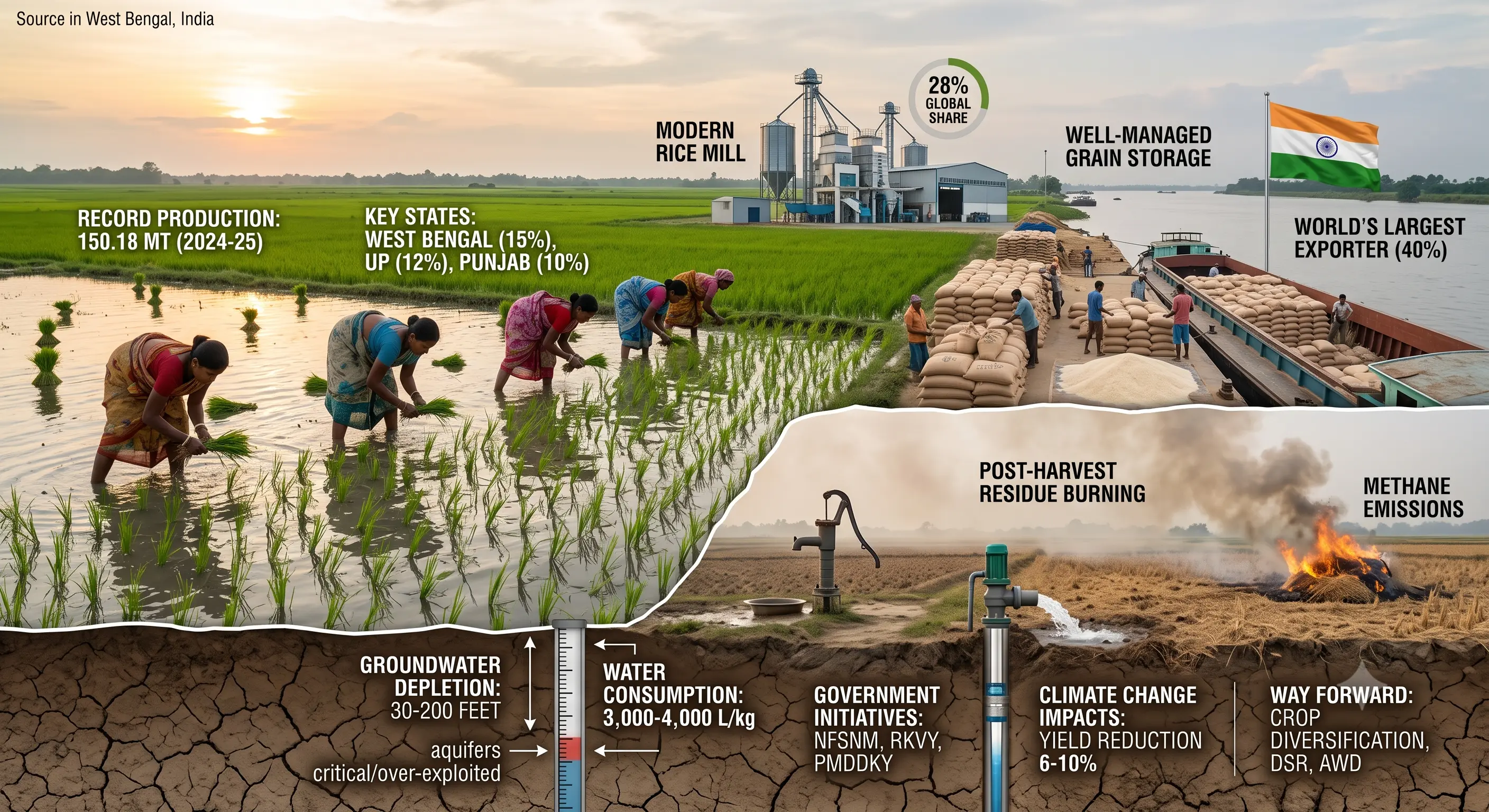
- •Record Production & Global Share: India produced a record 150.18 MT in 2024-25, accounting for over 28% of global output and officially surpassing China as the top producer.
- •Export Dominance: India is the world’s largest rice exporter, controlling nearly 40% of the global trade.
- •Top Producing States: West Bengal leads production (15%), followed by UP (12%) and Punjab (10%). Notably, Punjab boasts the highest yield in the country due to near-total irrigation and mechanization.
- •Cultivation Shift: To combat extreme water usage, Indian farmers are being encouraged to shift from traditional transplantation to Direct Seeding of Rice (DSR) and Alternate Wetting and Drying (AWD).
Key Government Initiatives for Rice Cultivation
| Initiative/Scheme | Objective & Focus | Bookmark |
|---|---|---|
| NFSNM | Targets productivity growth in low-yield rice districts. | |
| RKVY | Allows states to design region-specific rice projects, including irrigation and processing. | |
| Rice Fortification | Ensures rice distributed via PDS, PMGKAY, and PM-POSHAN is fortified with iron, folic acid, and vitamin B12. | |
| PMDDKY (2025-26) | Targets 100 low-productivity districts to strengthen irrigation, credit access, and post-harvest infrastructure. | |
| CCTS | Enables rice farmers to earn carbon credits by adopting methane-reducing practices like Alternate Wetting and Drying (AWD). |
Major Rice Varieties Cultivated
| Category | Examples / Export Destinations | Bookmark |
|---|---|---|
| Basmati | Exported primarily to West Asia. | |
| GI-Tagged Regional | Gobindobhog (WB), Joha (Assam), Navara (Kerala). | |
| Climate-Resilient | Kamala and Pusa DST Rice-1 (developed by ICAR). |
Related Entities
Impact & Significance
- •Global Food Security: Supplying 40% of the world's rice exports, any yield reductions in India due to water scarcity directly threaten global food stability and prices.
- •Economic Debt Trap: Farmers incur massive debt to fund costly deeper borewells and pumps as water tables drop, disproportionately hurting smallholders.
- •Public Health Risks: Flooded cultivation in regions with arsenic-contaminated groundwater leads to high arsenic uptake in grains (linked to cancer), compounded by heavy pesticide toxicity.
- •Fiscal Burden: Cultivation relies heavily on state support, with states like Punjab spending roughly Rs 39,000 per hectare solely on fertilizer and power subsidies for rice.
Challenges & Criticism
- •Groundwater Depletion: Producing 1 kg of rice consumes 3,000–4,000 liters of water. In major agrarian states, aquifers are classified as over-exploited, with groundwater plummeting from 30 feet to up to 200 feet.
- •Emissions & Pollution: Flooded paddies release substantial methane, and post-harvest residue burning in North India dramatically exacerbates winter air pollution via particulate matter and carbon monoxide.
- •Climate Vulnerability: Rising temperatures and erratic monsoons threaten to cut rice yields by 6–10%. Rainfed systems in northern and eastern India are highly susceptible to sudden production failures.
- •Soil Degradation: Prolonged flooded rice monoculture depletes essential soil micronutrients (like zinc and iron), enforcing a dependency on ever-increasing chemical fertilizer usage.
Future Outlook
- •Reforming Subsidy Structures: Shift from input-heavy subsidies (free power/water) to direct income and ecosystem-service payments. Guarantee MSP and robust procurement for diversified, less water-intensive crops like millets, pulses, and oilseeds.
- •Technological Adoption: Scale up water-efficient techniques like the System of Rice Intensification (SRI) and precision drip irrigation. Integrate AI-based digital advisory services to cut water use by 30–40% without yield loss.
- •Strengthening Policy Frameworks: Enforce bans on new borewells in over-exploited zones. Promote community-led groundwater governance, water budgeting, and strengthen Farmer Producer Organizations (FPOs).
- •Climate Resilience & Risk Mitigation: Break the rice-wheat monoculture through agroforestry and crop diversification. Expand the PMFBY (crop insurance) and invest in rural cold chains and agro-processing to reduce post-harvest losses.
UPSC Relevance
- • GS-3 (Agriculture & Economy): Major crops, cropping patterns, direct and indirect farm subsidies, MSP, and e-technology in the aid of farmers.
- • GS-3 (Environment): Conservation, environmental pollution (methane emissions, stubble burning), and groundwater depletion.
- • GS-1 (Geography): Geographical conditions for crop growth and distribution of water resources.
- • Essay Topics: 'The Paradox of India's Agricultural Success', 'Water Security vs. Food Security'.
Sample Questions
Prelims
Consider the following statements regarding Rice Production in India: 1. India accounts for about 15% of the global rice output and is the second-largest exporter. 2. West Bengal is the leading producer of rice in India, while Punjab records the highest yield. 3. Flooded rice paddies are entirely carbon-neutral and do not contribute to India's GHG emissions. Which of the statements given above is/are correct?
1. India accounts for about 15% of the global rice output and is the second-largest exporter.
2. West Bengal is the leading producer of rice in India, while Punjab records the highest yield.
3. Flooded rice paddies are entirely carbon-neutral and do not contribute to India's GHG emissions.
Answer: Option 2
Explanation: Statement 1 is incorrect: India produces over 28% of global output and is the largest exporter (40%). Statement 3 is incorrect: Flooded paddies create anaerobic soil, making them a major source of methane (10-20% of agri GHG emissions). Statement 2 is correct.
Mains
“India’s rise as the world’s leading rice producer underscores a critical water-energy-climate nexus.” Analyze the ecological and economic concerns associated with current rice cultivation practices in India and suggest a sustainable way forward.
Introduction: Acknowledge India's milestone of surpassing China to produce 150.18 MT of rice (28% of global output). Briefly define the water-energy-climate nexus driven by intensive cultivation.
Body:
• Ecological Concerns: Severe groundwater depletion (3,000–4,000 liters used per kg of rice); Methane emissions from flooded paddies (10–20% of agri GHG emissions); Soil micronutrient imbalances and air pollution from post-harvest stubble burning.
• Economic & Health Concerns: Smallholder debt traps due to costly borewells; Vicious cycle of power and fertilizer subsidies; Arsenic contamination in groundwater leading to toxic uptake in staple grains.
• Sustainable Way Forward: Subsidy reforms toward ecosystem payments; Adopting SRI, AWD, and DSR techniques; Crop diversification (millets, pulses) backed by assured MSP; Community-led groundwater governance.
Conclusion: Conclude that long-term food security cannot come at the cost of inter-generational ecological debt. Balancing production milestones with climate-resilient practices is imperative.