
India’s Future Demographic Challenges: Navigating Stabilisation, Ageing, and Policy Shifts
Highlighting findings from the report 'Unravelling India’s Demographic Future: Population Projections for States and Union Territories, 2021–2051', this article examines India's transition away from population explosion toward stabilisation, slower annual growth, and an ageing society. It assesses key impacts on school infrastructure, the closing window of the demographic dividend, the emerging silver economy, and required policy reforms in social security and labour force participation.
Introduction
Context & Background
Key Points
- •Departure from Population Explosion: India is transitioning from rapid demographic expansion to stabilisation. Between 2021 and 2051, population will increase from 1,355.8 million to 1,590.1 million, registering a low average annual growth rate of just 0.5%.
- •Drivers of Stabilisation: The shift is propelled by sustained declines in Total Fertility Rate (TFR), expansion of family planning awareness, and improvements in public healthcare outcomes.
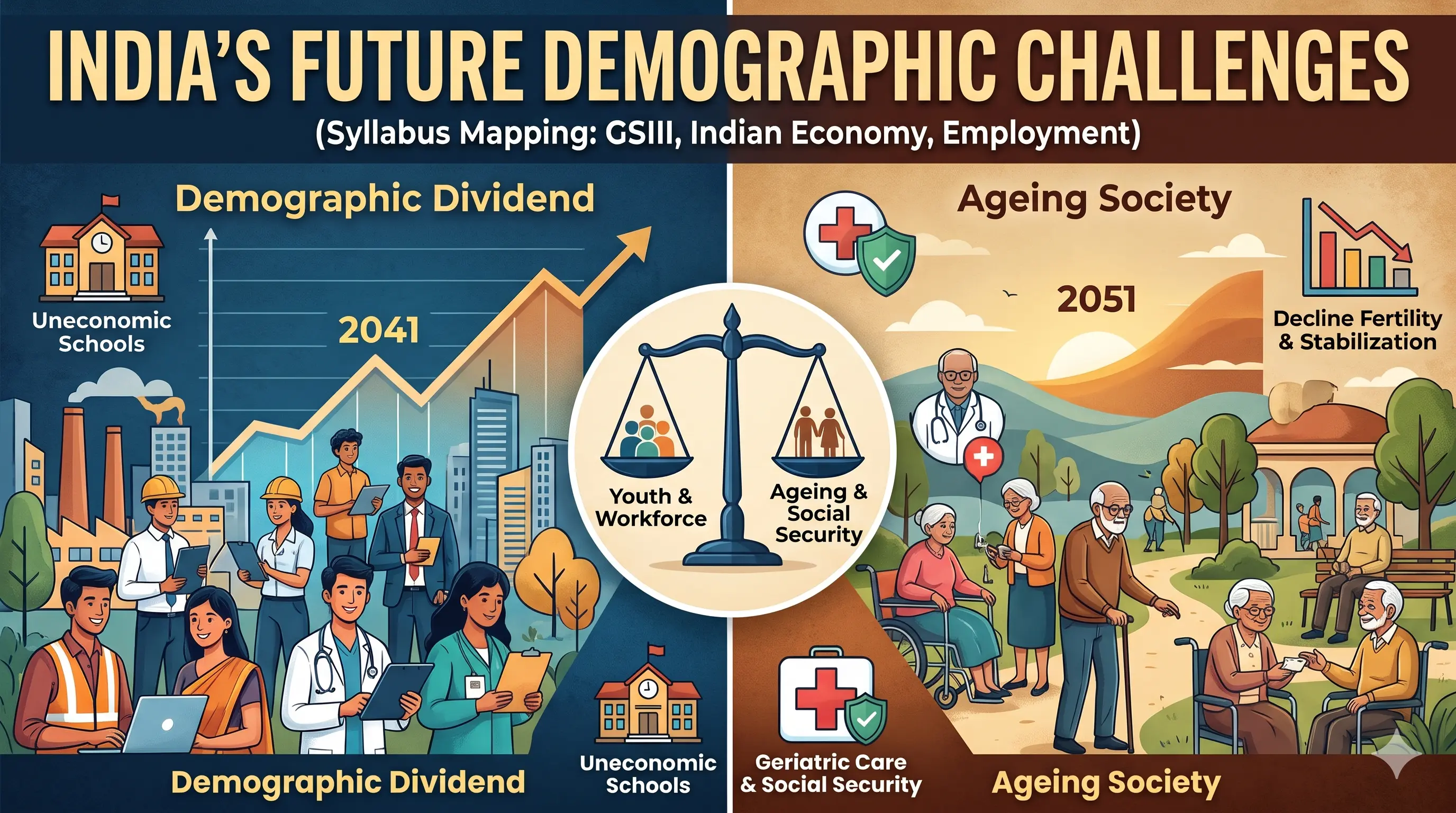
- •Shrinking Cohorts and Uneconomic Schools: A steep drop in children aged 0–4 is reducing primary school demand, leading to financially unsustainable ('uneconomic') government schools, alongside an increasing preference for private schooling.
- •Closing Window of Demographic Dividend: The working-age population is projected to peak around 2041 before starting to decline, creating a strict time window to mirror East Asian growth trajectories through rapid job creation and upskilling.
- •Rise of an Ageing Society: By 2051, over 20% of Indians will be aged 60 and older. The rising median age requires transitioning healthcare frameworks toward geriatric care, chronic disease management, and long-term care facilities.
- •The 'Gender Dividend' Imperative: Raising female labour force participation serves as the most viable mechanism to cushion the impending contraction in the working-age demographic share.
Demographic Projections and Milestones (2021–2051)
| Year/Milestone | Projected Population | Demographic Profile | Socio-Economic Significance | Bookmark |
|---|---|---|---|---|
| 2021 | 1,355.8 million | Youthful, expanding workforce | Base year of long-term projection | |
| 2041 | Projected Peak | Peak of working-age population | Demographic dividend window begins narrowing | |
| 2051 | 1,590.1 million | >20% aged 60 and above | Annual growth slows to ~0.5%; transition to ageing society |
Sectoral Implications of India's Demographic Shift
| Sector | Demographic Transition Dynamic | Key Challenge & Policy Mandate | Bookmark |
|---|---|---|---|
| Education Sector | Shrinking child population (ages 0–4); decline in student enrolments. | Rise of uneconomic government schools; shift toward private institutions; need to rationalise infrastructure and focus on learning quality. | |
| Employment & Workforce | Working-age population peaks around 2041; limited window to harness youth dividend. | Risk of an underutilised workforce without rapid job creation, productivity enhancement, and upskilling. | |
| Healthcare & Elderly Care | Over one-fifth (>20%) of the population aged 60+ by 2051; rising median age. | Increased fiscal strain on pensions; critical need for geriatric infrastructure; growth potential in the 'silver economy'. | |
| Gender Participation | Low historical female labour force participation rate (FLFPR). | Tapping into the 'gender dividend' to offset working-age population decline and boost overall GDP productivity. |
Related Entities
Impact & Significance
- •Narrowing Dividend Window: With the working-age segment peaking around 2041, India has a tight two-decade window to industrialise, upskill, and create formal employment before becoming a net-dependent ageing society.
- •Public Education Consolidation: Falling primary-age enrolments create systemic budgetary waste if non-viable schools are operated without consolidation or strategic repurposing.
- •Fiscal Burden on Social Security: The expansion of the 60+ age group beyond 20% by 2051 will place immense stress on public healthcare expenditures, non-contributory welfare funds, and family care structures.
- •Shift in Consumer Demand: Economic demand will pivot from infant/youth-centric consumer goods toward elderly healthcare, assistive living services, and wealth preservation instruments.
Challenges & Criticism
- •Growing Old Before Growing Rich: Unlike Western and East Asian economies that attained high per-capita income levels prior to population ageing, India risks confronting high dependency ratios at middle-income levels.
- •Sub-National Demographic Asymmetry: Southern and Western states are ageing significantly faster than Northern states (e.g., UP, Bihar), generating inter-state political, migration, and fiscal tensions.
- •Low Female Workforce Participation: Persistently low female labour force participation deprives the economy of key workforce buffers needed to offset the eventual decline in working-age cohorts.
- •Informal Sector Vulnerability: Over 80% of India's current labour force is employed informally without formal retirement accounts or institutional health insurance, making the aged population highly vulnerable.
Future Outlook
- •Education Infrastructure Rationalisation: Repurposing underutilised primary school infrastructure into vocational training hubs, community spaces, or modernised digital classrooms rather than merely shutting down uneconomic schools.
- •Developing the Silver Economy: Fostering economic ecosystems catering to elderly care, assistive technologies, specialised geriatric care, and private healthcare insurance models.
- •Universal Social Security Architecture: Restructuring non-contributory and contributory pension frameworks, life care models, and social security nets to insulate vulnerable senior citizens against old-age poverty.
- •Targeted Healthcare Resource Reallocation: Channeling public expenditure freed from reduced maternal and child healthcare demands into dedicated geriatric departments, preventive care, and chronic illness treatment.
UPSC Relevance
- • GS-3 (Indian Economy & Employment): Demographic dividend, labour market absorption capacity, upskilling, and inclusive growth.
- • GS-2 (Social Justice & Governance): Issues relating to the development and management of the Social Sector/Services relating to Health, Education, Human Resources, and vulnerable sections (elderly population).
- • GS-1 (Indian Society): Population dynamics, urbanization trends, changing family structures, and issues of the aged.
- • Essay Topics: 'India's Ageing Future: Preparing for the Silver Tsunami', 'Demographic Dividend vs. Demographic Disaster: The Employment Conundrum'.
Sample Questions
Prelims
With reference to India's projected demographic trends between 2021 and 2051, consider the following statements:
- (a)India's working-age population is projected to continue expanding consistently until the end of the 21st century.
- (b)By 2051, the proportion of India's population aged 60 years and above is projected to cross 20 per cent.
- (c)The total fertility rate decline has primarily led to an increase in student enrolment within rural government schools.
Mains
“India’s transition from a phase of population expansion to demographic stabilisation presents both a narrowing window of demographic dividend and the structural challenge of an ageing society.” Critically examine the sectoral implications and suggest key policy interventions required.
Introduction: Cite the report 'Unravelling India’s Demographic Future: Population Projections for States and UTs, 2021–2051' to frame India's shift from fear of population explosion to challenges of ageing and stabilisation.
Body:
• Stabilisation and the Closing Window: Mention population peak around 2041 (annual growth dropping to 0.5%) and how failing to generate productive jobs risks turning the dividend into demographic liabilities.
• Sectoral Pressures: (a) Education: emergence of uneconomic government schools due to shrinking 0–4 age cohorts; (b) Health & Fiscal: rising geriatric demand and underfunded pension nets as >20% cross age 60 by 2051.
• Strategic Interventions: Tapping into the 'gender dividend' by raising female labour force participation; expanding the silver economy; reorienting maternal health savings toward geriatric infrastructure; implementing portable social security cushions.
Conclusion: Emphasise that India must avoid the risk of 'growing old before growing rich' by synchronising skill development, capital investments, and institutional eldercare frameworks before the working-age window closes post-2041.