
India’s Rice Production and Export Strategy
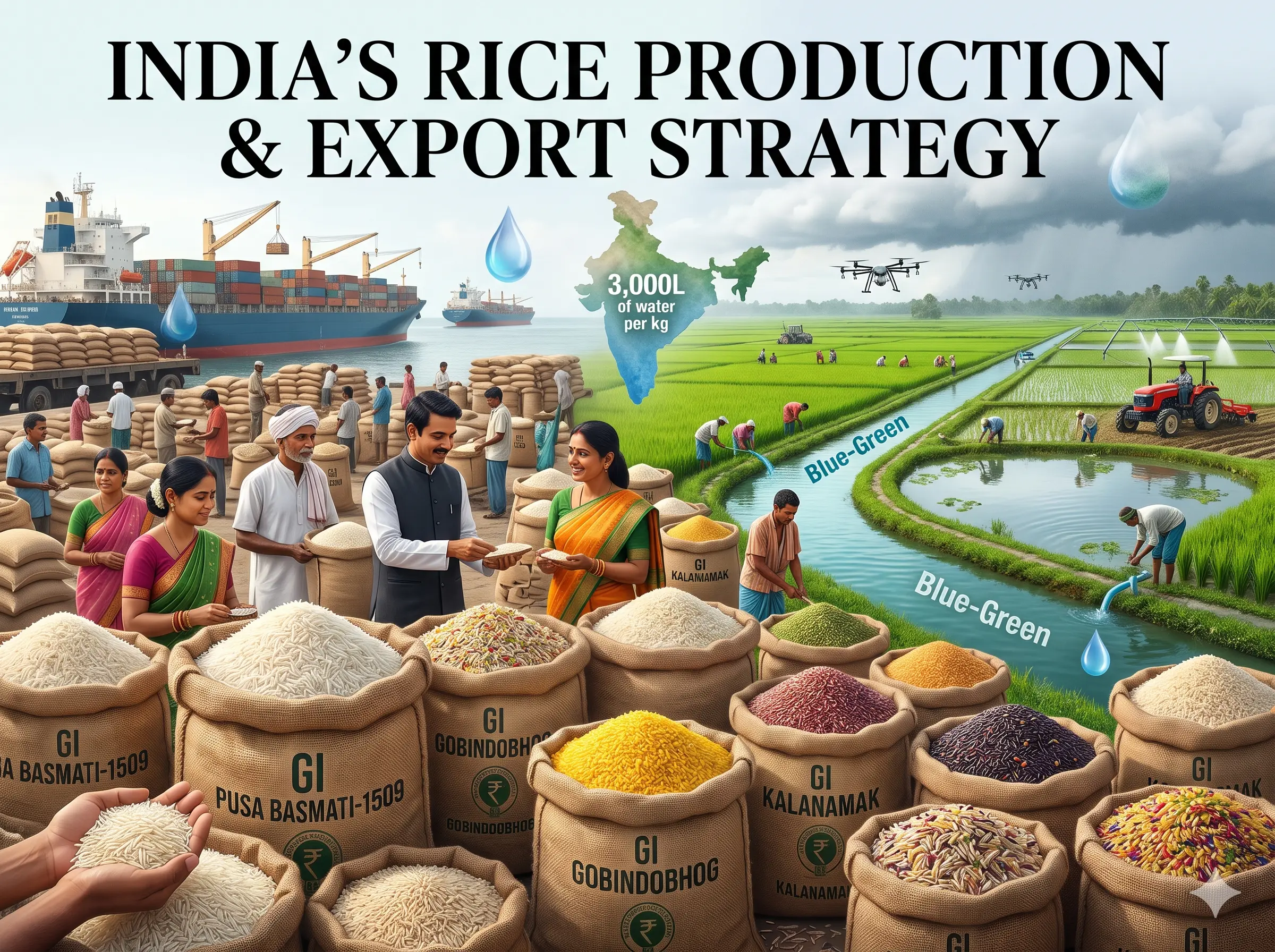
India emerged as the world's largest rice producer and exporter in 2024–25. However, this achievement hides a massive environmental cost due to the water-intensive nature of conventional paddy cultivation. This analysis explores the hidden 'virtual water' exports, the economic advantage of Basmati over non-Basmati rice, and the systemic shift required for sustainable agriculture.
Introduction
Context & Background
Key Points
- •The Water Footprint of Paddy: Paddy is severely water-intensive. Producing 1 kg of paddy takes about 2,000 litres of water, and 1 kg of milled rice requires nearly 3,000 litres. Exporting rice effectively means exporting billions of litres of India's scarce water.
- •The Basmati Economic Advantage: While India exports less than half as much Basmati as non-Basmati by volume, Basmati brings in almost identical revenue ($5.8–5.9 billion) due to a significantly higher unit value per kg.
- •Water Efficiency in Aromatic Rice: Non-Basmati paddy is transplanted in peak summer (June) requiring heavy irrigation. In contrast, Basmati is transplanted in July with the monsoon, drastically reducing water usage.
- •Climatic Role in Aroma: Basmati's distinct aroma comes from the compound 2-acetyl-1-pyrroline. This develops best when the crop flowers in October under cooler temperatures (30-31°C).
- •Advances in Rice Breeding: IARI scientists have developed high-yield varieties like Pusa Basmati-1509 (which matures in just 115-120 days) and disease-resistant strains (1847, 1885, 1886) that reduce the need for fungicides and antibiotics.
Global Rice Production and Export Landscape (2024-25)
| Country | Production (Estimated) | Export Volume | Bookmark |
|---|---|---|---|
| India | 150 million tonnes | 21.69 million tonnes | |
| China | 145.28 million tonnes | Not Available | |
| Thailand | Not Available | 7.86 million tonnes | |
| Vietnam | Not Available | 8.06 million tonnes |
Financial Comparison of India's Rice Exports
| Rice Category | Export Volume | Export Value | Average Unit Value | Bookmark |
|---|---|---|---|---|
| Basmati Rice | 5–6 million tonnes | $5.8–5.9 billion | ₹82.9–92.3 per kg | |
| Non-Basmati Rice | 11–14 million tonnes | $4.5–6.5 billion | ₹34–39.2 per kg |
Related Entities
Impact & Significance
- •Groundwater Depletion: The current model is rapidly draining aquifers in North-Western India, posing an existential threat to future farming generations.
- •Economic Maximization: High-value exports like Basmati and GI-tagged native rice allow India to earn the same foreign exchange while utilizing significantly fewer natural resources.
- •Pesticide Reduction: The adoption of genetically improved, disease-resistant Basmati varieties (like Pusa 1847) lowers the dependency on fungicides, improving soil health and meeting strict global residue standards.
Challenges & Criticism
- •Geographical Misalignment: Water-guzzling non-basmati crops are heavily cultivated in water-scarce states (Punjab, Haryana), while water-rich Eastern states are underutilized in government procurement pools.
- •Farmer Vulnerability: Transitioning to Basmati carries market risks. Without government-backed floor prices, farmers are vulnerable to severe price crashes in international markets.
- •Climate Change: Rising temperatures threaten the quality of aromatic rice. If temperatures stay high through October, the synthesis of the aroma compound drops significantly.
Future Outlook
- •Non-Basmati Phaseout in Stressed Regions: Gradually reducing non-basmati cultivation in water-stressed states like Punjab and Haryana, and shifting government procurement to Eastern states (UP, Bihar, Bengal, Assam) where groundwater is abundant.
- •Focus on GI-Protected Regional Varieties: Expanding the cultivation and export of high-value native aromatic rice such as Kalanamak, Gobindobhog, Katarni, and Seeraga Samba.
- •Basmati Expansion: Utilizing the full potential of India's 6.2 million hectare Basmati GI region (currently only ~2.1 million hectares are utilized for Basmati).
- •Policy Incentives: Setting a designated floor price for Basmati paddy in APMC mandis to protect farmers from price crashes, encouraging them to switch from non-basmati varieties.
UPSC Relevance
- • GS-3 (Agriculture): Major crops, cropping patterns in various parts of the country, different types of irrigation and irrigation systems storage.
- • GS-3 (Environment): Conservation, environmental pollution, and groundwater depletion.
- • Essay Topics: 'Virtual Water Export: The Hidden Cost of India's Agricultural Success'.
- • Mains Focus: Strategies for crop diversification and making Indian agriculture climate-resilient.
Sample Questions
Prelims
Consider the following statements regarding paddy cultivation and exports in India:
- (a)India earns significantly more foreign exchange from non-basmati exports than from basmati exports.
- (b)The distinctive aroma of Basmati rice is attributed to the compound 2-acetyl-1-pyrroline, which develops optimally under cooler temperatures.
- (c)Pusa Basmati-1509 is a traditional, slow-maturing variety that requires more water than modern non-basmati strains.
Mains
“India’s status as the top global rice exporter comes at a heavy environmental cost, particularly concerning groundwater depletion.” Analyze the statement and suggest policy measures to ensure the financial and environmental sustainability of India’s rice exports.
Introduction: Cite India's 2024-25 data as the world's largest rice exporter (21.69 MT) and producer. Introduce the concept of 'Virtual Water Export'.
Body:
• Environmental Cost (Virtual Water Export): Explain the water footprint of paddy (3,000 litres per kg of milled rice). Highlight the ecological damage in traditional grain bowls (Punjab/Haryana) due to continuous flooding and 20-30 irrigation cycles.
• Financial vs. Environmental Viability: Contrast Basmati vs Non-Basmati. Explain how Basmati yields similar forex earnings ($5.8-5.9 bn) at less than half the volume, while requiring less irrigation because it is transplanted during the monsoon.
• Measures/Way Forward: Geographic shifting of non-basmati procurement to Eastern India; promoting high-value GI-tagged aromatic varieties (Kalanamak, Gobindobhog); utilizing disease-resistant IARI seeds; and providing floor prices for Basmati.
Conclusion: Conclude that to maintain global leadership, India must transition from a 'volume-driven' export strategy to a 'value-driven' one, protecting both farmer incomes and the nation's fragile aquifers.