
Issues Faced by the WTO: Multilateralism under Strain ahead of MC14
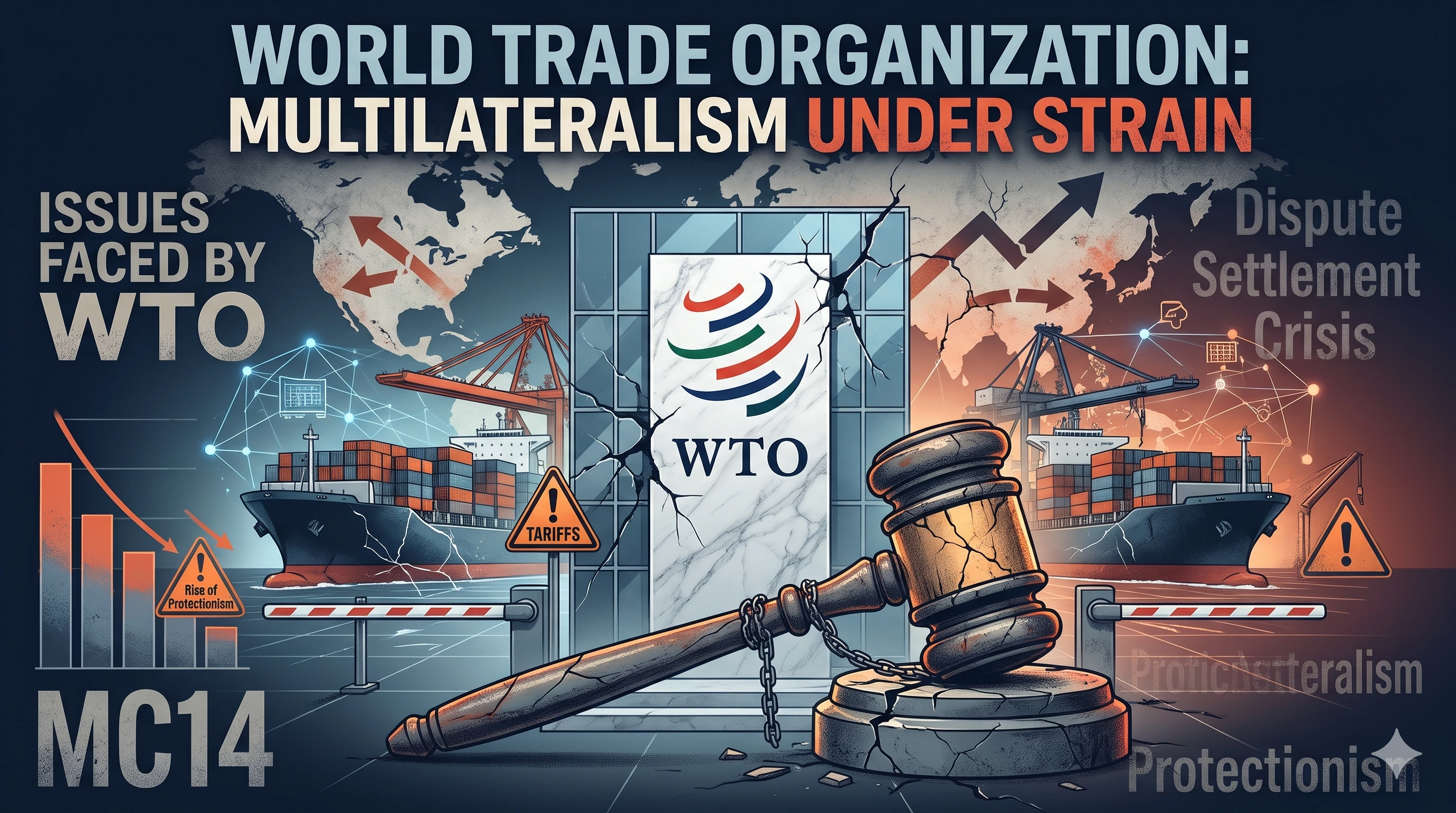
Amid the rise of 'wrecking-ball politics' and creeping unilateralism flagged by the Munich Security Conference 2026, the World Trade Organization faces an existential crisis. Ahead of MC14, critical debates over the paralyzed Appellate Body, the e-commerce customs moratorium, plurilateral agreements, and Special and Differential Treatment define India's leadership for the Global South.
Introduction
Context & Background
Key Points
- •Rise of 'Wrecking-Ball Politics': As highlighted in the Munich Security Conference 2026 Report, unilateral tariffs, geo-economic coercion, and weaponized trade policies are actively undermining the rules-based multilateral trading order.
- •Appellate Body Paralysis: The dispute settlement arm has remained dysfunctional since December 2019 due to the United States continually blocking the appointment of new Appellate Body judges, creating an 'appeal into the void' loophole.
- •Consensus Bottleneck: With 166 members having individual veto power, reaching broad consensus has paralyzed negotiating arms like the Doha Development Agenda, leading frustrated members toward plurilateral carve-outs.
- •Outdated Regulatory Framework: Current WTO rules were framed for a 20th-century merchandise economy, leaving cross-border data flows, artificial intelligence, platform monopolies, and digital taxation without harmonized multilateral oversight.
- •Proliferation of Mega-Regionals: Frustrations with multilateral stagnation have accelerated reliance on regional pacts like RCEP and CPTPP, eroding non-discriminatory MFN (Most Favored Nation) principles.
- •Subsidy Asymmetries & Green Protectionism: Developed economies continue outspending developing nations through green industrial policies and unilateral border taxes (such as carbon border adjustment mechanisms), raising non-tariff barriers.
Major Structural Faultlines in the WTO
| Area of Crisis | Manifestation | Impact on Global Trade | Bookmark |
|---|---|---|---|
| Dispute Settlement Mechanism | Appellate Body paralysis due to US blocking judicial appointments since 2019 | Weakens dispute enforcement; leaves trade conflicts (e.g., US–China) unresolved without binding appeal | |
| Decision-Making Gridlock | Consensus-based voting model among all 166 member nations | Prolonged stalemates in negotiations, most notably across the protracted Doha Development Round | |
| Rulebook Obsolescence | Rules lag behind technological advancements (digital economy, AI, cross-border data) | Absence of global standards for Big Tech regulation, data flows, and modern trade realities | |
| Rising Protectionism | Unilateral industrial subsidies and green barriers (e.g., US Inflation Reduction Act, EU CBAM) | Distorts fair market competition and penalizes developing economy exports | |
| Systemic Inequity | Entrenched domestic agricultural subsidies in the US and EU | Exposes farmers in developing economies like India to highly uncompetitive, distorted global markets |
Key Agenda Items and Divergences at MC14
| Agenda Item | Developed Countries' Stand | Developing Countries / India's Stand | Bookmark |
|---|---|---|---|
| Plurilateral Agreements (Annex 4) | Push to integrate pacts like Investment Facilitation for Development without full consensus | Opposed (notably by India); risks fragmenting the multilateral system and diluting consensus | |
| E-commerce Moratorium | Demand permanent extension to secure duty-free cross-border electronic transmissions | Oppose permanent extension; causes loss of vital tariff revenue and policy space in digital economies | |
| Special & Differential Treatment (SDT) | Seek to graduate and exclude large emerging markets (India, China, Brazil) from SDT flexibilities | Demand unconditional retention of SDT to safeguard policy space, poverty alleviation, and development | |
| Dispute Settlement Reform | Call for procedural changes while maintaining the block on appointments | Demand immediate, unconditional revival of a functional, two-tier Appellate Body |
Related Entities
Impact & Significance
- •Erosion of Multilateralism: Bypassing the WTO in favor of regional trade deals and plurilateral pacts risks creating a fragmented, two-tier global trading architecture.
- •Disproportionate Harm to Developing Economies: Without a binding dispute settlement body, developing economies lack institutional leverage against unilateral tariffs, sanctions, or non-tariff barriers.
- •Fiscal Losses from Digital Moratorium: Prohibiting customs duties on electronic transmissions denies developing nations vital tariff revenue as trade shifts rapidly from physical goods to digital downloads and streaming.
- •Threat to Agricultural Livelihoods: Continued protectionism and high farm subsidies in advanced nations depress international food prices and undermine food security for agrarian economies like India.
Challenges & Criticism
- •Paralysis of the Appellate Body: The United States' sustained refusal to appoint new judges has effectively dismantled the two-tier dispute resolution mechanism.
- •Push for Fragmented Plurilateralism: Attempts to introduce selective plurilateral agreements (e.g., Investment Facilitation) without universal consensus circumvent Annex 4 safeguards.
- •Erosion of Special & Differential Treatment (SDT): Attempts by advanced nations to disqualify major emerging economies like India and Brazil from development flexibilities threaten domestic policy space.
- •Green Protectionism: Unilateral carbon border adjustment measures and domestic subsidy acts are enacted under environmental pretexts, shifting the burden of climate transition onto developing nation exports.
Future Outlook
- •Restoring the Two-Tier Dispute Settlement: Re-establishing a fully functional Appellate Body with clear timelines and binding enforcement is imperative to restore trust in WTO adjudication.
- •Balancing Digital Governance: Formulating an equitable multilateral framework on digital trade that respects national data sovereignty and allows domestic revenue generation, rather than enforcing blanket indefinite moratoria.
- •Modernizing Subsidies with Fairness: Establishing transparent global disciplines on industrial and environmental subsidies to prevent protectionism masked under climate mitigation.
- •Preserving the Development Dimension: Ensuring institutional reforms modernize procedures without dismantling Special and Differential Treatment (SDT) provisions vital for developing nations.
UPSC Relevance
- • GS-2 (International Relations): Important International institutions, their structure, mandate, and functioning; India's role in the Global South.
- • GS-3 (Economy): Effects of liberalization on the economy; Issues related to direct and indirect farm subsidies; E-commerce rules and intellectual property rights.
- • Mains Focus: Structural challenges facing the WTO, dispute resolution crisis, and India's strategy to defend multilateralism at MC14.
- • Essay Topics: 'Multilateralism in the Era of Geo-Economic Fragmentations', 'Free Trade vs Fair Trade: The Developing World Perspective'.
Sample Questions
Prelims
With reference to the World Trade Organization (WTO), consider the following statements: 1. The inclusion of Plurilateral Agreements into Annex 4 of the WTO Agreement requires the consensus of all WTO members. 2. The WTO moratorium on customs duties on electronic transmissions was permanently made binding by the 1998 Geneva Ministerial Declaration. 3. The Appellate Body of the WTO dispute settlement system consists of seven permanent judges appointed by simple majority voting. Which of the statements given above is/are correct?
- (a)1 only
- (b)1 and 2 only
- (c)2 and 3 only
- (d)1, 2 and 3
Mains
“The World Trade Organization is facing an existential crisis characterized by procedural paralysis and rising economic nationalism.” Examine the key contentious issues ahead of MC14 and analyze India’s strategic role in defending multilateralism and the interests of the Global South.
Introduction: Highlight the current context using the Munich Security Conference 2026 report on 'wrecking-ball politics', unilateral trade practices, and the institutional breakdown of the WTO's dispute settlement mechanism.
Body:
• Core Systemic Crises: Appellate Body deadlock since 2019; structural delays caused by the 166-member consensus model; failure to update rules for digital commerce, AI, and green subsidies; rise of non-tariff barriers (e.g., CBAM).
• Contentious Issues at MC14: Debate on Plurilateralism vs Multilateralism (Annex 4 incorporation); expiration of the 1998 E-commerce Moratorium and loss of tariff sovereignty; developed economies attempting to restrict Special and Differential Treatment (SDT).
• India's Strategic Imperative & Global South Leadership: Building coalitions among developing nations and LDCs; championing unconditional revival of the Appellate Body; defending policy space for public stockholding in agriculture and digital industrialization.
Conclusion: Emphasize that a rules-based, non-discriminatory multilateral trading system remains the best defense against unilateral coercion for developing nations, necessitating constructive consensus-driven reforms.