
Jharkhand Megaliths: A Living Cultural Tradition Seeking UNESCO Status
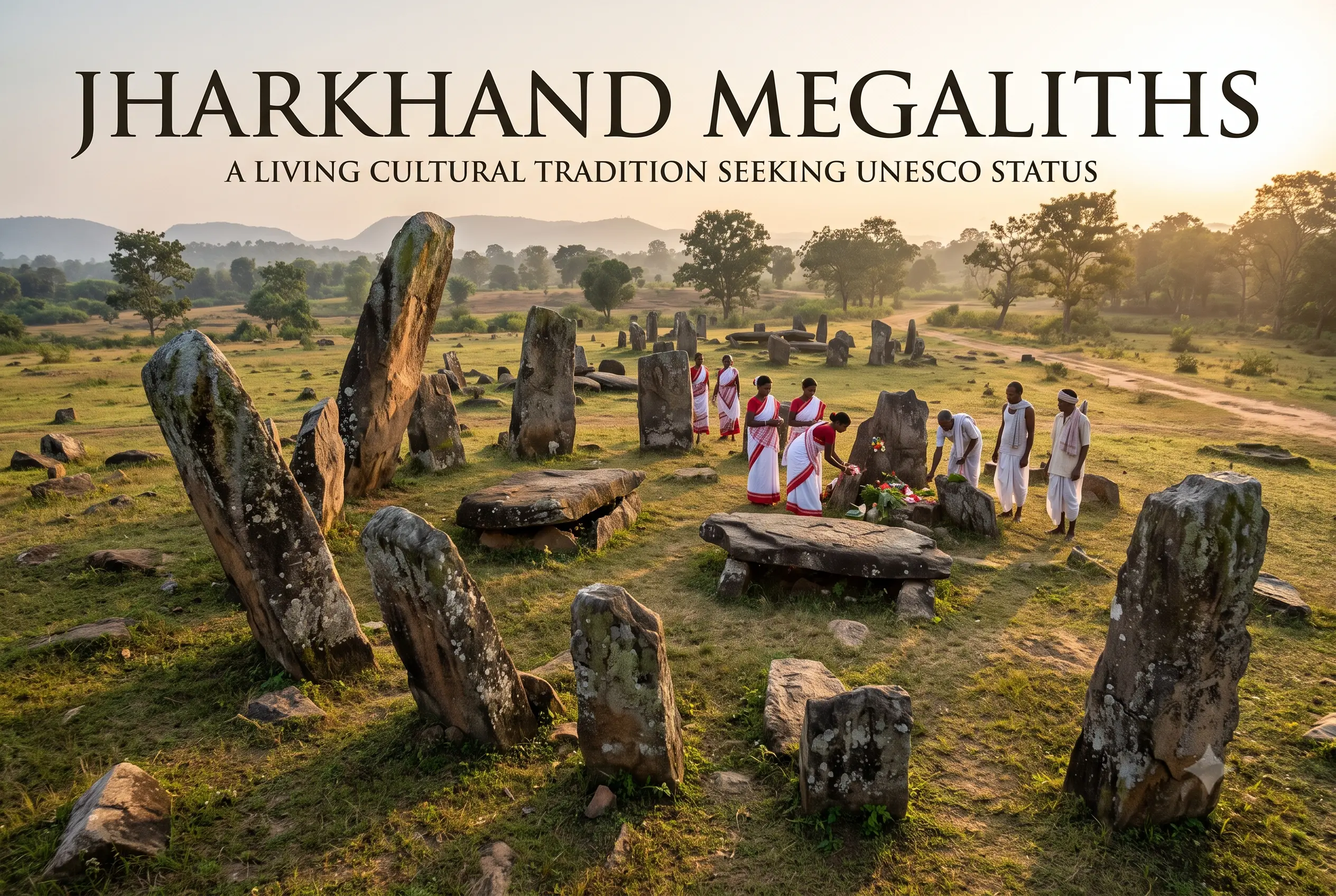
Jharkhand has initiated a high-level diplomatic and cultural outreach to secure UNESCO World Heritage status for its extensive megalithic landscapes. This article highlights the significance of these sites, which are not just archaeological remains but living traditions maintained by indigenous communities, bridging prehistoric astronomy and ancient geology.
Introduction
Context & Background
Key Points
- •Geological Continuum: Jharkhand lies on the Singhbhum Craton, one of the oldest stable landmasses on Earth (over 3.3 billion years old), providing a rare geological-cultural continuum.
- •A Living Tradition: Unlike many global megalithic sites that are purely archaeological, Jharkhand’s megaliths represent a living cultural tradition that is actively maintained by indigenous groups such as the Munda community.
- •Chokahatu (Ranchi): This site is regarded as the largest living megalithic landscape in the Indian subcontinent, where new memorial stones continue to be added even today.
- •Prehistoric Astronomy: At Pakari Barwadih (Hazaribag), aligned monoliths track solar movement and equinoxes, placing Jharkhand within the global history of prehistoric astronomy, comparable to sites like Stonehenge.
- •Historical Chronology: While megaliths globally range from the Neolithic to the Iron Age, the Megalithic Culture in India mainly belongs to the Iron Age, with some exceptions found in Chalcolithic-Megalithic sites.
Types of Megaliths in India
| Category | Type | Key Features | Examples | Bookmark |
|---|---|---|---|---|
| Polylithic Type | Dolmen | Table-like burial structure with upright stones and a flat capstone; often covered with earth or stones | Hire Benkal, Karnataka | |
| Polylithic Type | Cairn | Man-made heap of stones; funerary, ritual, or astronomical purpose | Ottiyambakkam, Tamil Nadu | |
| Polylithic Type | Cromlech | Stone circle or arrangement of large stones; ritual or burial association | South India (general) | |
| Polylithic Type | Cist | Stone-lined burial chamber, sometimes associated with other monuments | Brahmagiri, Karnataka | |
| Monolithic Type | Menhir | Single upright standing stone; memorial or ritual marker | Ellarigudem, Telangana | |
| Monolithic Type | Stone Circle | Standing stones arranged in circular or elliptical form | Junapani, Madhya Pradesh |
Related Entities
Impact & Significance
- •Preservation of Indigenous Identity: The continued practice of erecting and maintaining megaliths anchors the socio-cultural and spiritual identity of tribes like the Munda.
- •Global Archaeoastronomy Map: The solar-aligned structures at Pakari Barwadih establish India's place alongside globally renowned prehistoric astronomical sites.
- •Bridging Deep Time: The combination of a 3.3-billion-year-old craton and thousands of years of continuous human ritual offers an unparalleled perspective on human and geological history.
Challenges & Criticism
- •Industrial Encroachment: Jharkhand is a mineral-rich state, and rapid mining, industrialization, and infrastructure expansion pose a direct physical threat to these unprotected landscapes.
- •Lack of Documentation: While famous monuments get widespread attention, ancient tribal megaliths lack comprehensive academic documentation and state-sponsored protection.
- •Erosion of Oral Traditions: As younger generations of indigenous communities migrate to cities, the living oral traditions associated with these rituals face the risk of dying out.
Future Outlook
- •UNESCO Inscription: Securing World Heritage status will bring global expertise, targeted conservation funding, and formal frameworks to protect these sites from destruction.
- •Eco-Cultural Tourism: Promoting sustainable tourism models that respect the sanctity of the living traditions while educating global tourists on prehistoric astronomy.
- •Further Archaeoastronomy Research: Encouraging scientific studies at sites like Pakari Barwadih to further decode the ancient astronomical knowledge of indigenous communities.
UPSC Relevance
- • GS-1 (Indian Heritage and Culture): Salient aspects of Art Forms, Literature and Architecture from ancient to modern times.
- • GS-1 (History): Prehistoric cultures, Iron Age in India, and the evolution of megalithic structures.
- • Mains Focus: Significance of living traditions and archaeoastronomy in India's cultural heritage; indigenous practices.
Sample Questions
Prelims
Consider the following statements regarding Megaliths in India:
1. Megaliths in India exclusively belong to the Neolithic period.
2. The site of Pakari Barwadih in Jharkhand is known for monoliths that track solar movement and equinoxes.
3. The first excavated Megalithic site in India was Hire Benkal in Karnataka.
Answer: Option 2
Explanation: Statement 1 is incorrect; they mainly belong to the Iron Age with some Chalcolithic exceptions. Statement 3 is incorrect; the first excavated site was Adichanallur in Tamil Nadu. Statement 2 is correct.
Mains
“Megalithic sites in India are not just relics of the Iron Age but, in some regions, represent a continuum of living cultural and astronomical heritage.” Discuss with special reference to the megaliths of Jharkhand.
Introduction: Define 'Megalith' (Greek: mega + lithos). Introduce Jharkhand's recent diplomatic push to secure UNESCO World Heritage status for its megalithic landscapes.
Body:
• Archaeological Significance: Briefly define Megaliths (Dolmen, Menhir, etc.) and their historical context (predominantly Iron Age in India). Mention early excavations like Adichanallur.
• The Living Tradition: Explain how sites in Jharkhand (like Chokahatu) differ from global sites as they are actively maintained by indigenous tribes (Munda) for memorials and rituals.
• Astronomical & Geological Importance: Highlight the Singhbhum Craton's geological age and the alignment of monoliths at Pakari Barwadih for tracking equinoxes, comparing it to Stonehenge.
Conclusion: Conclude by emphasizing the need for UNESCO World Heritage status to protect these sites from modern industrial threats and to preserve the indigenous identity.