
LNG and LPG Price Determination: Global Mechanisms and Indian Impacts
Amidst the ongoing West Asia conflict in March 2026, global crude oil prices surged by nearly 30%, directly inflating LNG and LPG costs. This article explores the mechanisms for pricing these energy resources, their dependence on crude oil indices, and the severe economic implications for India's energy, agriculture, and social welfare sectors.
Introduction
Context & Background
Key Points
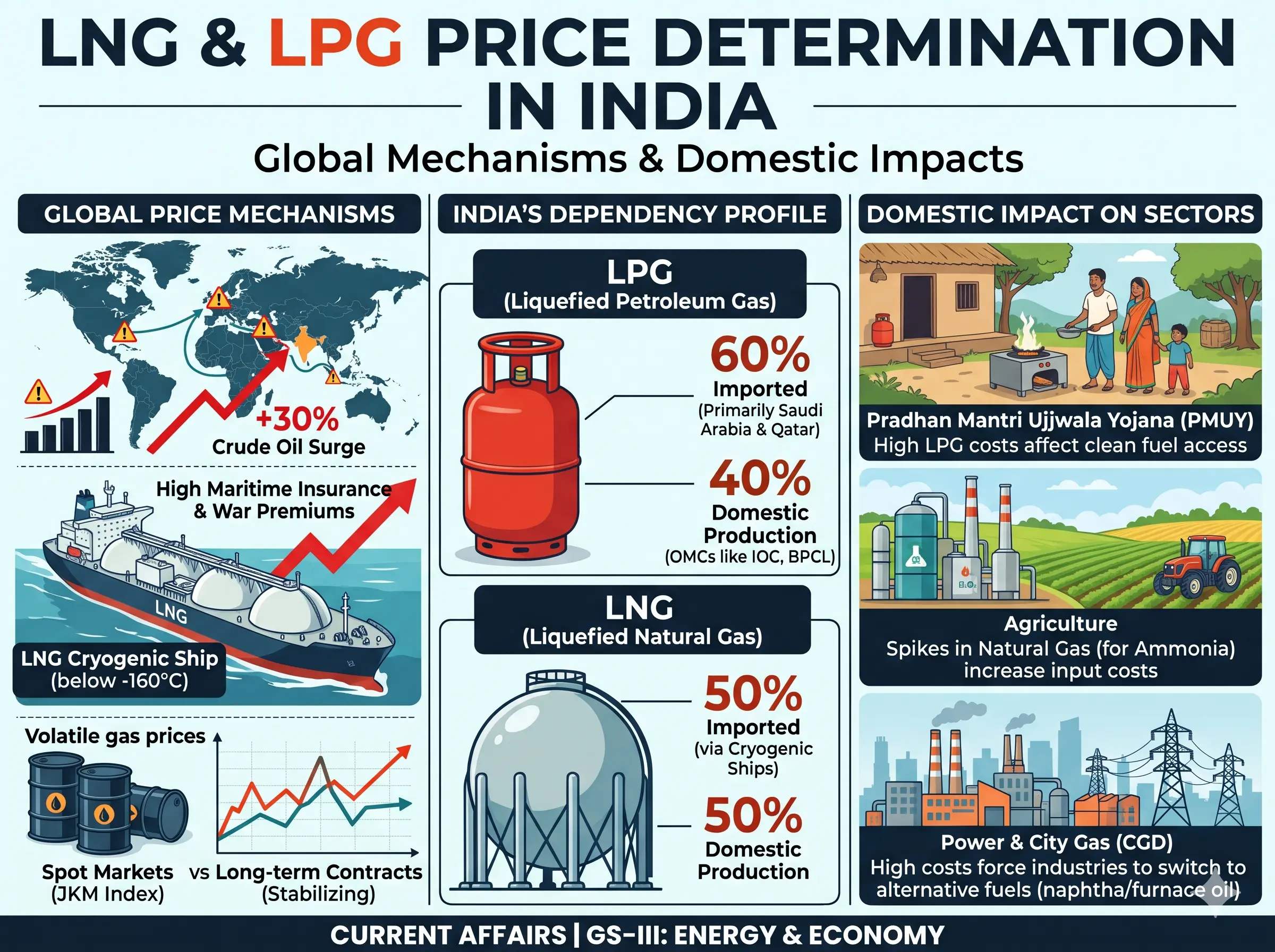
- •Crude Oil Linkage: Globally, both LNG and LPG prices do not have a single fixed global rate. Instead, they are generally indexed to or float alongside crude oil prices. A surge in crude directly triggers a price hike in these gases.
- •Geopolitical Sensitivity: Conflicts in West Asia—such as the closure of choke points like the Strait of Hormuz—disrupt supplies, causing immediate supply chain gaps and driving up 'war premiums' on energy.
- •Supply Gaps & Dominant Producers: When major exporters like Qatar shut down or reduce production, it creates a massive global supply vacuum, forcing prices disproportionately higher for all purchasing nations.
- •Transportation and Insurance Premiums: LNG requires specialized logistics; it must be cooled to below -160°C and transported in insulated cryogenic tanks. During wartime, soaring shipping and maritime insurance premiums add heavily to the final landed cost.
- •Storage Capacity Constraints: Nations with limited domestic storage infrastructure, such as India, are exceptionally vulnerable to immediate price shocks compared to Western countries that possess massive underground strategic reserves.
India's Import vs. Domestic Production Profile
| Energy Resource | Import Share | Domestic Share | Key Vulnerabilities / Notes | Bookmark |
|---|---|---|---|---|
| LPG (Liquified Petroleum Gas) | 60% (Primarily from Saudi Arabia & Qatar) | 40% (Produced by OMCs like IOC, BPCL) | Highly vulnerable to West Asian geopolitical stability. | |
| LNG (Liquified Natural Gas) | 50% (Imported via specialized cryogenic ships) | 50% | Pricing influenced by long-term contracts and spot indices (JKM). |
Procurement and Pricing Mechanisms
| Contractual Structure | Nature of Agreement | Impact on Pricing | Bookmark |
|---|---|---|---|
| Long-term Contracts | Pre-negotiated agreements for bulk procurement over a span of years (e.g., India-Qatar deals). | Provides crucial price stability and buffers against sudden global shocks. | |
| Spot Markets | Immediate, on-the-spot purchases for short-term needs. | Highly volatile; tracked by indices like the Japan Korea Marker (JKM). |
Related Entities
Impact & Significance
- •Threat to Social Welfare: Elevated LPG prices directly undermine the Pradhan Mantri Ujjwala Yojana. As cylinder refill costs rise, economically vulnerable households are forced back to using highly polluting biomass fuels.
- •Agricultural Cost Inflation: A little under 30% of natural gas in India is utilized to synthesize ammonia for fertilizers. Sustained price spikes inevitably inflate the government's fertilizer subsidy bill and agricultural input costs.
- •Industrial Fuel Switching: Natural gas is critical for City Gas Distribution (21%) and power generation (13%). Unaffordable spot prices force industries to abandon clean gas and switch back to heavily polluting fuels like naphtha or furnace oil, derailing emission targets.
- •Current Account Deficit: A 30% surge in global energy prices directly widens India's import bill, putting downward pressure on the Rupee and exacerbating domestic inflation.
Challenges & Criticism
- •Over-Reliance on Spot Markets: While long-term contracts provide safety, a significant portion of India's immediate needs are met via the volatile spot market, exposing the economy to the whims of global crises.
- •Lack of Buffers: India suffers from a severe lack of strategic underground and cryogenic storage capacities. Unlike European nations that stockpile gas, India operates on a "just-in-time" model, amplifying the impact of supply shocks.
- •Geographical Concentration: Relying predominantly on a handful of Middle Eastern countries (like Saudi Arabia and Qatar) makes India's energy security hostage to the geopolitical stability of a single, highly volatile region.
Future Outlook
- •Diversifying Supply Chains: India must aggressively reduce its reliance on the volatile Middle East by forging long-term procurement contracts with stable producers in other regions, such as Australia and the United States.
- •Expanding Strategic Gas Reserves: Heavily investing in large-scale underground and cryogenic storage facilities to create a strategic buffer that can insulate the domestic market from sudden spot-market price spikes.
- •Accelerating Renewable Transitions: Reducing overall dependence on natural gas in power generation and industry by scaling up green alternatives like Green Hydrogen and solar capacities.
- •Boosting Domestic Exploration: Incentivizing domestic Oil Marketing Companies (OMCs) and private players to ramp up deep-water exploration to increase the domestic share of gas production.
UPSC Relevance
- • GS-3 (Economy & Energy): Energy security, infrastructure, inflation management, and the economic burden of fertilizer subsidies.
- • GS-2 (International Relations): The direct impact of West Asian geopolitics and maritime chokepoints (like the Strait of Hormuz) on India's domestic interests.
- • Mains Focus: Analyzing the cascading effects of global energy shocks on domestic social schemes (Ujjwala) and industrial operations.
- • Prelims Focus: Understanding terms like JKM, cryogenic transport requirements (-160°C), and India's exact import dependencies (60% LPG, 50% LNG).
Sample Questions
Prelims
With reference to the natural gas and petroleum sector in India, consider the following statements: 1. India currently imports 100% of its Liquified Petroleum Gas (LPG) requirements. 2. The 'Japan Korea Marker (JKM)' is often seen in the news in the context of global spot pricing for Liquified Natural Gas (LNG). 3. In India, over 80% of natural gas is used exclusively for power generation. Which of the statements given above is/are correct?
- (a)1 and 2 only
- (b)2 only
- (c)2 and 3 only
- (d)1, 2, and 3
Mains
“The pricing of LNG and LPG is not just an economic calculation, but a reflection of global geopolitical stability.” Analyze this statement. How do sudden spikes in these energy resources threaten India's socio-economic developmental goals?
Introduction: Briefly mention the March 2026 West Asia crisis causing a 30% crude price surge. Define India's dependency (imports 60% of its LPG and 50% of its LNG).
Body:
• Global Pricing Mechanisms: Explain the absence of a single global price, linkage to crude oil volatility, the divide between long-term contracts and spot markets (JKM index), and how war premiums (insurance, shipping) inflate costs.
• Geopolitical Vulnerability: Discuss the over-reliance on West Asia (Qatar, Saudi Arabia), maritime chokepoints (Strait of Hormuz), and India's lack of sufficient strategic storage.
• Socio-Economic Threats to India: Impact on PM Ujjwala Yojana (affordability of clean cooking fuel); inflation in agriculture (30% natural gas used for ammonia/fertilizers); forced industrial shift (21% CGD, 13% power) to polluting alternatives like naphtha.
Conclusion: Conclude by recommending a shift towards energy diversification—both geographically (new suppliers) and technologically (renewables and strategic reserves) to build resilience.