
Menstrual Health as a Constitutionally Protected Right
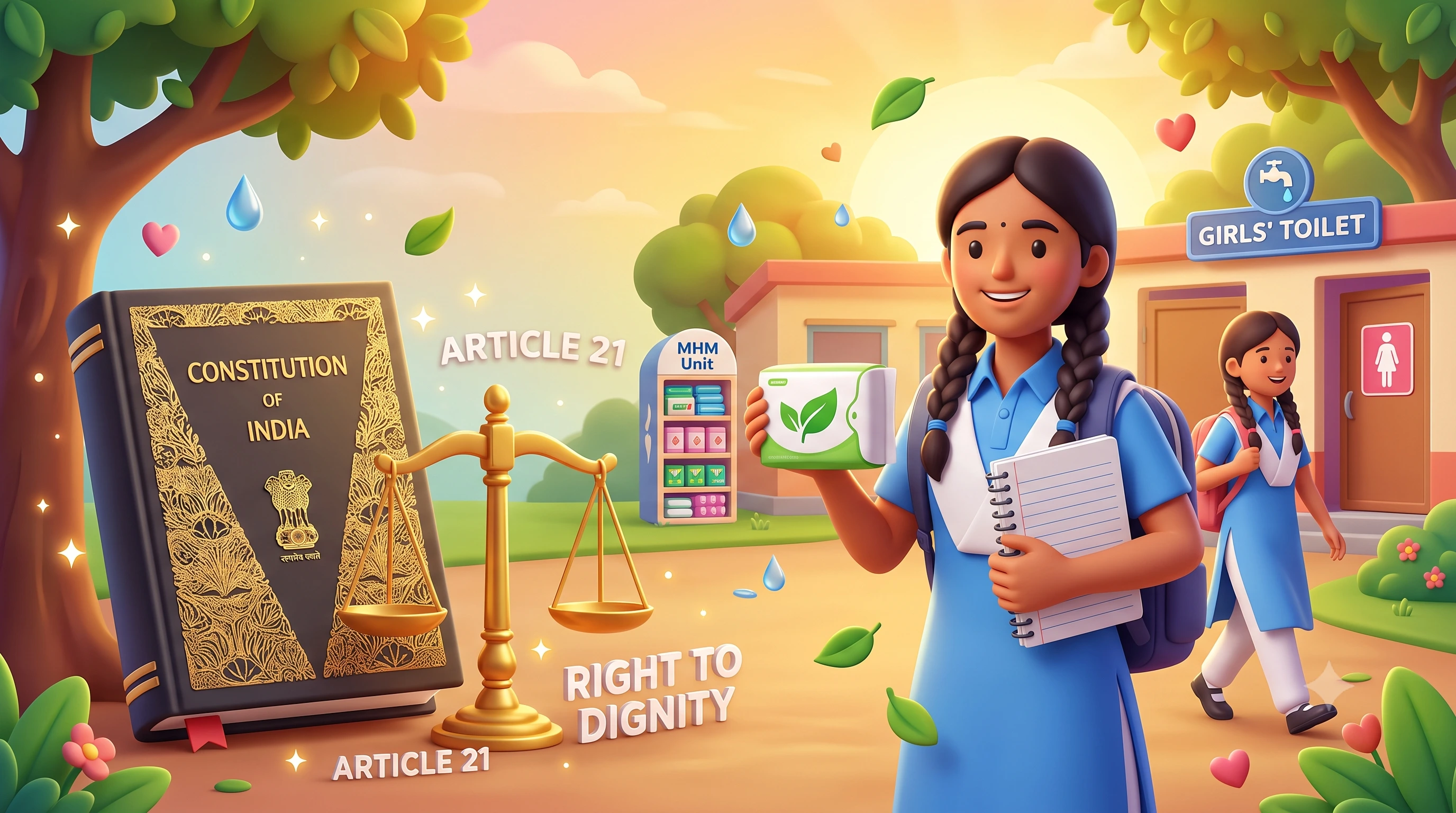
In a landmark ruling in Dr. Jaya Thakur vs. Union of India, the Supreme Court affirmed that access to menstrual health is an integral part of the fundamental right to life under Article 21. This article examines the constitutional framework, ongoing challenges like period poverty, and the legal responsibility of the State to ensure access to sanitary products and infrastructure.
Introduction
Context & Background
Key Points
- •Article 21 (Right to Life and Dignity): The judgment linked personal dignity to the availability of safe and private menstrual facilities, noting that deprivation leads to embarrassment, health risks, and school absenteeism.
- •Article 14 (Equality Before Law): The absence of Menstrual Hygiene Management (MHM) infrastructure was recognized as a gender-based impediment undermining fair educational competition.
- •Article 21A (Right to Education): The ruling underscored that menstrual poverty should not become a factor pushing students out of the formal education system.
- •Provision of Free Sanitary Products: All public and private schools are directed to distribute biodegradable sanitary napkins (meeting ASTM D-6954 standards) to girls in Classes 6–12.
- •Sanitation Infrastructure: Institutions must maintain operational, gender-segregated, and accessible toilets, with assured water supply and hygiene materials.
- •MHM Support Units & Compliance: Schools are to establish dedicated menstrual support corners with emergency supplies. District Education Officers are mandated to conduct periodic reviews; non-compliant private institutions risk losing recognition.
Dimensions of Menstrual Health
| Dimension | Description / Key Aspects | Bookmark |
|---|---|---|
| Overall Definition | A holistic state of physical, mental, and social well-being related to the menstrual cycle, going beyond menstruation to include managing periods safely, comfortably, and with dignity. | |
| Physical & Biological Well-being | Regular and predictable menstrual cycles; Access to safe, hygienic, and effective menstrual products and materials. | |
| Mental & Emotional Well-being | Freedom from stigma, shame, and emotional or psychological stress associated with menstruation. | |
| Social & Cultural Well-being | Ability to participate fully in education, work, sports, and social activities without discrimination; Protection from harmful cultural practices (e.g., isolation). | |
| Access to Information & Healthcare | Timely, accurate, age-appropriate education; Understanding links between the menstrual cycle and overall health (fertility, nutrition, bone health, iron levels). |
Related Entities
Impact & Significance
- •Continuity in Schooling: Addresses monthly absenteeism; reports from 2025 show rural girls often miss school days due to inadequate support, which the ruling seeks to mitigate.
- •Protection of Human Dignity: Affirms the right to privacy, reduces stigma, and empowers students to seek assistance without the fear of societal shame.
- •Public Health Outcomes: Access to hygienic products drastically lowers the risk of reproductive tract infections associated with unsafe menstrual practices.
- •Advancing Gender Parity: Removing menstruation-related barriers ensures that biological factors do not dictate long-term economic and social mobility.
- •Environmental Considerations: The legal mandate for biodegradable materials (ASTM D-6954 standards) aligns sanitation practices with sustainability and waste management goals.
Challenges & Criticism
- •Entrenched Stigma and Social Taboos: Menstruation is frequently treated as 'unclean,' resulting in restrictive customs like temporary isolation, diet limits, and exclusion from religious or social events.
- •Period Poverty: Many cannot afford sanitary pads regularly and rely on unsafe substitutes like old cloth, ash, or leaves, raising infection risks.
- •Insufficient Sanitation and Privacy: A widespread lack of clean, private, well-equipped toilets—with running water, secure doors, and disposal bins—in schools and workplaces.
- •Limited Healthcare Recognition: Conditions linked to menstruation, such as PCOS, endometriosis, and severe menstrual pain (dysmenorrhea), are often normalized or overlooked, delaying diagnosis.
Future Outlook
- •Educational Integration: Incorporate age-appropriate menstrual health education for all students through national and state curricula.
- •Technology-Enabled Facilities: Install vending machines and discreet disposal units within restrooms to enhance privacy.
- •Community Outreach: Engage frontline health and childcare workers to extend awareness programs to families and local communities.
- •Digital Oversight: Introduce real-time tracking platforms for inventory management and inspection reporting.
- •Local Manufacturing Support: Encourage women-led self-help groups (SHGs) to produce eco-friendly sanitary products, improving affordability and availability.
UPSC Relevance
- • GS-2 (Social Justice & Health): Issues relating to the development and management of Social Sector/Services relating to Health and Education.
- • GS-2 (Governance): Mechanisms, laws, institutions, and bodies constituted for the protection and betterment of vulnerable sections.
- • Essay Topics: 'Women Empowerment and Health', 'Constitutional Morality and Gender Justice'.
- • Mains Focus: Judicial activism in expanding Article 21, the societal impacts of period poverty, and systemic hurdles to women's education.
Sample Questions
Prelims
With reference to the initiatives for Menstrual Health in India, consider the following statements: 1. The 'Suvidha' oxo-biodegradable sanitary pads are provided at a subsidized rate under the Pradhan Mantri Bharatiya Janaushadhi Pariyojana. 2. The National MHM Guidelines were issued under the National Health Mission (NHM). Which of the statements given above is/are correct?
1. 1 only
2. 2 only
3. Both 1 and 2
4. Neither 1 nor 2
Answer: Option 1
Explanation: Statement 1 is correct. Statement 2 is incorrect; the National MHM Guidelines were issued under the Swachh Bharat Mission, not the National Health Mission.
Mains
“Access to menstrual hygiene is not merely a welfare measure but a fundamental constitutional right.” Discuss this statement in light of the Supreme Court's ruling in Dr. Jaya Thakur vs. Union of India. Highlight the key challenges in ensuring menstrual health in India.
Introduction: Introduce the Supreme Court's judgment in Dr. Jaya Thakur vs. Union of India, which elevated menstrual hygiene management to a fundamental right, moving the discourse from welfare charity to a rights-based approach.
Body:
• Constitutional Mandate: Link Article 21 (Dignity), Article 14 (Equality), and Article 21A (Right to Education). Explain how the SC framed MHM as a State's legal responsibility.
• Significance: Ensures continuity in schooling, advances gender parity, protects dignity, and mitigates public health risks.
• Challenges: Social taboos/stigma, period poverty and product affordability gaps, infrastructural deficits in schools (lack of toilets/disposal), and healthcare recognition gaps (PCOS/endometriosis).
Conclusion: Conclude by stating that recognizing MHM as a fundamental right is a progressive step, but realizing it requires a multi-pronged approach integrating education, infrastructure, and de-stigmatization via community participation.