
National Sports Governance (National Sports Bodies) Rules, 2026
The Central Government has notified the National Sports Governance (National Sports Bodies) Rules, 2026, under the National Sports Governance Act, 2025. This legislation aims to institutionalize transparency, ensure professional management, and foster an athlete-centric sports governance framework in India, combatting long-standing structural and procedural challenges.
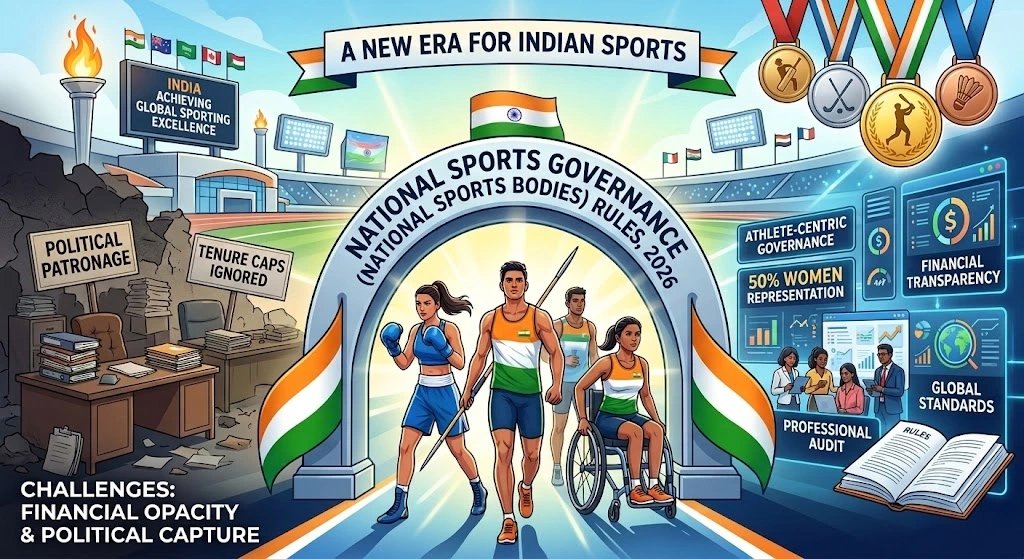
Introduction
Context & Background
Key Points
- •Constitutional Position: Sports regulation is technically a State Subject under Entry 33 of the State List in the Seventh Schedule, making unified national enforcement a complex task.
- •Democratic Deficit: Athlete representation in decision-making has historically been tokenistic. Women are vastly under-represented in leadership roles, and opaque selections foster mistrust.
- •International Interventions: Governance collapses and parallel factions have frequently led to international embarrassment, such as the suspensions of the AIFF (2022), WFI (2023), and AKFI (2024).
- •Financial & Electoral Opacity: Central grants, sponsor funds, and media rights often lack transparency. Combined with dubious electoral rolls and ignored tenure caps, many National Sports Federations (NSFs) operate like personal fiefdoms.
- •National Sports Policy Shift: The Cabinet has cleared the new NSP 2025, replacing the 2001 policy. It focuses on integrating sports with education, creating a people's movement, and achieving global sporting excellence.
Key Provisions of the National Sports Governance Framework
| Aspect | Details | Bookmark |
|---|---|---|
| Primary Objective | Ensure professional management, financial transparency, and athlete-centric governance in recognized sports bodies. | |
| Representation Requirements | Mandates the inclusion of at least four Sportspersons of Outstanding Merit (SOMs) in the General Body, with 50% reserved for women. | |
| Institutional Framework | Establishes the National Olympic Committee, National Paralympic Committee, and distinct National/Regional Sports Federations. | |
| Electoral Oversight | Outlines provisions for a National Sports Election Panel and sets procedures for the registration and updating of affiliate units. |
Major Challenges in India's Sports Governance
| Category | Issues Identified | Bookmark |
|---|---|---|
| Structural Problems | Political capture, age and tenure caps routinely flouted, parallel associations claiming legitimacy, and deep patronage networks. | |
| Process & Compliance | Electoral malpractices (sham elections, dubious rolls), financial opacity in central grants/sponsorships, and excessive litigation (350+ cases). | |
| Athlete-Centric Issues | Arbitrary selection trials, weak safeguarding against harassment, and structural neglect of disability sports. | |
| International Risks | Conflicts between IOC's demand for autonomy and domestic oversight, along with doping risks undermining global image. |
Related Entities
Impact & Significance
- •Empowering Athletes: Shifts the power dynamic from entrenched administrators directly to athletes by ensuring sportspersons and women have a mandatory say in governance.
- •Curbing Legal Gridlock: Establishes a clear, statutory framework for elections and dispute resolution, aiming to drastically reduce the massive backlog of litigation that stalls sports administration.
- •Global Alignment: Ensures that domestic federations comply with international standards, mitigating the risk of embarrassing global suspensions over autonomy and governance issues.
- •Inclusive Ecosystem: Mandates the mainstreaming of para-sports and the building of structured support systems, ensuring equal rewards, funding, and media coverage.
Challenges & Criticism
- •Deep-Rooted Patronage: Entrenched leadership networks and political capture make the transition to professional, merit-based management extremely difficult to enforce on the ground.
- •Autonomy vs. Oversight: Balancing the International Olympic Committee's (IOC) strict requirements for federation autonomy against the Indian government's push for transparency and accountability remains a tightrope walk.
- •Electoral Manipulation: Persistent historical issues with dubious electoral rolls and sham elections often undermine the credibility of sports bodies, testing the efficacy of the new Election Panel.
- •Safeguarding Gaps: Even with new rules, existing mechanisms against sexual harassment and retaliation remain weak without the establishment of truly independent 'safe sport' units.
Future Outlook
- •Athlete-Centric Governance: Ensuring athletes’ voices are genuinely heard in decision-making, backed by the mandatory inclusion of women and sportspersons of merit in all federations.
- •Grassroots to Elite Integration: Developing a seamless, data-driven pipeline from programs like Khelo India directly into SAI Training Centres, National Camps, and eventually International Games.
- •Professionalisation of Sports Bodies: Moving away from purely political leadership by hiring trained sports administrators, managers, and legal experts to run daily operations.
- •Technology & Sports Science: Creating a Central Sports Science Cloud to track injury logs, training loads, and recovery analytics to optimize athlete performance safely.
UPSC Relevance
- • GS-2 (Governance): Government policies and interventions for development in various sectors; transparency and accountability.
- • GS-2 (Statutory & Regulatory Bodies): The structure, organization, and functioning of bodies like the National Sports Board and sports federations.
- • Essay Topics: 'The intersection of politics and sports in India', 'Building a culture of sporting excellence'.
- • Mains Focus: Analyzing the structural flaws in Indian sports administration and evaluating the impact of the 2025 Act.
Sample Questions
Prelims
Consider the following statements regarding Sports Governance in India:
1. Sports regulation is a Union subject under the Seventh Schedule of the Constitution.
2. The National Sports Governance Rules, 2026 mandate the inclusion of at least four sportspersons of outstanding merit in the General Bodies.
3. The National Sports Policy 2025 was recently cleared to replace the original 1984 policy.
Answer: Option 2
Explanation: Statement 1 is incorrect; Sports is a State subject under Entry 33 of the State List. Statement 2 is correct; the 2026 rules mandate at least 4 SOMs (with 50% women). Statement 3 is incorrect; the NSP 2025 replaces the 2001 policy.
Mains
Highlighting the structural and procedural challenges in India's sports governance, evaluate how the National Sports Governance Act, 2025 aims to foster an 'athlete-centric' ecosystem.
Introduction: Define the context of the National Sports Governance Act, 2025, and its primary objective to professionalize sports bodies and ensure financial transparency.
Body:
• Structural and Procedural Challenges: Discuss the political capture of NSFs, democratic deficit with token athlete representation, electoral malpractices, and massive financial opacity.
• Athlete-Centric Issues: Elaborate on arbitrary selection trials, weak safeguarding against sexual harassment, and the structural neglect of disability sports.
• Provisions and Interventions: Detail the mandatory inclusion of Sportspersons of Outstanding Merit (SOMs), 50% women SOM representation, independent audits, and compliance with international standards under the 2025 Act.
Conclusion: Conclude that transitioning from political fiefdoms to professional, transparent federations is an indispensable step to realize India's potential as a global sporting powerhouse.