
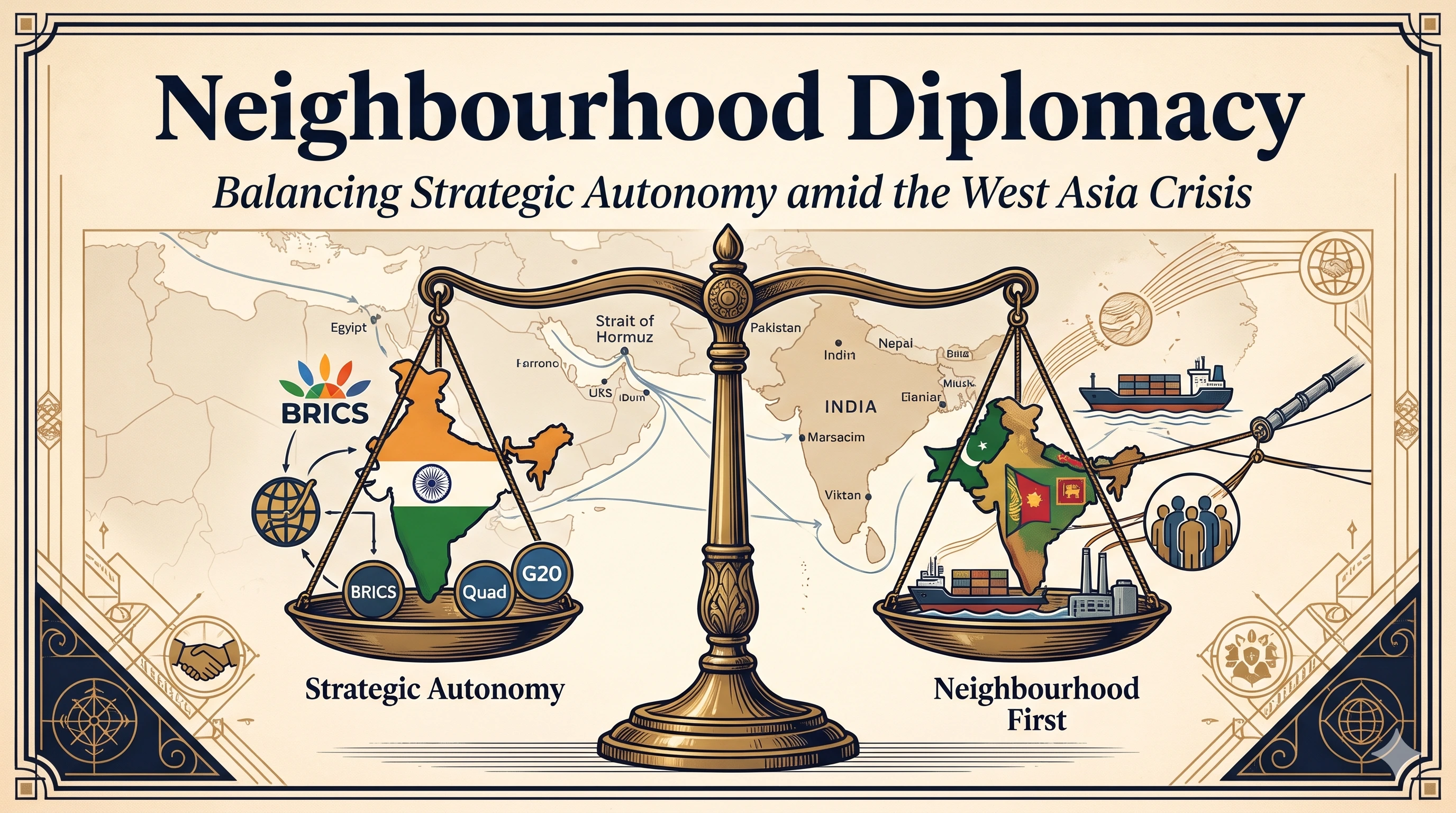
Neighbourhood Diplomacy: Balancing Strategic Autonomy amid the West Asia Crisis
The ongoing conflict in West Asia poses severe challenges to India's strategic autonomy and its Neighbourhood First diplomacy. This analysis examines the diplomatic friction arising from perceived policy shifts, the imperative of securing regional energy and maritime supply lines for South Asia, and the roadmap for restoring India's traditional multi-alignment posture.
Introduction
Context & Background
Key Points
- •Perception of Strategic Tilt: India's initial response appeared closer to the US–Israel position, drawing scrutiny because it refrained from explicitly criticising their actions while condemning Iran's retaliation.
- •Diplomatic Delay and Optics: A delay in expressing condolences following Iran's leadership loss created concerns regarding India's responsiveness to regional sentiments, particularly as neighbouring countries reacted swiftly.
- •Departure from Traditional Balancing: India has historically maintained equitable, robust relations across West Asian rivals; the current crisis highlights the friction of maintaining that delicate equilibrium.
- •Neighbourhood Divergence: Partners such as Bangladesh, Sri Lanka, and the Maldives adopted strictly balanced positions, underscoring diplomatic divergence within South Asia.
- •Net Security Provider Responsibility: As regional tensions escalate into the Indian Ocean and Persian Gulf, India's role extends beyond domestic interests to shielding neighbouring economies from energy crunches, trade disruptions, and diaspora emergencies.
Impact on Regional Security and Neighbourhood Stability
| Dimension | Regional Vulnerability | India's Strategic Role | Bookmark |
|---|---|---|---|
| Energy Security | Disruptions in the Strait of Hormuz directly threaten fuel supplies to smaller South Asian nations. | Acting as an energy anchor through fuel assistance, credit lines, and emergency reserves. | |
| Diaspora Welfare | Millions of South Asian expatriates (Indian, Nepalese, Bangladeshi, Sri Lankan) face conflict risks. | Coordinating regional evacuation, consular support, and joint humanitarian response operations. | |
| Maritime & Trade Routes | Rising tensions in the Persian Gulf and Indian Ocean choke critical sea lanes of communication (SLOCs). | Operating as a net security provider by patrolling sea lanes and securing trade transit. | |
| Supply Chain Resilience | Severe spikes in shipping freight, food inflation, and fertilizer supply crunches across South Asia. | Facilitating essential commodity exports and maintaining buffer stocks for neighbouring partners. |
Strategic Stance Comparison: India vs. South Asian Neighbours
| Actor / Grouping | Observed Diplomatic Posture | Strategic Implications | Bookmark |
|---|---|---|---|
| India (Initial Response) | Condemned retaliatory strikes swiftly; delayed condolences and muted criticism of US–Israel actions. | Created optics of a strategic tilt, sparking scrutiny regarding strategic autonomy and Global South leadership. | |
| Neighbourhood (Bangladesh, Sri Lanka, Maldives) | Maintained strict neutrality, balanced statements, and rapid outreach across all conflict parties. | Highlighted a clear divergence between India's early posture and broader South Asian sensitivities. |
Related Entities
Impact & Significance
- •Energy Vulnerability: Prolonged supply crunches or logistical bottlenecks in the Persian Gulf raise import bills and inflation rates across South Asian states lacking substantial strategic petroleum reserves.
- •Diaspora Welfare: Hostilities put over 8 million South Asian workers across the Gulf at risk, requiring extensive diplomatic coordination and emergency evacuation planning.
- •Maritime Trade Disruptions: Escalated shipping risks and rising war-risk insurance premiums directly hurt the competitiveness of South Asian exports.
- •Economic Interdependence: Smaller regional partners face macroeconomic volatility, increasing their reliance on Indian credit lines, currency swap arrangements, and food security buffers.
Challenges & Criticism
- •Optics of Alignment: Shifting positions risk being construed as abandoning traditional strategic neutrality, complicating relationships with key partners like Iran.
- •Sub-Regional Fragmentation: Divergent foreign policy stances within SAARC/BIMSTEC members can weaken collective diplomatic leverage during global crises.
- •Economic Burden of Anchor Role: Underwriting fuel, grain, and financial stabilization packages for multiple neighbours places a notable fiscal demand on India's resources.
- •Balancing Great-Power Rivalries: Managing ties across the US, Russia, China, and regional West Asian rivals demands exceptional diplomatic dexterity without compromising strategic autonomy.
Future Outlook
- •Reaffirming Strategic Neutrality: Re-engage all regional actors equitably without taking rigid partisan stances, re-establishing India's reputation as an honest, dependable partner.
- •Reviving Multi-Alignment: Calibrate diplomatic ties simultaneously across Tehran, Tel Aviv, Riyadh, Abu Dhabi, and Washington to preserve room for strategic maneuver.
- •Humanitarian and Consular Coordination: Institute a institutionalised South Asian evacuation and disaster response mechanism to protect regional migrant labor across the Gulf.
- •Diversification of Supply Corridors: Accelerate investments in alternative trade routes, renewable energy transitions, and expanded strategic petroleum reserves to blunt future regional shocks.
- •Consolidating Regional Frameworks: Leverage platforms like BIMSTEC, IORA, and the Colombo Security Conclave to enhance collective maritime safety, anti-piracy operations, and critical supply resilience.
UPSC Relevance
- • GS-2 (International Relations): India and its neighbourhood relations, effect of policies of developed and developing countries on India's interests, and Indian diaspora.
- • GS-3 (Security & Economy): Security challenges and their management in border/maritime areas, energy security, and supply chain vulnerabilities.
- • Mains Focus: Analyzing India's strategic autonomy during great power and regional conflicts, and its role as a net security provider in South Asia.
Sample Questions
Prelims
Regarding India's foreign policy and maritime security architecture in the Indian Ocean and West Asian region, consider the following statements: 1. The Colombo Security Conclave serves as a regional maritime security platform involving South Asian and Indian Ocean nations. 2. The Strait of Hormuz connects the Persian Gulf directly with the Arabian Sea without passing through the Gulf of Oman. 3. Under its 'Neighbourhood First' policy, India extends lines of credit and fuel support to stabilize neighbouring economies during external supply shocks. Which of the statements given above are correct?
- (a)1 and 2 only
- (b)1 and 3 only
- (c)2 and 3 only
- (d)1, 2, and 3
Mains
“Geopolitical volatility in West Asia severely tests India’s capacity to maintain strategic autonomy while fulfilling its commitments under the Neighbourhood First policy.” Critically examine the economic, maritime, and diplomatic implications of this dynamic for South Asia.
Introduction: Contextualize the West Asia conflict and highlight India's dual imperative: preserving strategic neutrality among Gulf powers while safeguarding vital energy, trade, and diaspora interests across South Asia.
Body:
• Diplomatic & Autonomy Challenges: Divergence with South Asian partners; optics of leaning toward the US-Israel axis; risk of diminishing leadership standing in the Global South.
• Regional Security & Economic Impacts: Vulnerability of shared diaspora; disruptions at the Strait of Hormuz causing balance of payments and energy crises for neighbours like Sri Lanka and Bangladesh.
• Measures / Way Forward: Stepping up as an economic and energy anchor; coordinating joint evacuation frameworks; reinforcing multi-alignment via multilateral platforms (IORA, BRICS).
Conclusion: Emphasize that balancing principled neutrality with regional leadership reinforces India's credentials as a responsible net security provider and an autonomous global actor.