
Nepal’s Political Transition and Strategic Implications
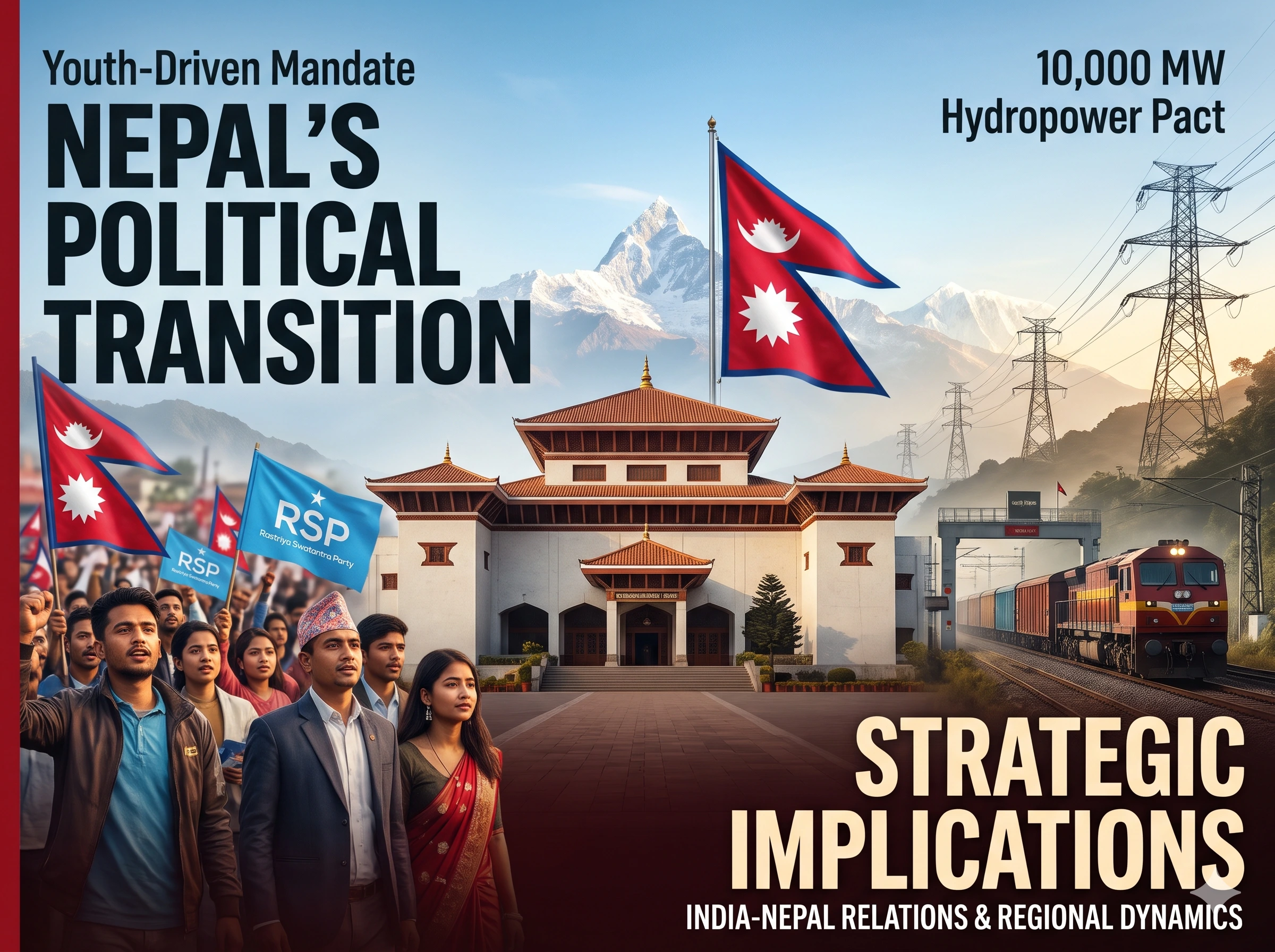
Following the decisive victory of Balendra Shah and the Rastriya Swatantra Party (RSP) in Nepal's 2026 parliamentary elections, traditional political dynamics have shifted significantly. This article analyzes the youth-driven political transition, the domestic and governance hurdles facing the new administration, and the strategic opportunities and challenges for India-Nepal bilateral relations.
Introduction
Context & Background
Key Points
- •The Rise of New Political Leadership: Balendra Shah (Balen), former Mayor of Kathmandu and an independent reformist figure, led the Rastriya Swatantra Party (RSP) to a decisive victory, positioning himself as the face of anti-establishment politics and administrative reform.
- •Collapse of Traditional Elites: Decades-long dominant parties like the Nepali Congress, CPN-UML, and the Maoist factions suffered heavy electoral setbacks as voters decisively rejected chronic political instability, systemic corruption, and dynastic politics.
- •Youth-Driven Mandate: With Nepal's median age around 25 years, the election reflected aggressive Gen-Z mobilization seeking transparent governance, domestic employment, and an end to patronage networks.
- •Shift Away from Rigid Ideology: The conventional foreign policy divide—Nepali Congress leaning toward New Delhi and communist factions tilting toward Beijing—is yielding to a more pragmatic, issue-based, and nationalist posture.
- •Severe Economic & Migration Headwinds: Around 14% of Nepal's population (~3.5 million citizens) works abroad. Heavy structural dependence on remittances, vulnerability to West Asian conflicts, and a lack of local job creation remain pressing domestic challenges.
- •Diplomatic Inexperience & Strategic Balancing: The incoming leadership faces the challenge of managing complex diplomacy between India (its largest trade and transit partner) and China (major infrastructure investor), without deep prior diplomatic experience.
Key Dimensions of India–Nepal Strategic Partnership
| Cooperation Pillar | Strategic Potential & Significance | Challenges / Limitations | Bookmark |
|---|---|---|---|
| Trade & Transit Dependency | India is Nepal’s largest trade partner; vital transit route for a landlocked nation through Indian ports. | Historical friction over transit disruptions (e.g., the 2015 blockade perception). | |
| Energy & Hydropower Cooperation | Nepal’s surplus hydropower exports linked to India-led grids; agreement to import 10,000 MW over 10 years. | Geopolitical sensitivities around power plants funded or constructed by Chinese entities. | |
| Regional & Border Security | Open border facilitating deep 'Roti-Beti' socio-cultural ties and sub-regional frameworks like BBIN. | Territorial frictions (Kalapani–Lipulekh dispute) and open-border migration management. | |
| Strategic Infrastructure | Connectivity partnerships in road, rail, and energy transmission corridors. | Underutilization of Chinese-financed projects (e.g., Pokhara International Airport) and air-route permissions. |
Major Milestones in Contemporary Nepal Politics and Bilateral Relations
| Event / Framework | Year / Timeline | Nature | Key Takeaway / Impact | Bookmark |
|---|---|---|---|---|
| Balendra Shah & RSP Victory | 2026 | National Elections | Rejection of traditional elites, focus on clean governance and technocratic delivery. | |
| 10-Year Hydropower Pact | 2024 | Bilateral Agreement | India committed to importing 10,000 MW of power from Nepal over a decade. | |
| Constitution & Border Blockade | 2015 | Diplomatic Strain | Strained ties over constitutional provisions, leading to transit disruptions and trust deficits. | |
| India-Nepal Treaty of Peace & Friendship | 1950 | Foundational Framework | Establishes open borders, national treatment to citizens, and close security ties. |
Related Entities
Impact & Significance
- •Regional Geopolitics: Signals a potential departure from historical zero-sum balances between New Delhi and Beijing in favor of a strictly delivery-driven foreign policy.
- •Economic Interdependence: Deepens the imperative for cross-border power transmission, industrial collaboration, and expedited transport connectivity through Indian ports.
- •Border & Cultural Links: Reinforces the unique nature of the open border and 'Roti-Beti' familial relationships while requiring updated administrative mechanisms for security.
- •Sub-Regional Connectivity: Accelerates potential integration within eastern South Asia via BBIN road, rail, and electricity trading networks.
Challenges & Criticism
- •Unrealistic Delivery Timelines: The incoming government faces immense domestic pressure to produce immediate economic and administrative results against deep institutional inertia.
- •Diplomatic Sensitivities: Navigating complex boundary disputes and sovereignty sensitivities without derailing broader commercial and security cooperation.
- •Chinese Debt & Infrastructure Assets: Resolving the viability of major infrastructure assets such as Pokhara International Airport without inflaming bilateral tensions with regional powers.
- •External Economic Shocks: Managing remittance vulnerabilities and energy supplies arising from geopolitical disruptions in West Asia, where millions of Nepali citizens are employed.
Future Outlook
- •Proactive Diplomatic Outreach: New Delhi should extend an early high-level invitation to Balendra Shah to engage with the emerging leadership, understand its policy orientation, and signal respect for the mandate.
- •Expanding the Energy Corridor: Rapidly operationalize cross-border transmission networks to fulfill the bilateral target of exporting 10,000 MW of hydroelectric power to India, cementing economic interdependence.
- •Sub-Regional Economic Integration: Leverage frameworks like the BBIN (Bangladesh-Bhutan-India-Nepal) initiative for seamless multimodal logistics, transit facilitation, and joint infrastructure financing.
- •Non-Intrusive Partnership Model: Move deliberately past past grievances—including the 2015 blockade perceptions—by adopting an equal-partnership approach rooted in mutual development, cultural links, and economic diplomacy.
- •Technical Support & Connectivity Access: Address long-standing transit issues, grant reciprocal overflight clearances where feasible, and aid Nepal in mitigating global external shocks like fuel and fertilizer disruptions.
UPSC Relevance
- • GS-2 (International Relations): India and its neighbourhood relations, bilateral agreements, and the strategic influence of external powers like China in South Asia.
- • GS-2 (Indian Foreign Policy): Operational dynamics of India's 'Neighbourhood First' policy and sub-regional cooperation frameworks (BBIN).
- • GS-3 (Border Management & Security): Challenges of managing open international borders, internal security implications, and cross-border movement.
- • Mains Focus: Analyzing how political transitions in buffer states influence India's security and economic architecture, and suggesting ways to move from traditional diplomacy to economic statecraft.
Sample Questions
Prelims
With reference to India–Nepal bilateral cooperation, consider the following statements:
- (a)India has entered into a long-term framework agreement to import 10,000 MW of power from Nepal over 10 years.
- (b)The 1950 Treaty of Peace and Friendship between India and Nepal strictly mandates a closed border regime requiring standard visas for citizens of both nations.
- (c)The BBIN connectivity framework includes India, Nepal, Myanmar, and Bhutan.
Mains
“Political transitions in Nepal often redefine its strategic balancing between India and China.” In light of the rise of new political forces in Nepal, analyze the emerging challenges and opportunities for India–Nepal bilateral relations.
Introduction: Introduce Nepal's 2026 electoral transition, highlighting the mandate for administrative reform and its critical geographic significance as a Himalayan buffer state between India and China.
Body:
• Context of the Political Shift: Highlight the decline of traditional ideological parties and the rise of a youth-backed, technocratic, and nationalist leadership prioritizing economic outcomes over past alignments.
• Strategic Challenges for India: Managing diplomatic inexperience of the new dispensation; unresolved boundary issues (Kalapani–Lipulekh); navigating Chinese infrastructure engagements; ensuring open border security.
• Opportunities for a Reset: Scaling hydropower trade (10,000 MW pact); sub-regional integration via BBIN; revitalizing people-to-people ('Roti-Beti') ties; providing non-intrusive transit, logistics, and economic support.
Conclusion: Conclude that India must operationalize a forward-looking 'Neighbourhood First' posture that prioritizes mutual economic interdependence, energy diplomacy, and structural respect for Nepal's sovereign aspirations.