
NITI Aayog Initiative on MSME Scheme Convergence
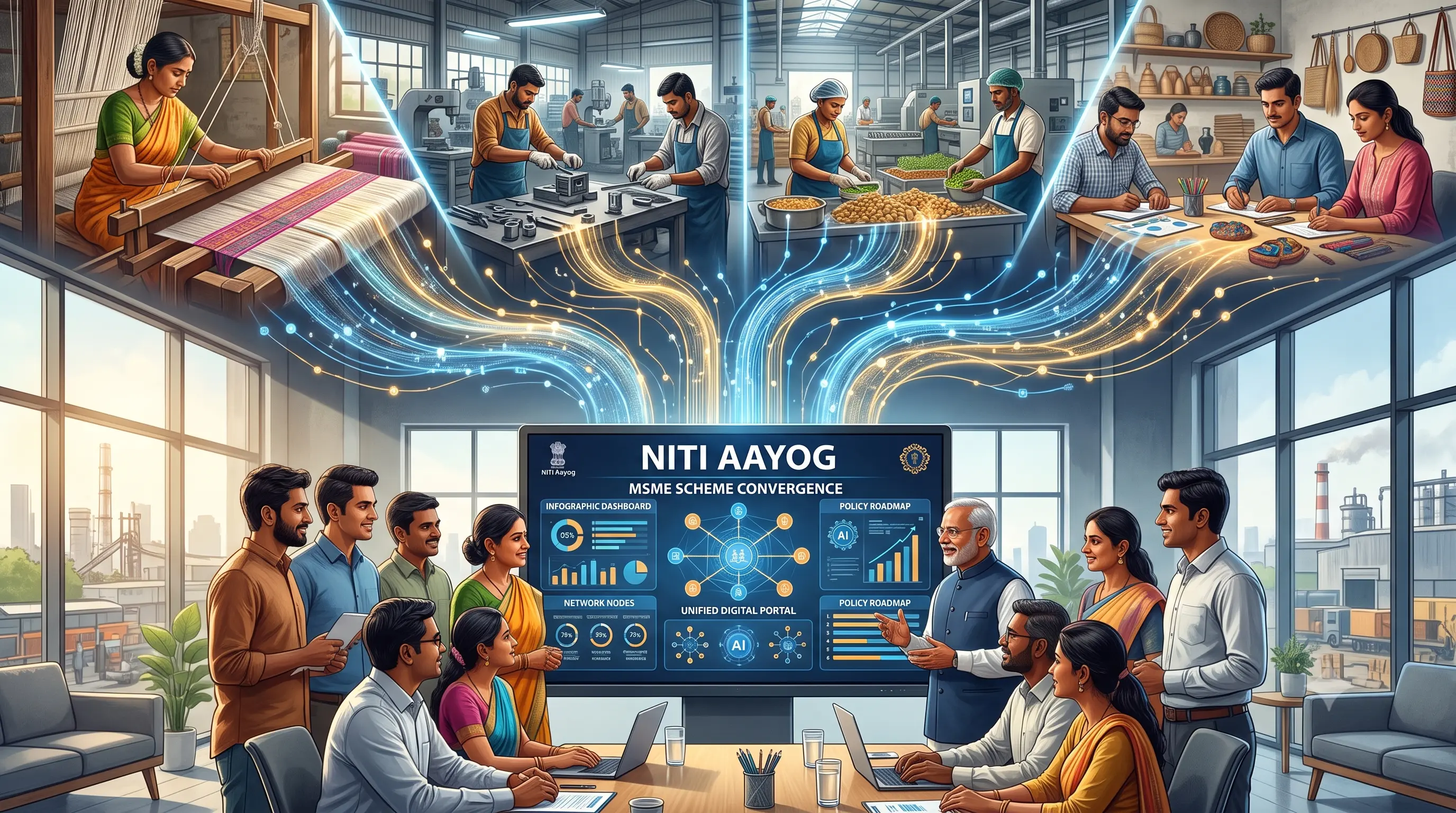
NITI Aayog has released a roadmap for converging MSME schemes to reduce duplication, improve outreach, and strengthen the delivery of credit, innovation, and infrastructure support to India's vast MSME sector.
Introduction
Context & Background
Key Points
- •Information Convergence: Integrating government-generated MSME data across the Centre and States to significantly improve governance, targeting, and monitoring.
- •Process Convergence: Aligning scheme design and implementation to merge overlaps, unify common components, and actively reduce redundancies across ministries.
- •Safeguards for Vulnerable Groups: Preserving highly targeted, dedicated programs like the National SC/ST Hub and the Promotion of MSMEs in the North Eastern Region (NER).
- •Independence of Flagship Schemes: Keeping large-scale flagship schemes like the Prime Minister’s Employment Generation Programme (PMEGP) and PM Vishwakarma independent due to their massive size and strategic role.
Status of MSME in India
| Parameter | Data / Contribution | Macro Significance | Bookmark |
|---|---|---|---|
| Gross Value Added (GVA) | ~30% of India's GVA | Macro Importance | |
| Exports (FY 2023–24) | 45.7% of total exports | Export Backbone | |
| Employment | 11 crore+ people | Largest non-farm job creator | |
| Enterprise Base | 6.3 crore MSMEs | Massive base of small production |
Related Entities
Impact & Significance
- •Economic Multiplier: By streamlining credit and infrastructure support, the initiative directly boosts a sector that contributes 30% to the national GVA.
- •Protecting Livelihoods: Making government schemes more accessible will safeguard and expand the 11 crore+ jobs currently sustained by MSMEs.
- •Export Competitiveness: Consolidating marketing assistance and linking it to global buyers will help scale the 45.7% export contribution of MSME products.
Challenges & Criticism
- •Scheme Fragmentation: The existence of 18 separate schemes creates major overlaps across ministries, resulting in duplicated benefits and diluted impact.
- •Low Awareness Reach: Even with substantial public spending, multiple schemes with completely different entry points reduce discoverability, causing eligible MSMEs to miss out.
- •High Compliance Load: Separate documentation, verification, and reporting requirements for similar benefits severely raise transaction costs and create time-loss for small firms.
- •Data Silos: A lack of shared beneficiary databases across Centre and States means scheme monitoring is fragmented, leading to weak outcome tracking and mis-targeting in delivery.
Future Outlook
- •Centralised AI Portal: Building a unified, AI-enabled digital window integrating all schemes, featuring AI chatbots, dashboards, and mobile access to provide real-time guidance to entrepreneurs.
- •Cluster Scheme Integration: Merging SFURTI (Scheme of Fund for Regeneration of Traditional Industries) with the MSE-CDP (Micro and Small Enterprises–Cluster Development Programme) to achieve scale efficiency, and creating a dedicated traditional industries sub-window.
- •Skill Programme Rationalisation: Restructuring skill development into a three-tier model: (i) entrepreneurship/business skills, (ii) MSME technical skills, and (iii) rural/women artisan training, effectively removing overlaps.
- •Marketing & Innovation Focus: Setting up structured domestic exhibitions and global buyer connections, alongside integrating the ASPIRE scheme into 'MSME Innovative' as a special agro-rural category with ring-fenced budgets.
UPSC Relevance
- • GS-3 (Indian Economy): Growth and development, employment, industrial policy, and effects of liberalization on the economy.
- • GS-2 (Governance): Government policies and interventions for development in various sectors and issues arising out of their design and implementation.
- • Mains Focus: Analyzing the structural bottlenecks in the MSME sector and evaluating NITI Aayog's solutions for governance efficiency.
Sample Questions
Prelims
With reference to the MSME sector in India and NITI Aayog's scheme convergence roadmap, consider the following statements:
1. MSMEs contribute to more than 50% of India's Gross Value Added (GVA).
2. Under the new roadmap, flagship schemes like PMEGP are to be merged into a single overarching MSME umbrella scheme.
3. The roadmap suggests integrating ASPIRE into the MSME Innovative scheme as a special agro-rural category.
Answer: Option 3
Explanation: Statement 1 is incorrect; MSMEs contribute approximately 30% of India's GVA. Statement 2 is incorrect; NITI Aayog recommends keeping large-scale flagships like PMEGP and PM Vishwakarma independent due to their strategic role. Statement 3 is correct.
Mains
Despite contributing significantly to employment and exports, India's MSME sector suffers from scheme fragmentation and high compliance burdens. Discuss the framework proposed by NITI Aayog for MSME scheme convergence and its potential impact.
Introduction: Introduce the macroeconomic significance of MSMEs (30% GVA, 45.7% exports, 11 crore+ jobs) and the context of NITI Aayog's newly released roadmap.
Body:
• Current Challenges: Highlight scheme fragmentation (18 schemes under MSME Ministry alone), low awareness, massive compliance load, and data silos leading to leakages.
• NITI Aayog's Convergence Framework: Explain the dual approach of 'Information Convergence' (shared databases) and 'Process Convergence' (merging overlaps).
• Key Recommendations: Detail the Centralised AI Portal, Cluster Scheme Integration (merging SFURTI with MSE-CDP), Skill Rationalisation (three-tier model), and keeping strategic flagships (PMEGP) standalone.
Conclusion: Conclude that rationalizing government support will lower transaction costs, improve ease of doing business, and ultimately unlock the true growth potential of the 6.3 crore MSMEs driving India's economy.