
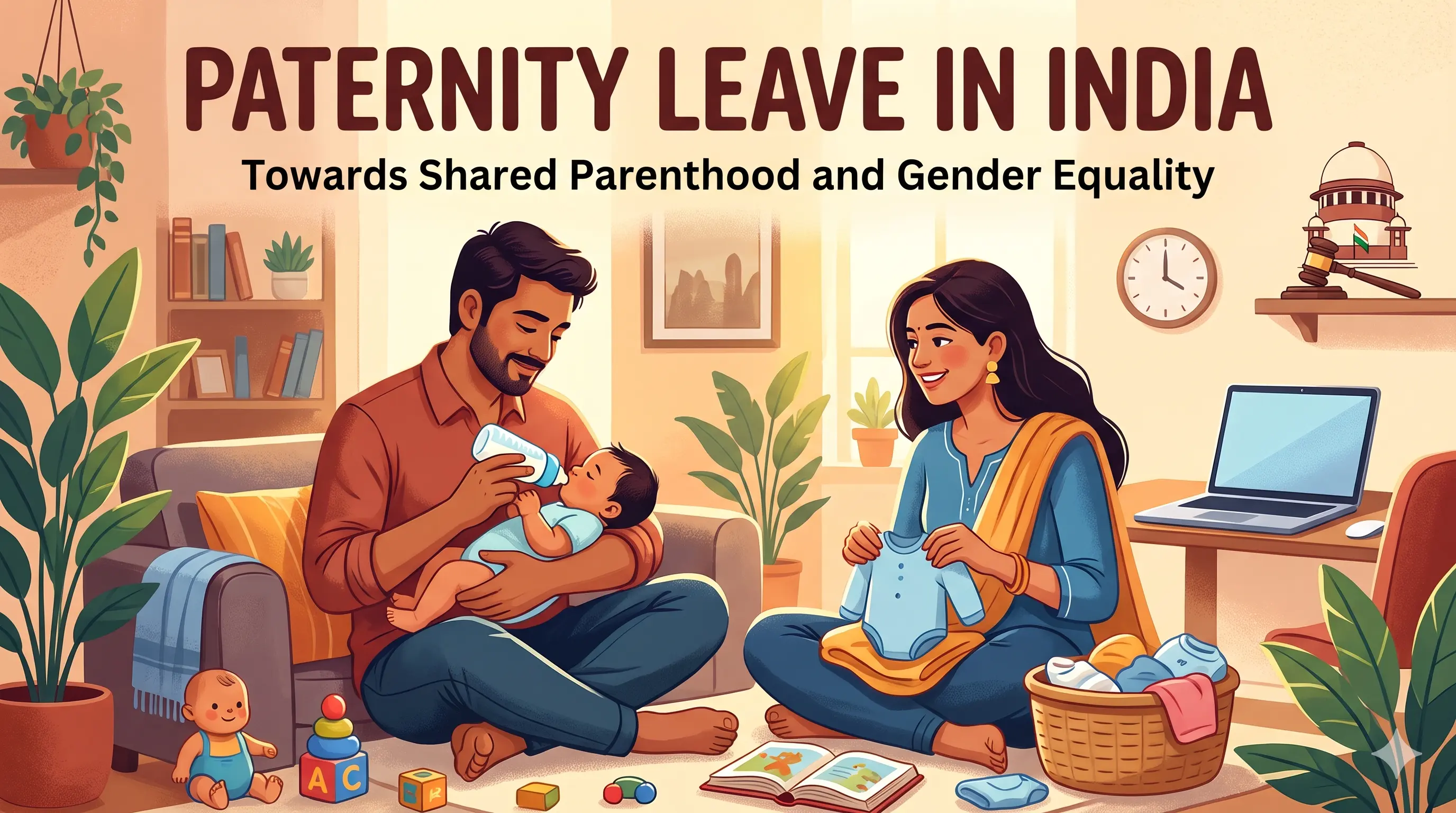
Paternity Leave in India: Towards Shared Parenthood and Gender Equality
The Supreme Court recently removed the age restriction on maternity leave for adoptive mothers, upholding reproductive autonomy. Alongside this, the Court emphasized the urgent need for formal paternity leave laws in India to dismantle gender stereotypes, promote shared caregiving, and ensure workplace equality.
Introduction
Context & Background
Key Points
- •Removal of Age-Based Restriction: The Supreme Court read down Section 60(4) of the Code on Social Security, 2020, granting adoptive mothers 12 weeks of leave regardless of the child's age, upholding Articles 14 (equality) and 21 (personal liberty).
- •Motherhood Beyond Biology: The Court established that maternity benefits arise from the role of caregiving, not merely childbirth, acknowledging adoption as a key aspect of reproductive choice and personal autonomy.
- •Maternity Leave as a Basic Right: The judgment described maternity protection as a fundamental human entitlement, essential for financial security and workplace inclusion without the fear of job loss.
- •The Call for Paternity Leave: Highlighting the importance of both parents in early childcare, the Court stressed that the absence of paternity leave reinforces gender stereotypes and urged the government to introduce it within the social security system.
Current Legal & Policy Landscape for Parental Leave
| Provision / Law | Details | Current Status / Limitation | Bookmark |
|---|---|---|---|
| Code on Social Security, 2020 | Maternity leave for adoptive mothers. | Age restriction (child under 3 months) struck down by SC as unconstitutional. | |
| Central Civil Services (Leave) Rules | Grants 15 days of paternity leave. | Applicable only to male government employees; excludes the private sector. | |
| Maternity Benefit (Amendment) Act, 2017 | 26 weeks leave for biological mothers; mandates crèche facilities. | Can lead to hiring bias against women; poor compliance with crèche mandates. | |
| Paternity and Parental Benefit Bill, 2025 | Proposes extending paternity leave to 8 weeks. | Pending Private Member's Bill; yet to become a formal law. |
Global vs. Indian Context on Paternity Leave
| Country / Region | Policy Feature | Impact / Observation | Bookmark |
|---|---|---|---|
| Sweden | "Use-it-or-lose-it" paternity leave model. | Encourages fathers' participation and significantly reduces workplace bias. | |
| Norway and Iceland | Dedicated, state-backed paternity leave. | Leads to higher gender equality indices and shared domestic roles. | |
| India (Formal Private Sector) | No statutory mandate for paternity leave. | Reinforces the patriarchal norm that caregiving is exclusively a woman's burden. |
Related Entities
Impact & Significance
- •Enhances Female Labour Force Participation: When fathers share early childcare duties, women can return to work sooner, reducing career breaks and dropouts.
- •Gender Equality at the Workplace: Shared childcare ensures women aren't viewed as a 'liability' or 'costlier' workforce, reducing employer bias in hiring and promotions.
- •Challenges Patriarchal Norms: Paternity leave normalizes the idea that domestic and caregiving roles are a joint responsibility, not exclusively a woman's job.
- •Maternal Health Improvement: Active support from fathers significantly reduces the physical and emotional stress on mothers during the postnatal recovery period.
- •Addresses Hidden Inequality: It helps redistribute the invisible burden of unpaid care work, which heavily skews against women even in dual-income Indian households.
Challenges & Criticism
- •Absence of Private Sector Laws: Without a statutory mandate for private companies, the vast majority of Indian fathers cannot take time off for caregiving without losing pay.
- •Barriers in Adoption: The adoption process under CARA is fraught with documentation delays and complex legal steps, postponing early childcare support for adoptive parents.
- •Unintended Hiring Bias: Highly progressive maternity benefits (like 26 weeks of leave) without matching paternity benefits sometimes cause private employers to quietly avoid hiring women of childbearing age.
- •Discriminatory Frameworks: Until the recent SC ruling, laws treated adoptive mothers differently based on the adopted child's age, showcasing inconsistencies in policy.
- •Lack of Supportive Infrastructure: Poor compliance with workplace crèche mandates and limited flexible working options severely hinder women attempting to balance careers with childcare.
Future Outlook
- •Gender-Neutral Parental Leave: India needs to introduce statutory paternity leave across all sectors and gradually transition towards a shared parental leave system.
- •Legal Harmonisation: Provisions across the Maternity Benefit Act, the Code on Social Security, and the Juvenile Justice Act must be aligned to remove policy inconsistencies.
- •Strengthening Adoption Processes: Administrative procedures must be simplified to reduce the severe delays in declaring children legally free for adoption.
- •Supporting Employers: To prevent hiring biases against women, the government could provide fiscal incentives or subsidies to offset maternity/paternity-related costs for businesses.
- •Focus on the Informal Sector: Social security networks must be expanded to ensure that parental benefits are accessible and portable for workers outside the formal economy.
UPSC Relevance
- • GS-1 (Society): Role of women, women's organizations, social empowerment, and the impact of patriarchy on the division of labor.
- • GS-2 (Social Justice): Welfare schemes for vulnerable sections, issues relating to development and management of Social Sector/Services.
- • Essay Topics: 'The invisible burden of unpaid care work', 'True gender equality begins at home: The case for shared parenthood'.
- • Mains Focus: Analyzing the judicial push for paternity leave and the unintended consequences of the Maternity Benefit Act (e.g., hiring biases).
Sample Questions
Prelims
Consider the following statements regarding parental benefits and laws in India: 1. The Central Civil Services (Leave) Rules grant 15 days of paternity leave to male government employees. 2. The Maternity Benefit Act mandates compulsory paternity leave of 15 days for private-sector employees. 3. The Supreme Court recently upheld the Code on Social Security provision that restricts maternity leave to only those who adopt a child below three months of age.
- (a)1 only
- (b)1 and 2 only
- (c)2 and 3 only
- (d)1, 2 and 3
Mains
“The absence of a statutory paternity leave framework in India reinforces patriarchal stereotypes and hinders women's workforce participation.” Analyze this statement in the context of recent judicial observations.
Introduction: Cite the Supreme Court's judgment in Hamsaanandini Nanduri v. Union of India, which not only expanded adoptive mothers' rights but also urged the State to legislate paternity leave to foster shared caregiving.
Body:
• How Absence Hinders Equality: Reinforces the 'Wollstonecraft Dilemma'; disproportionate burden of unpaid care work on women; employers viewing women as a 'costlier' workforce, leading to hiring bias and career breaks.
• Benefits of Paternity Leave: Challenges patriarchal norms; improves maternal physical and mental health during postnatal recovery; enhances Female Labour Force Participation Rate (FLFPR) by allowing mothers to rejoin work earlier.
• Current Challenges: No mandate for the private sector; only 15 days for government employees; informal sector entirely excluded.
Conclusion: Conclude that moving from 'maternity leave' to 'shared parental leave'—supported by state subsidies for employers—is essential to align India with global best practices and achieve true gender parity.