
Prioritising Natural Gas Supplies Amid West Asia Crisis
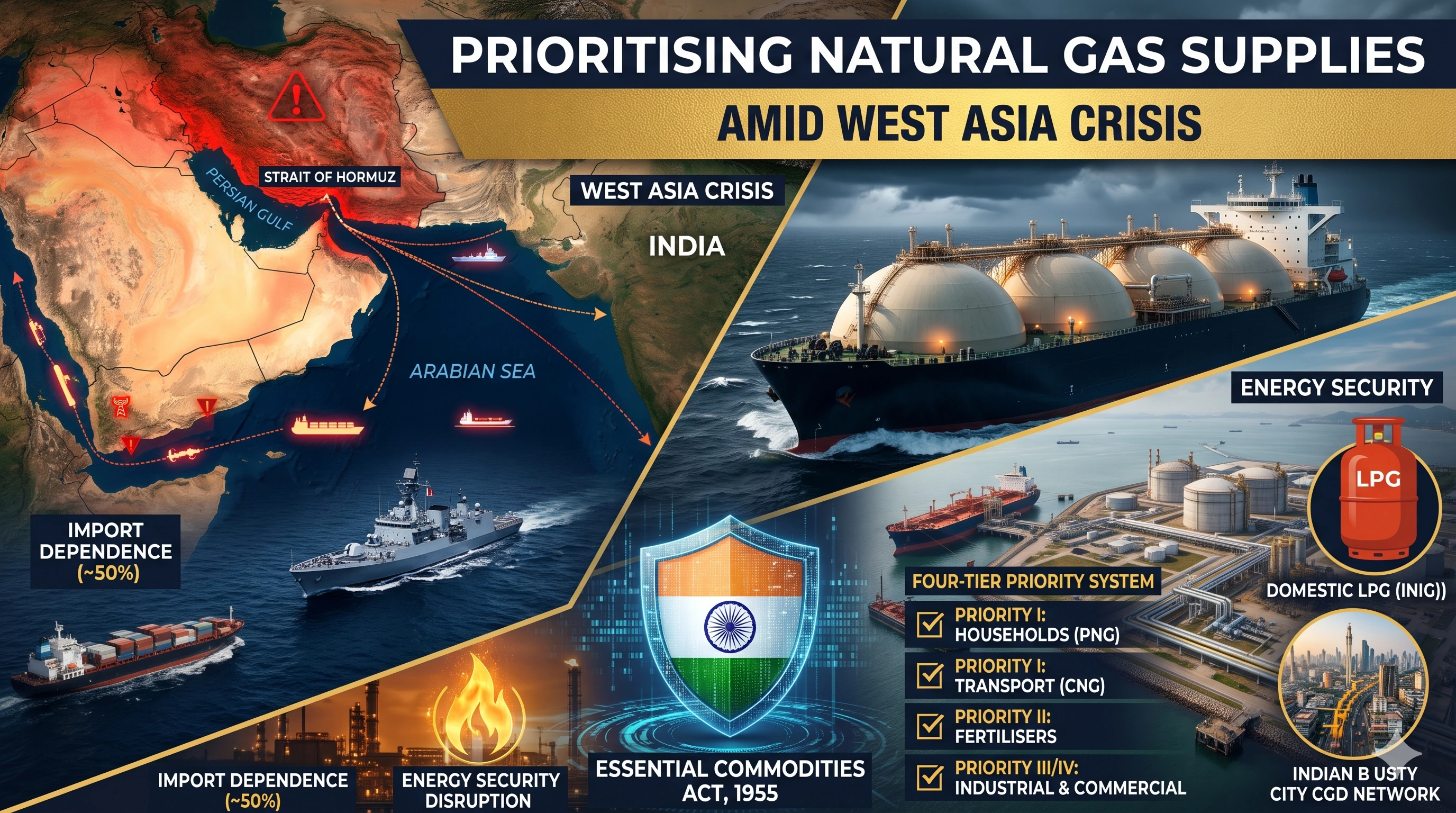
Amid maritime trade disruptions in the Strait of Hormuz due to the ongoing West Asia conflict, India's LNG supplies have faced a severe supply shock. In response, the Government of India invoked emergency powers under the Essential Commodities Act, 1955 to enforce a four-tier gas rationing framework, protecting domestic and transport sectors while curbing supplies to non-priority industries.
Introduction
Context & Background
Key Points
- •Emergency Powers Invocation: The Ministry of Petroleum and Natural Gas (MoPNG) exercised emergency powers under the Essential Commodities Act, 1955 to legally regulate, ration, and prioritise natural gas distribution across sectors.
- •Chokepoint Vulnerability: The Strait of Hormuz connects the Persian Gulf to the Gulf of Oman and handles one-fifth of global petroleum and LNG trade. Over 50% of India's LNG and 80% of imported LPG transit this narrow waterway.
- •Import Dependence: India consumes approximately 190 million standard cubic metres per day (mscmd) of natural gas, with 50% sourced via LNG. LPG imports account for almost 60% of national consumption.
- •Industrial Curtailment: Supplies have been curtailed to non-priority industrial users: refineries are capped at 65% of average consumption, while petrochemical units, gas-based power stations, and difficult-block consumers face severe supply reductions.
- •Managing Domestic LPG Demand: Refiners were mandated to increase domestic LPG output using propane/butane streams (achieving a 10% boost). The minimum refill booking interval was raised from 21 to 25 days to prevent hoarding.
- •High-Cost Diversification: Alternative LNG sourcing from the US and Norway faces sharp constraints, including ~2-month shipping transit times and spot prices spiking from $6–8/MMBtu to nearly $15/MMBtu.
Four-Tier Gas Allocation Framework (MoPNG)
| Category | Allocated Supply (%) | Sectors Covered | Bookmark |
|---|---|---|---|
| Priority Category I | 100% | PNG (households), CNG (transport), LPG production, pipeline operational fuel | |
| Priority Category II | 70% | Fertiliser plants (compliance strictly certified via PPAC) | |
| Priority Category III | 80% | Tea industries, manufacturing units, and grid-connected industrial users | |
| Priority Category IV | 80% | Commercial and industrial consumers supplied via City Gas Distribution (CGD) |
India's Gas Import Vulnerability Metrics
| Indicator | Metric / Volume | Strategic Significance | Bookmark |
|---|---|---|---|
| Total Natural Gas Demand | ~190 mscmd | Around 50% met through imported LNG | |
| Strait of Hormuz Dependency | Over 50% of LNG imports (~30% total gas use) | Chokepoint for imports from Qatar and UAE | |
| Domestic LPG Import Dependency | ~60% of total demand | Over 80% of LPG imports transit via Strait of Hormuz | |
| Daily Household Cylinders | ~60 lakh cylinders/day | Maintained for 33+ crore domestic consumers |
Related Entities
Impact & Significance
- •Consumer Protection: Strict prioritisation prevents supply outages and retail price volatility for over 33 crore domestic LPG and PNG users.
- •Food Security Buffer: Ring-fencing gas supply (at 70%) for fertiliser plants protects urea production during critical agricultural seasons.
- •Industrial Slowdown: Squeezing feedstocks to refineries (capped at 65%), petrochemicals, and gas-powered power plants hampers production schedules and industrial GDP contribution.
- •Inflationary & Fiscal Pressure: Spot LNG prices escalating to ~$15/MMBtu widen the import bill, burdening current account balances and subsidy budgets.
Challenges & Criticism
- •Absence of Strategic Gas Reserves: Unlike crude oil (where India maintains ~9.5 days of strategic reserves via ISPRL), India lacks dedicated subterranean strategic storage for natural gas.
- •Arbitrage and Supply Rationing Friction: Cutting off industrial and petrochemical consumers risks operational shutdowns, contract disputes, and revenue losses for gas marketing utilities.
- •Long Lead Logistics: Sourcing replacement LNG cargoes from suppliers like the US or Norway requires up to 60 days of ocean transit, proving ineffective for immediate crisis mitigation.
- •High Cost Disincentive: Procuring replacement gas on the spot market at prices exceeding $15/MMBtu creates an unsustainable financial burden on downstream off-takers.
Future Outlook
- •Strategic Gas Reserves (SGR): Fast-tracking the establishment of underground strategic gas storage reserves, analogous to the Strategic Petroleum Reserves (ISPRL), to cushion maritime supply disruptions.
- •Deepwater Domestic Exploration: Incentivising upstream exploration in deepwater, ultra-deepwater, and high-pressure high-temperature (HPHT) domestic basins to raise indigenous output.
- •Geographic Import Diversification: Contracting long-term supplies with producers outside the Persian Gulf, including Australia, the United States, Mozambique, and West African nations.
- •Accelerating Decarbonisation: Expanding utility-scale renewables, green hydrogen, and bio-CNG (CBG) blending under the SATAT initiative to structurally decouple industrial demand from imported hydrocarbons.
UPSC Relevance
- • GS-3 (Indian Economy & Energy Security): Import dependency on hydrocarbons, energy security strategies, and supply chain logistics.
- • GS-2 (International Relations): Geopolitics of West Asia, maritime chokepoints, and vulnerability of India's sea lanes of communication (SLOCs).
- • GS-3 (Infrastructure): National Gas Grid expansion, CGD network resilience, and Strategic Petroleum/Gas Reserves.
- • Mains Focus: Analytical questions evaluating the trade-off between protecting consumer welfare and industrial competitiveness during external supply shocks.
Sample Questions
Prelims
With reference to India's energy landscape and maritime geography, consider the following statements:
- (a)The Strait of Hormuz directly connects the Red Sea with the Gulf of Aden.
- (b)Under the Essential Commodities Act, 1955, the Central Government can regulate the production, supply, and distribution of essential commodities during emergencies.
- (c)Domestic gas production currently satisfies over 85% of India's total natural gas demand.
Mains
“India's vulnerability to maritime energy chokepoints poses a significant threat to its macroeconomic stability and energy sovereignty.” In light of the recent West Asian crisis, analyse the policy response of the government and suggest long-term measures to achieve energy resilience.
Introduction: Define India's natural gas import landscape (~50% LNG import dependency) and cite the Strait of Hormuz disruption as an illustration of critical energy chokepoint vulnerability.
Body:
• Impact of the Crisis: Disruption in the Strait of Hormuz (30% of gas consumption, 80% LPG imports impacted); spike in spot LNG prices; supply squeezes on petrochemical and refining sectors.
• Immediate Policy Interventions: Invoking Essential Commodities Act, 1955; implementing a 4-tier rationing framework (100% to PNG/CNG, 70% to fertilisers); anti-hoarding booking intervals for LPG.
• Long-Term Strategic Measures: Operationalising Strategic Gas Reserves; geographical diversification of LNG contracts (US, Australia); expanding domestic exploration and accelerating green transition (Green Hydrogen, CBG).
Conclusion: Conclude by highlighting that true energy security lies not merely in supply diversification, but in accelerating domestic renewable integration and green fuel substitution.