
Invisible Citizens? Racism and exclusion of Northeastern communities in India
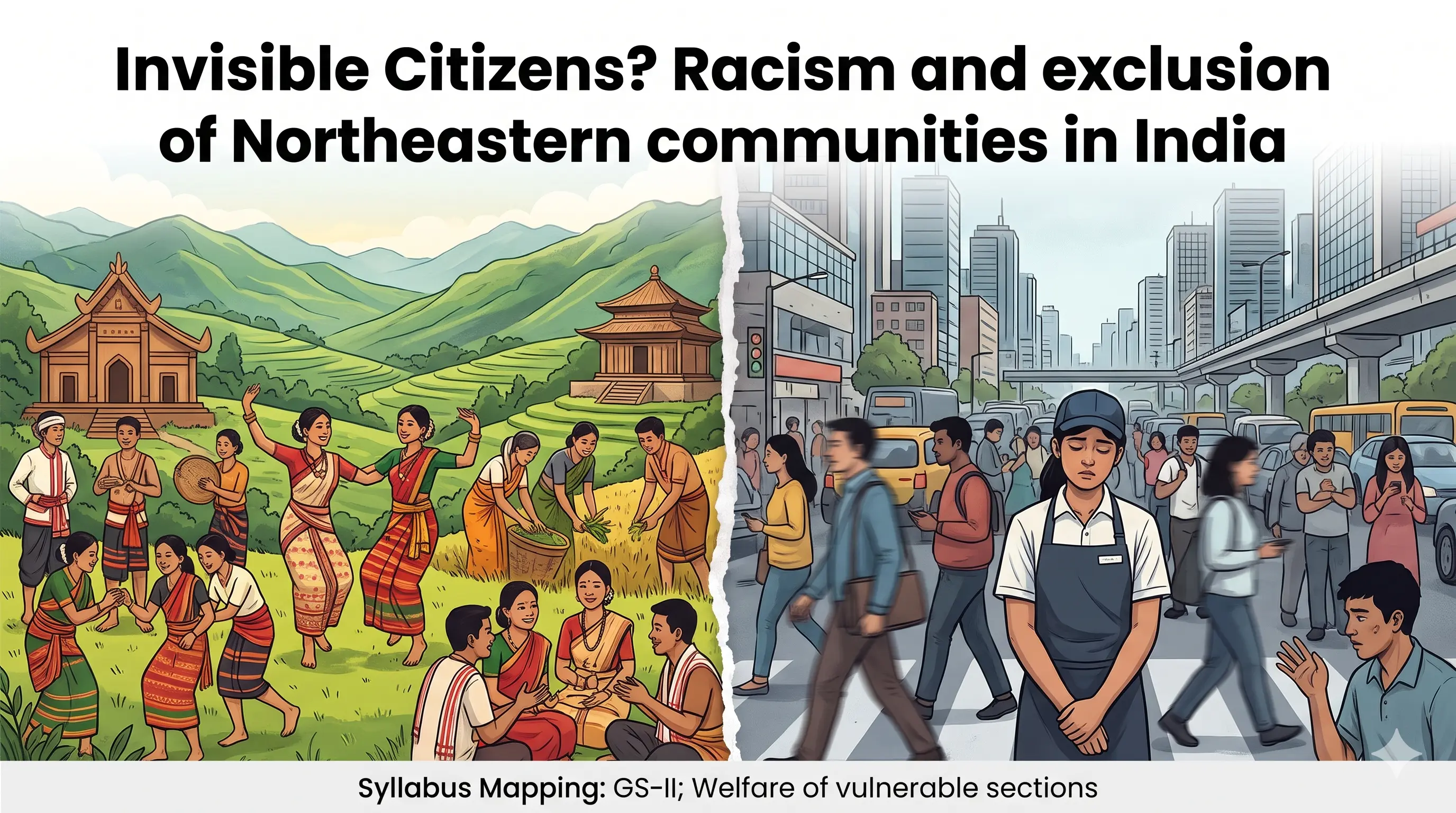
The MHA has directed NCR cities to appoint nodal officers to address racial discrimination faced by Northeastern communities. This article explores the socio-cultural roots of casual racism, its psychological and physical impacts, and the urgent need for legal, institutional, and educational reforms to protect marginalized groups.
Introduction
Context & Background
Key Points
- •Definition of Casual Racism: It is the everyday, subtle expression of prejudice through jokes, offhand comments, or routine behaviours that normalise inequality.
- •Socio-Cultural Fault Lines: Despite constitutional equality, NCRB data and high-profile killings like those of Nido Tania (2014) and Anjel Chakma (2025) highlight persistent racism against Northeasterners.
- •Historical Invisibility: Mainstream school curricula largely ignore Northeastern histories (like the Ahom dynasty), fostering ignorance instead of familiarity.
- •Phenotypic Stereotyping: Mongoloid features are wrongly equated with being “foreign,” resulting in slurs that build an unconstitutional racial hierarchy.
- •Power Asymmetry: Northeastern migrants often work in hospitality and retail, exposing them to landlord harassment, workplace exploitation, and structural impunity.
- •Escalation of Violence: Verbal abuse and micro-aggressions often escalate into physical violence, consistent with Allport’s scale of prejudice.
Racism Against North-East Indians: Key Issues & Impacts
| Category | Issue | Impact and Escalation | Bookmark |
|---|---|---|---|
| Historical Invisibility | School curricula traditionally focus on the Gangetic plains, leaving the histories of the Ahom dynasty and regional freedom movements unacknowledged. | Fosters deep-seated ignorance and reinforces stereotypes rather than promoting national familiarity. | |
| Phenotypic Stereotyping | Mongoloid features are wrongly associated with being “foreign,” leading to xenophobic slurs like “chinky” or “Chinese.” | Creates a racial hierarchy that directly contradicts India’s pluralistic and democratic ethos. | |
| Social Exoticisation | Distinct food, attire, and gender norms are often “othered,” exoticised, or subjected to moral policing. | Results in the hyper-sexualisation of women and dehumanisation of men, cementing social prejudice. | |
| Casual Racism | Everyday “jokes,” chants, and micro-aggressions normalize disrespect in public and private spaces. | Lowers the social and moral thresholds, making discriminatory behavior culturally acceptable. | |
| Physical Violence | Verbal abuse frequently evolves into physical assault, as seen in the tragic Nido Tania murder case. | Validates Allport’s Scale of Prejudice, showing how hate speech inevitably leads to physical harm. | |
| Power Asymmetry | Migrants often work in hospitality/retail, facing unique urban vulnerabilities in housing and employment. | Enables structural impunity, where landlords and employers exploit victims without fear of legal consequences. | |
| Policing Deficit | Authorities often dismiss racial slurs as “jokes” (e.g., Anjel Chakma’s case), failing to categorize them as hate crimes. | Weakens the legal deterrence required to protect marginalized communities in metropolitan hubs. | |
| Policy Implementation | While the Bezbaruah Committee (2014) suggested IPC amendments and nodal officers, progress remains slow. | Uneven implementation and political under-prioritization leave existing legal safeguards toothless. |
Related Entities
Impact & Significance
- •Psychological Trauma: Constant exposure to micro-aggressions harms self-esteem, internalizes prejudice, and creates a severe sense of alienation.
- •Escalation to Physical Harm: Unchecked verbal abuse frequently normalizes violence, leading to tragic physical assaults and hate crimes (e.g., Nido Tania).
- •Economic Vulnerability: Migrant workers in retail and hospitality suffer landlord harassment and workplace exploitation due to power asymmetries.
- •Erosion of Constitutional Values: Persistent racial hierarchies directly violate the fundamental rights to equality and dignity, undermining India's pluralistic fabric.
Challenges & Criticism
- •Policing Deficit: Law enforcement often dismisses racial slurs and micro-aggressions as "jokes," failing to recognize them as hate crimes, which weakens legal deterrence.
- •Slow Policy Implementation: Critical legal safeguards recommended by the Bezbaruah Committee (2014) remain unevenly implemented and politically under-prioritized.
- •Structural Impunity: Power imbalances in urban centers allow landlords and employers to exploit Northeastern migrants without fear of legal repercussions.
- •Normalization of Stereotypes: Societal acceptance of exoticisation and everyday racism lowers the moral threshold, making it extremely difficult to eradicate prejudice.
Future Outlook
- •Legal Teeth (IPC Amendments): Explicitly defining “Racial Discrimination” under the IPC by enacting the Bezbaruah Committee recommendations (Sections 153C and 509A) as cognizable and non-bailable offences.
- •Curriculum Reform: Integrating the history and geography of the “Seven Sisters and Sikkim” into national NCERT textbooks to build "cognitive familiarity".
- •Dedicated Legal & Social Support: Creating targeted helplines/social media channels and a specialized panel of public prosecutors (with 50% women) for Northeastern victims.
- •Expansion of SPUNER & Representation: Scaling the Special Police Unit for North East Region model to all major Tier-1 and Tier-2 cities, alongside increasing institutional representation of Northeastern professionals in media and administration.
UPSC Relevance
- • GS-2 (Social Justice): Mechanisms, laws, institutions, and bodies constituted for the protection and betterment of vulnerable sections.
- • GS-1 (Indian Society): Diversity of India, regionalism, and social empowerment.
- • Essay Topics: 'Prejudice and Pluralism: The fault lines of Indian diversity', 'The psychological violence of casual racism'.
- • Mains Focus: Analyzing the Bezbaruah Committee recommendations and the socio-cultural roots of regional alienation.
Sample Questions
Prelims
With reference to the Bezbaruah Committee (2014), consider the following statements:
- (a)It was constituted to look into the concerns of citizens from the North Eastern States living in different parts of the country.
- (b)It recommended the insertion of new sections in the Indian Penal Code (IPC) to penalize racial discrimination.
- (c)Both 1 and 2
- (d)Neither 1 nor 2
Mains
“Casual racism against Northeastern communities in mainland India is a product of historical invisibility and socio-cultural stereotyping.” Analyze this statement and suggest institutional measures to ensure their constitutional right to equality.
Introduction: Define casual racism and mention recent MHA directives to appoint nodal officers in NCR to address discrimination against Northeastern citizens.
Body:
• Socio-Cultural Roots: Lack of Northeastern history in mainstream curricula (Ahom dynasty); phenotypic stereotyping leading to “othering”; exoticisation of food and gender norms.
• Impact of Casual Racism: Psychological violence, alienation, urban vulnerability (housing/workplace exploitation), and escalation to physical violence (e.g., Nido Tania case).
• Institutional Measures: Implementing Bezbaruah Committee recommendations (IPC 153C and 509A); expanding SPUNER to Tier-1/Tier-2 cities; NCERT curriculum reforms; dedicated legal prosecutors.
Conclusion: Conclude by emphasizing that legal deterrence must be coupled with 'cognitive familiarity' to transform the constitutional promise of fraternity and equality into a lived reality for Northeastern citizens.