
Rakhigarhi: Redevelopment as a Global Heritage Site
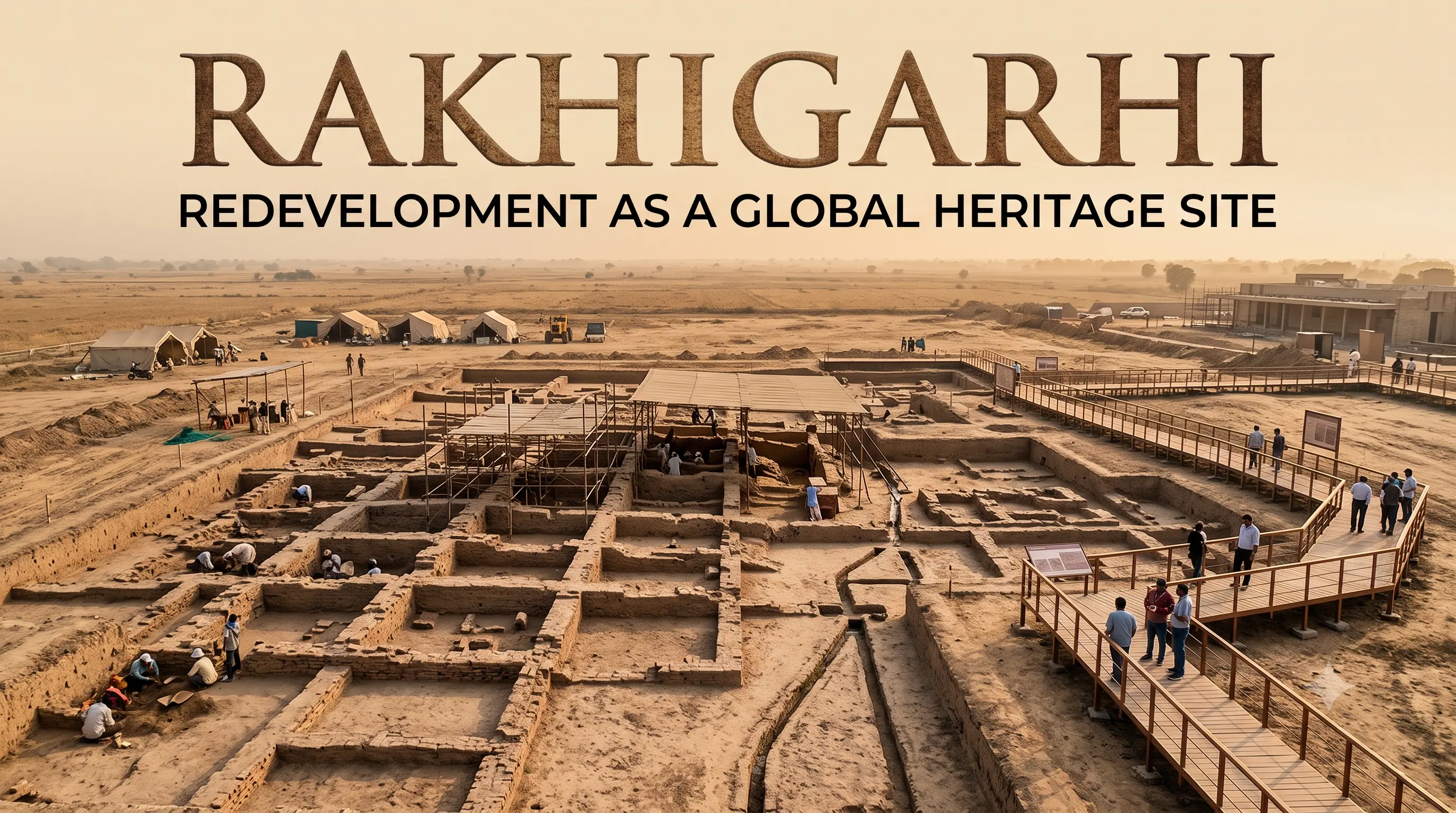
The Chief Minister of Haryana has allocated ₹500 crores for the redevelopment of Rakhigarhi into a Global Heritage site. Located in the Hisar district, it is the largest known Indus Valley Civilization (IVC) site in India, revealing advanced urban planning, unique seals, and complex burial practices.
Introduction
Context & Background
Key Points
- •Largest IVC Site: Rakhigarhi is recognized as the largest known Indus Valley Civilization site within Indian territory, even surpassing Mohenjo-daro in total area.
- •Geographical Context: The site is situated in the Hisar district of Haryana, historically located along the now-dry Drishadvati (Ghaggar-Hakra) river system.
- •Urban Planning: Excavations by the ASI under Amarendra Nath have unearthed a Mature Harappan planned township featuring houses made of mud and burnt bricks alongside a well-developed drainage system.
- •Rare Artifacts: A significant discovery includes a rare cylindrical seal bearing five Harappan script characters and an alligator motif, alongside steatite seals and sealings.
- •Religious and Social Life: The presence of triangular and circular fire altars on mud floors, as well as animal sacrificial pits lined with mud bricks, highlights distinct ritual practices. Furthermore, extended burials—especially female burials with rich grave goods like jasper beads—indicate clear social stratification.
- •Rich Craftsmanship: The site yielded diverse antiquities including stone blades, bone points, copper objects, animal figurines, and a terracotta toy cart frame and wheel.
Major Archaeological Findings at Rakhigarhi
| Category | Key Findings | Significance | Bookmark |
|---|---|---|---|
| Urban Settlement | Mud and burnt bricks, advanced drainage system | Reflects a highly planned Mature Harappan township. | |
| Seals and Pottery | Cylindrical seal with alligator motif; Red ware (Dish-on-stand, perforated jars) | Indicates distinct administrative tools and a well-developed ceramic industry. | |
| Ritual Practices | Animal sacrificial pits, triangular and circular fire altars | Points to complex ceremonial and ritualistic activities. | |
| Burials & Social Life | Female burials with jasper, agate beads, and shell bangles | Provides strong evidence of social stratification and rich funerary customs. |
Related Entities
Impact & Significance
- •Historical Recalibration: Rakhigarhi's immense size cements the importance of the Ghaggar-Hakra river basin, rather than just the Indus river, as a core demographic center of the Harappan civilization.
- •Tourism and Economy: Developing the site will put Haryana on the global historical tourism map, bringing infrastructure and employment to the Hisar region.
- •Academic Value: The well-preserved skeletal remains found in the extended burials offer invaluable genetic data to researchers studying the migration patterns of ancient South Asians.
Challenges & Criticism
- •Encroachment: Because the modern village of Rakhigarhi sits directly on top of parts of the ancient mounds, land acquisition and preventing further encroachment remain highly sensitive and difficult tasks.
- •Weathering of Structures: The excavated mud-brick architecture is highly vulnerable to monsoon rains and erosion. Without immediate structural canopies, vital historical evidence risks dissolving.
- •Pace of Excavation: Despite its importance, large tracts of the site remain unexcavated due to funding bottlenecks and logistical challenges, which this new ₹500 crore allocation aims to resolve.
Future Outlook
- •Global Heritage Status: The ₹500 crore allocation will facilitate world-class museum infrastructure, making Rakhigarhi a major node for international historical tourism.
- •Advanced Research: Sustained funding will allow for more sophisticated archaeological techniques, such as DNA analysis of burial remains, to further decode Harappan ancestry.
- •Site Preservation: Development funds will be crucial in creating protective structures to save exposed mud-brick architectures from weathering and climate degradation.
UPSC Relevance
- • GS-1 (Art & Culture / Ancient History): Salient features of the Indus Valley Civilization, urban planning, and socio-religious practices.
- • GS-1 (Geography): Paleochannels, drying up of the Ghaggar-Hakra river system and its impact on ancient settlements.
- • Prelims Focus: Matching IVC sites with their respective states, rivers, and unique archaeological findings (e.g., cylindrical seal, fire altars).
Sample Questions
Prelims
Consider the following statements regarding the Rakhigarhi archaeological site: 1. It is the largest known Indus Valley Civilization site located within Indian territory. 2. It is situated on the banks of the Luni river in Rajasthan. 3. Excavations here have yielded triangular and circular fire altars and a cylindrical seal.
1. 1 and 2 only
2. 2 and 3 only
3. 1 and 3 only
4. 1, 2, and 3
Answer: Option 3
Explanation: Statement 1 is correct. Statement 2 is incorrect; Rakhigarhi is located in the Hisar district of Haryana along the Drishadvati (Ghaggar-Hakra) river system. Statement 3 is correct; fire altars and a rare cylindrical seal were significant findings.
Mains
"The excavations at Rakhigarhi have fundamentally expanded our understanding of the Indus Valley Civilization's extent and socio-cultural life." Discuss this statement in light of recent archaeological findings.
Introduction: Introduce Rakhigarhi, located in the Hisar district along the Drishadvati river, as a pivotal Harappan site excavated by Amarendra Nath.
Body:
• Scale and Urban Planning: Mention its status as the largest IVC site; elaborate on the Mature Harappan planned township, drainage systems, and use of mud/burnt bricks.
• Socio-Cultural Insights: Discuss the evidence of social stratification through female burials with rich grave goods (jasper/agate beads); mention the highly developed red ware ceramic industry.
• Religious Practices: Highlight the discovery of animal sacrificial pits and triangular/circular fire altars, which provide deep insights into Harappan belief systems.
Conclusion: Conclude by mentioning the recent ₹500 crore allocation by the Haryana government to elevate Rakhigarhi to a Global Heritage site, emphasizing the need to preserve this unparalleled historical asset.