
Ratnagiri Excavations & Odisha's Diamond Triangle: Unearthing Maritime & Monastic Links
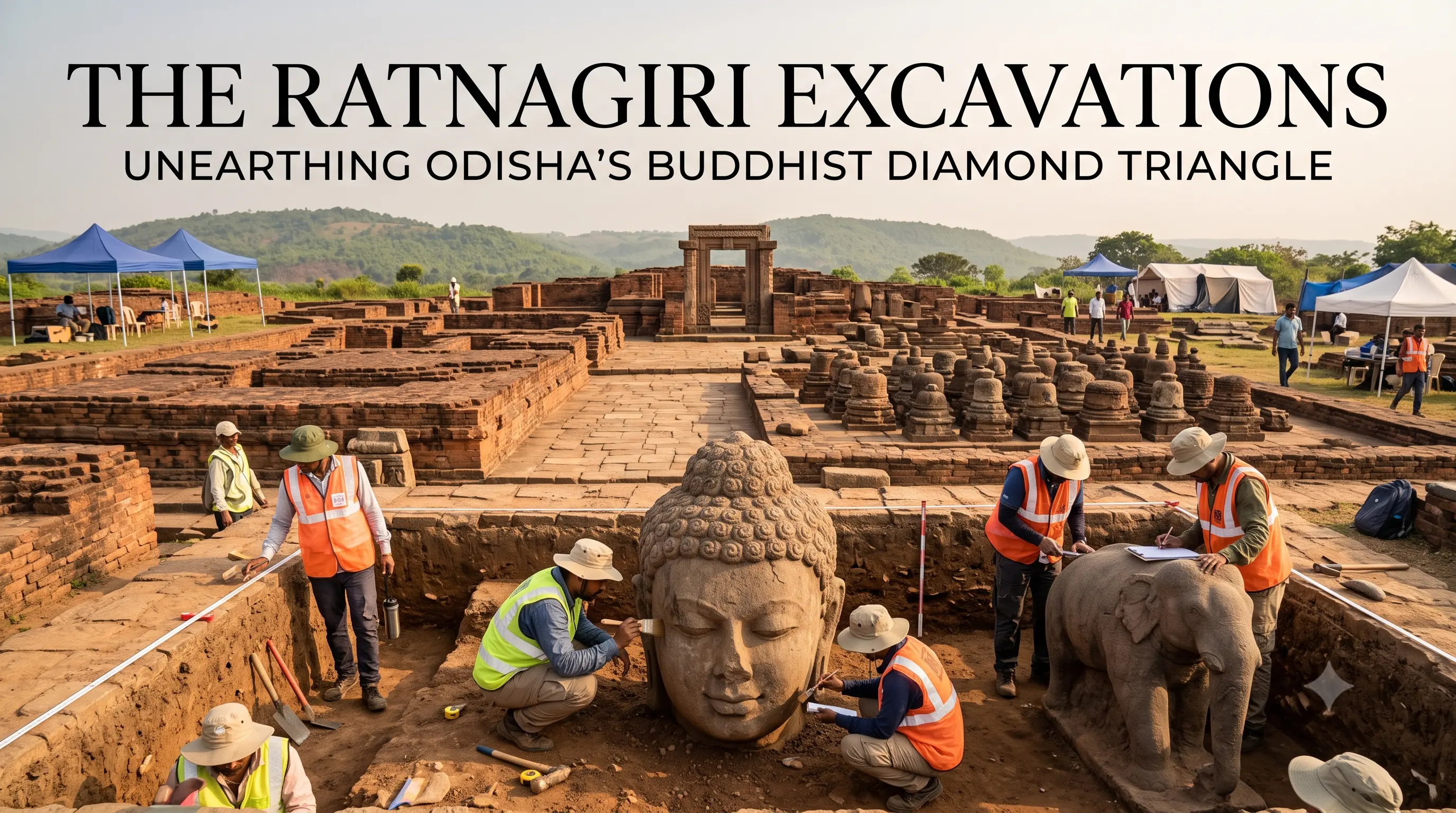
After nearly 60 years, the Archaeological Survey of India (ASI) has resumed excavations at Ratnagiri in Odisha's Jajpur district. Recent 2024–25 discoveries—including colossal Buddha heads and a new shrine complex—highlight Ratnagiri's role as a Vajrayana hub and its historical cultural links with Southeast Asia.
Introduction
Context & Background
Key Points
- •Architectural & Scholastic Excellence: Monastery 1 at Ratnagiri features an ornate chlorite doorway depicting Lakshmi and Vajrapani, alongside a unique curvilinear (Rekha Deula–type) roof—the only known Buddhist monastery in India with this temple architecture style. It housed a 12-foot seated Buddha in Bhumisparsha Mudra.
- •Transmission to Southeast Asia: Stone tablets inscribed with Sanskrit dharanis in Kutila script and Tantric icons of Tara and Avalokitesvara found at Ratnagiri heavily influenced Buddhist iconography in the Srivijaya Empire (Indonesia). Ancient Kalinga maintained these maritime trade links through ports commemorated today in the Baliyatra festival.
- •Evolution into Vajrayana Hub: Ratnagiri evolved from a Mahayana centre into a paramount seat of Vajrayana (Tantric) Buddhism. Tibetan historical sources such as Pag Sam Jon Zang identify Ratnagiri as a crucial centre for the origination and dissemination of the Kalachakra Tantra tradition, leading scholars to refer to it as the 'Nalanda of the East'.
- •Lalitgiri's Relic Discovery: Lalitgiri provides evidence of unbroken Buddhist occupation from the 2nd–3rd century BCE to the 13th century CE. Excavations revealed sacred relic caskets nested in four materials (khondalite, steatite, silver, and gold) inside a Theravada stupa.
- •Advanced Monastic Architecture at Udayagiri: Known as 'Sunrise Hill', Udayagiri boasts the Simhaprastha Mahavihara—a rare double-storied monastery equipped with a pradakshinapatha (circumambulatory path), vaulted windows, and upper shrine chambers.
Sites of Odisha's Diamond Triangle
| Site Name | Location & Setting | Key Features / Finds | Historical Significance | Bookmark |
|---|---|---|---|---|
| Ratnagiri | Jajpur district (Assia hills, between Brahmani & Birupa rivers) | Colossal Buddha heads, Monastery 1 with Rekha Deula roof, 700+ votive stupas, Dharani inscriptions | Hub of Vajrayana Buddhism & Kalachakra Tantra; 'Nalanda of the East'; cultural ties with Srivijaya Empire | |
| Lalitgiri | Cuttack district (Nandapahad hillock, Assia hills) | Theravada stupa with four-fold relic caskets (gold, silver, steatite, khondalite), Sri Chandraditya Vihara sealing | Oldest site (2nd-3rd c. BCE to 13th c. CE); shows doctrinal continuity across Theravada, Mahayana & Vajrayana | |
| Udayagiri | Jajpur district (Assia hills, right bank of Birupa river) | Madhavapura Mahavihara, Simhaprastha Mahavihara (double-storied monastery with vaulted windows) | Major Mahavihara complex active up to 10th-11th century CE with inscribed Dhyani Buddhas |
Recent Archaeological Discoveries at Ratnagiri (2024–25)
| Discovery / Artifact | Key Characteristics | Archaeological / Cultural Implication | Bookmark |
|---|---|---|---|
| Colossal Buddha Heads | Three heads up to 1.5 m tall with intact facial features and unique curly hair patterns | Rare survival from historical iconoclasm; displays distinct stylistic variance in Odishan Buddhist art | |
| New Shrine Complex | Uncovered south of the main monasteries; includes a chaitya/shrine structure | Indicates broader spatial layout and expansion of the monastic complex than previously mapped | |
| Monolithic Elephant | 5-foot-long elephant sculpture | Stylistically comparable to the ancient Ashokan rock-cut elephant at Dhauli |
Related Entities
Impact & Significance
- •Soft Power & Cultural Diplomacy: Unearthing tangible evidence of Kalinga's ancient maritime connections with Southeast Asia (Java, Sumatra, Bali) strengthens India's 'Act East' policy and deepens historic ties with ASEAN nations.
- •UNESCO World Heritage Aspirations: Fresh excavations and systematic documentation strengthen the case for including Odisha's Diamond Triangle (currently on the Tentative List) in the final UNESCO World Heritage list.
- •Understanding Maritime Silk Routes: The Dharani inscriptions and iconographic diffusion offer invaluable academic insight into the exchange of religion, art, and script across the Bay of Bengal.
- •Heritage Tourism & Local Economy: Promoting the Diamond Triangle as a premier Buddhist pilgrimage circuit boosts cultural tourism in Odisha.
Challenges & Criticism
- •Historical Iconoclasm & Vandalism: Many key sculptures and structures at Ratnagiri suffered damage during medieval invasions, requiring careful restoration and structural conservation.
- •Long Excavation Gap: A nearly 60-year gap between major ASI excavation phases led to delays in fully mapping the surrounding monastic settlement and sub-surface shrines.
- •Infrastructure & Tourism Management: Despite high international significance, connectivity, site interpretation centers, and preservation infrastructure across the Diamond Triangle sites require substantial upgrade.
Future Outlook
- •Interdisciplinary Mapping: Utilizing modern non-invasive technologies like LiDAR and Ground Penetrating Radar (GPR) to map unexcavated mounds around the Assia hill range.
- •Southeast Asian Academic Collaborations: Joint research programs with institutions in Indonesia, Thailand, and Sri Lanka to cross-examine Kutila script inscriptions and Vajrayana iconographic links.
- •Integrated Heritage Circuit Development: Creating a unified Buddhist corridor linking Ratnagiri, Lalitgiri, Udayagiri, and Dhauli with enhanced tourist facilities and digital interpretation centers.
UPSC Relevance
- • GS-1 (Art & Culture): Ancient Indian architecture, Buddhist monastic traditions (Mahayana/Vajrayana), temple-style influences (Rekha Deula), and artistic/sculptural evolution.
- • GS-1 (History): India's ancient maritime trade, cultural expansion in Southeast Asia (Kalinga/Baliyatra), and dynasties of Odisha (Bhaumakara).
- • Prelims Focus: Sites forming the 'Diamond Triangle', UNESCO Tentative List status, key Buddhist mudras (Bhumisparsha), scripts (Kutila), and relic caskets.
Sample Questions
Prelims
With reference to the Buddhist heritage of Odisha, consider the following statements: 1. Ratnagiri, Lalitgiri, and Udayagiri together form the famous 'Diamond Triangle' of Buddhist sites in Odisha. 2. Monastery 1 at Ratnagiri is unique for incorporating a curvilinear (Rekha Deula) roof design typical of Odishan temple architecture. 3. The Tibetan text 'Pag Sam Jon Zang' associates Ratnagiri with the origin of the Kalachakra Tantra tradition. Which of the statements given above are correct?
1. 1 and 2 only
2. 2 and 3 only
3. 1 and 3 only
4. 1, 2 and 3
Answer: Option 4
Explanation: All three statements are correct. Ratnagiri, Lalitgiri, and Udayagiri form the Diamond Triangle. Monastery 1 at Ratnagiri has a unique Rekha Deula type curvilinear roof, and Tibetan sources like Pag Sam Jon Zang identify Ratnagiri as a hub of Kalachakra Tantra.
Mains
“The Buddhist sites of Odisha's Diamond Triangle served not only as seats of scholastic learning but also as crucial conduits for India's cultural and maritime expansion into Southeast Asia.” Elaborate with special reference to recent archaeological findings at Ratnagiri.
Introduction: Mention the resumption of ASI excavations at Ratnagiri after 60 years and define the 'Diamond Triangle' (Ratnagiri, Lalitgiri, Udayagiri) in Odisha's Assia hill range.
Body:
• Scholastic & Architectural Prominence: Ratnagiri as the 'Nalanda of the East'; evolution from Mahayana to Vajrayana/Kalachakra Tantra; unique architectural features like the Rekha Deula roof in Monastery 1 and colossal Buddha figures.
• Maritime & Cultural Links with Southeast Asia: Transmission of Sanskrit Dharani inscriptions in Kutila script; influence of Tantric iconography (Tara, Avalokitesvara) on the Srivijaya Empire; historic trade celebrated through Baliyatra.
• Significance of 2024–25 Discoveries: Uncovering colossal Buddha heads, a new chaitya complex, and monolithic elephant sculptures that offer fresh material evidence of regional artistic synthesis and expansion.
Conclusion: Conclude by emphasizing the need for UNESCO World Heritage designation and integrated heritage conservation to leverage India's soft power under the Act East policy.