
Regulating Social Media for Children: Policy Challenges and Global Lessons
Following announcements by Karnataka and Andhra Pradesh to restrict social media access for minors, debate has intensified over safeguarding children's mental health versus preserving digital rights. This article examines the drivers behind social media restrictions, implementation bottlenecks, international regulatory precedents, and a balanced way forward.
Introduction
Context & Background
Key Points
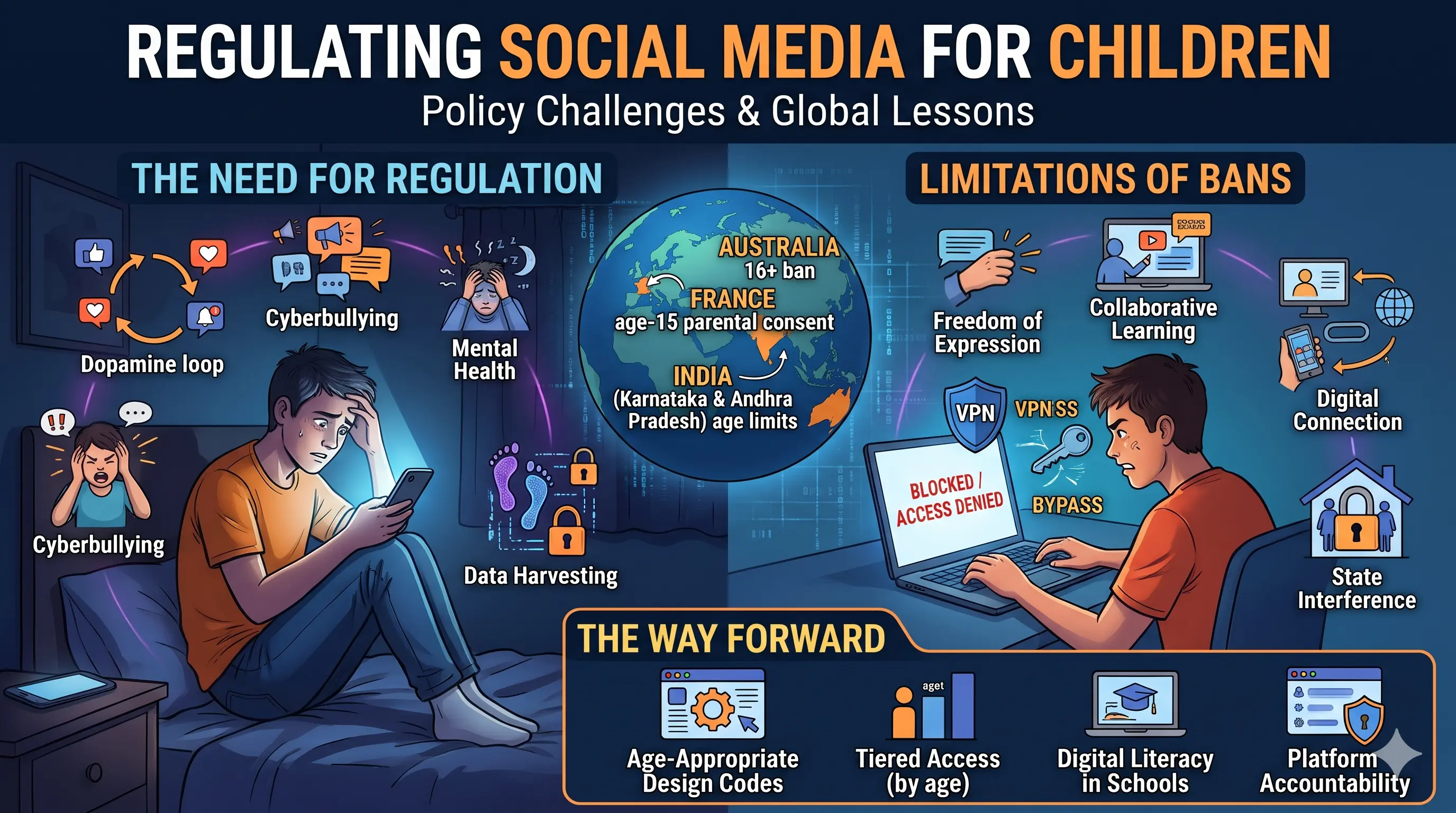
- •Neurobiological Vulnerabilities: Adolescents are uniquely sensitive to dopamine-driven reward loops (likes, shares, notifications). This induces compulsive validation-seeking, eroding sleep cycles, academic attention spans, and offline social conditioning.
- •Empirical Mental Health Linkages: Prolonged exposure to algorithmic feeds and curated aesthetics correlates strongly with heightened anxiety, body dysmorphia, depression, and social hopelessness among teens, as emphasized in recent policy assessments like the Economic Survey 2025-26.
- •Ecosystem Risks: Minors routinely encounter predatory behavior, algorithmically amplified cyberbullying, radicalizing rabbit holes, and exposure to viral misinformation that their cognitive maturity cannot critically filter.
- •Data Profiling & Consent Asymmetry: Commercial platforms collect vast digital footprints without meaningful minor consent, exposing underage populations to commercial exploitation and permanent behavioral profiling.
- •Regulatory Enforcement Deficits: Outright age bans face severe technological bypasses, including VPN adoption, unverified age self-declarations, and migration to unmonitored dark-web or fringe forums.
- •Civil Liberties & Overreach: Outright bans risk curtailing children's rights under the UNCRC (freedom of information and expression), while displacing parental discretion with heavy-handed state paternalism.
Global Approaches to Regulating Children's Social Media Access
| Country / Jurisdiction | Regulatory Mechanism | Key Focus / Scope | Bookmark |
|---|---|---|---|
| Australia | Strict access ban for minors under 16 | Imposes heavy financial penalties on non-compliant social media platforms. | |
| France | Digital age of consent set at 15 | Mandates parental consent for users under 15 years of age. | |
| United States | State-level enactments (e.g., Utah, Arkansas) | Mandatory parental approval and digital age verification before minors open accounts. | |
| China | Enforced 'Youth Mode' algorithms | Strict limitations on daily screen time alongside aggressive content filtering. | |
| United Kingdom | Online Safety Act | Statutory duty of care on platforms to shield minors and enforce age checks. | |
| Indonesia | Age-specific platform restrictions (March 2026) | Prohibits users under 16 from accessing high-risk social media spaces. | |
| India | Sub-national policy proposals (Karnataka, Andhra Pradesh) | Exploring age thresholds and statutory limits on minors' platform onboarding. |
Blanket Bans vs. Graded/Tiered Regulation
| Dimension | Blanket Prohibition | Tiered Regulation (Way Forward) | Bookmark |
|---|---|---|---|
| Implementation & Compliance | Prone to circumvention (VPNs, proxy accounts, fringe apps). | High compliance via integrated Age-Appropriate Design Codes and platform accountability. | |
| Child Rights & Growth | Curbs digital literacy, peer solidarity, and educational collaboration. | Balances online safety with progressive digital skill acquisition and free expression. | |
| Parental & Civic Role | Perceived as state overreach displacing parental agency. | Empowers families and educators through guided frameworks and media literacy. |
Related Entities
Impact & Significance
- •Adolescent Well-being: Mitigates severe psychiatric burdens, sleep deprivation, low self-worth, and digital fatigue documented among heavy adolescent users.
- •Safety Against Online Harms: Curbs exposure to predatory grooming, cyberbullying, unauthorized non-consensual image sharing, and radicalizing echo chambers.
- •Protection of Informational Autonomy: Prevents tech conglomerates from harvesting uncurated biometrics, behavioral graphs, and psychological profiles from minors.
- •Digital Inclusion & Equity: Overly restrictive rules risk widening knowledge divides for underprivileged or marginalized youth who rely on open social platforms for learning, activism, and community building.
Challenges & Criticism
- •Circumvention & 'Dark' Migration: Bans often push minors toward proxy servers, virtual private networks (VPNs), and unmoderated fringe platforms where risks are considerably higher.
- •Infringement on Information Rights: Deprives youth of valuable informal learning, civic awareness, peer networking, and opportunities for creative self-expression.
- •Privacy Risks of Age Verification: Rigid age-verification regimes often necessitate collecting sensitive identity documents (e.g., Aadhaar or passports), creating massive centralized surveillance and data leak liabilities.
- •State Paternalism vs. Parental Authority: Critics contend that state-enforced prohibitions displace parental autonomy and family-level decision-making regarding digital exposure.
Future Outlook
- •Age-Appropriate Design Codes: Transition from crude access bans to legally binding design standards requiring default high-privacy modes, disabled location tracking, and restrictions on unknown adult messaging.
- •Tiered Age-Gated Access: Deploy a graded access matrix: strict prohibitions under 13, supervised and algorithmic-free interfaces for ages 13–15, and expanded access with active safety guardrails for minors aged 16 and above.
- •Systemic Platform Accountability: Shift the burden of proof onto platforms through independent algorithm safety audits and liability for harmful addictive mechanics, mirroring landmark tort precedents.
- •Curricular Digital Literacy: Introduce mandatory school-level programs educating young users on algorithmic manipulation, privacy hygiene, data collection, and healthy screen-time habits.
- •Cross-Border Regulatory Harmonization: Leverage multilateral bodies (such as the WHO and global tech governance consortia) to establish universal safety and data privacy baselines for children.
UPSC Relevance
- • GS-2 (Social Justice & Vulnerable Sections): Mechanisms, laws, and institutions designed for the protection and betterment of children.
- • GS-2 (Governance): State regulation vs. fundamental freedoms (Article 19 and Article 21 privacy rights); federal dynamics of state-level digital policies.
- • GS-4 (Ethics): Ethical dilemmas in tech platform design, persuasive design ethics, corporate social responsibility vs. corporate profits, and paternalism vs. autonomy.
- • Mains Focus: Analyzing why blanket prohibitions fail in digital spaces and proposing systemic, child-centric regulatory alternatives.
Sample Questions
Prelims
Consider the following statements regarding digital regulation for minors: 1. The concept of an 'Age-Appropriate Design Code' mandates that online platforms design their systems with children's safety and privacy as default settings. 2. In the Indian Constitution, the regulation of social media platforms falls under the State List of the Seventh Schedule. 3. The Online Safety Act was enacted by the United Kingdom to impose a legal duty of care on tech platforms to protect children online. Which of the statements given above is/are correct?
- (a)1 and 2 only
- (b)1 and 3 only
- (c)2 and 3 only
- (d)1, 2, and 3
Mains
"Blanket bans on social media for minors often replace one set of vulnerabilities with another." Critically evaluate the rationale behind restricting children's digital access and suggest a balanced regulatory framework.
Introduction: Introduce the context of Karnataka and Andhra Pradesh proposing age-based bans, linking it to the global discourse on adolescent mental health and algorithmic design liabilities.
Body:
• Arguments for Prohibition: Neurological vulnerability to dopamine hooks, anxiety/depression epidemics (Economic Survey 2025-26), protection against cyber predators, dark patterns, and unauthorized data harvesting.
• Limitations & Systemic Hazards: Technical unenforceability (VPNs driving children into darker corners of the web), violation of rights to information and digital expression, disruption of peer support networks, and state overreach into family autonomy.
• Balanced Regulatory Architecture: Moving from blanket bans to tiered access; implementing statutory 'Safety by Design' standards; mandating independent algorithmic audits; institutionalizing school-level digital hygiene curricula.
Conclusion: Emphasize that protecting children in the digital era requires reforming the predatory design of digital spaces rather than walling young citizens off from the modern information commons.