
Reimagining India’s Water Governance: From Crisis to Sustainability
As groundwater depletion reaches critical levels and climate change alters monsoon patterns, India faces a severe water crisis. This article examines the supply-demand mismatch, agricultural over-extraction, and multi-dimensional measures and strategic reforms needed for sustainable water governance.
Introduction
Context & Background
Key Points
- •Institutional Frameworks: The Jal Shakti Abhiyan (JSA) focuses on water conservation in 256 water-stressed districts, while the Jal Jeevan Mission (JJM) shifts the focus to 'Service Delivery' by providing tap connections. NITI Aayog’s Composite Water Management Index (CWMI) instills competitive federalism.
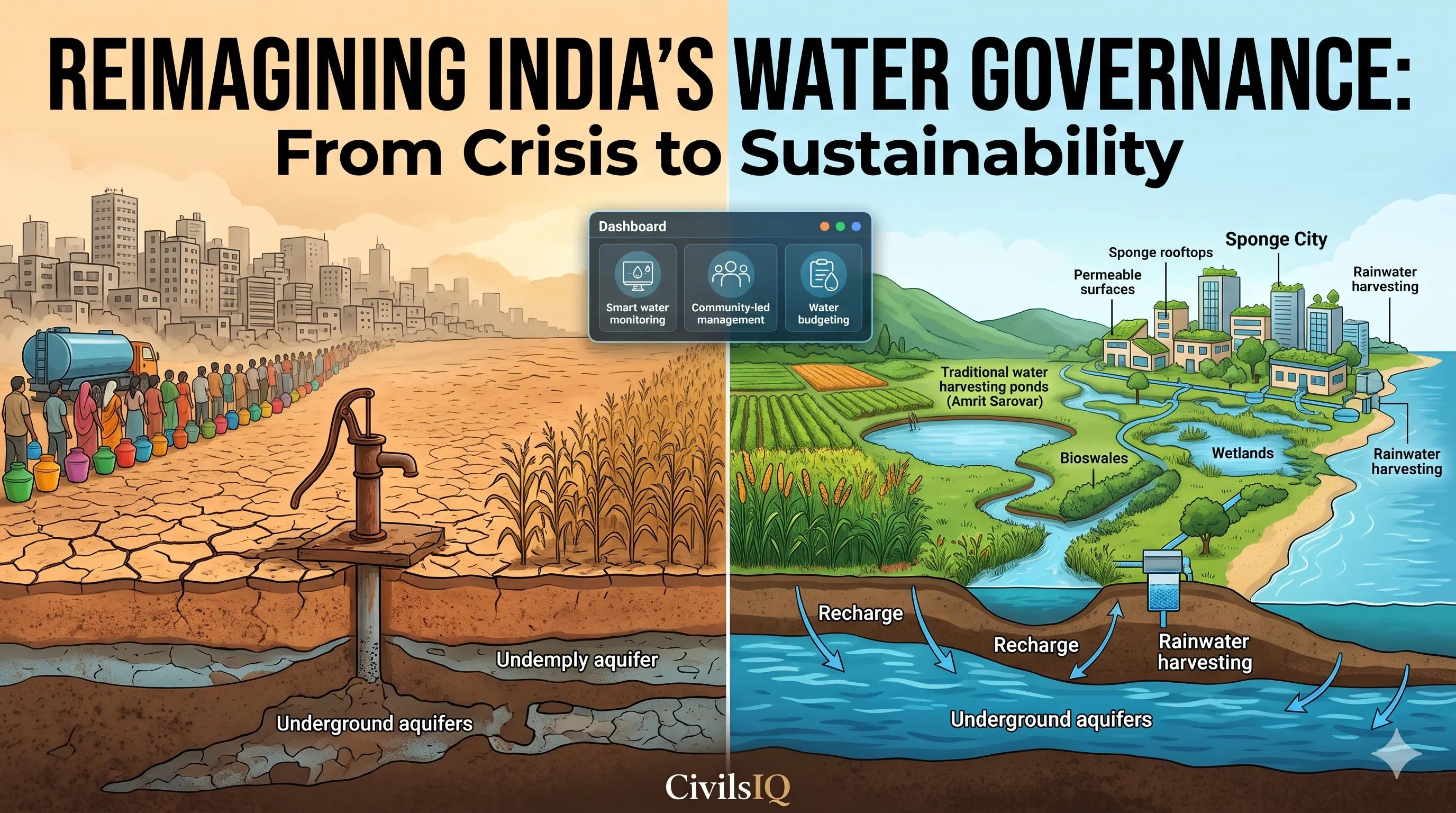
- •Groundwater Management: Atal Bhujal Yojana (ABHY) is a World Bank-funded initiative for community-led groundwater management, utilizing 'Water Budgeting'. Furthermore, NAQUIM is mapping India's aquifers to identify recharge zones.
- •Agricultural Water Efficiency: PMKSY promotes micro-irrigation ('Per Drop More Crop'), while the PM-KUSUM Scheme solarizes pumps, incentivizing farmers to pump less water and sell surplus solar electricity.
- •Urban Rejuvenation: AMRUT 2.0 promotes the circular economy of water (treating and reusing 20% of municipal sewage), and Namami Gange focuses on the conservation and pollution abatement of the Ganga.
- •Community Conservation: Mission Amrit Sarovar aims to rejuvenate 75 water bodies per district, and the Catch the Rain Campaign nudges stakeholders to build rainwater harvesting structures before the monsoon.
Strategic Reforms for Sustainable Water Governance in India
| Focus Area | Problem | Solution | Bookmark |
|---|---|---|---|
| Management of 'Green Water' (Soil Moisture) | Traditional policy focuses almost exclusively on Blue Water (rivers, lakes, aquifers). | Launch a National Green Water Mission to promote regenerative practices like mulching, no-till farming, and cover cropping. | |
| Correcting Agricultural Distortions | Agriculture consumes 90% of India's water, but Crop Water Productivity is low. Subsidies are locked into water-intensive rice and wheat. | Shifting 3.6 million hectares from rice to millets and pulses could save 29 billion cubic meters of water annually. | |
| National Circular Water Economy Mission | Only 28% of urban used water is treated, and reuse is negligible. | Transition from a 'disposal mindset' to a 'recovery mindset' through city-specific reuse targets and PPPs for sludge management. | |
| 'Sponge Cities' vs. Concrete Sinks | Urbanization increased built-up area by 33% since 2005, creating impervious surfaces that block recharge and magnify floods. | Blue-Green Infrastructure (integrating wetlands/urban forests) and Swachh Bharat 3.0 for decentralized waste treatment. | |
| Governance Reform and Digital Accounting | Fragmented and outdated legal regime. Water management is 'blind' due to a lack of real-time data. | Leverage Digital Public Infrastructure (DPI) for real-time accounting and implement tariff reform to shift toward cost recovery. |
Related Entities
Impact & Significance
- •Public Health Crisis: With over 70% of surface water unfit for consumption, waterborne diseases create a massive health and economic burden on vulnerable populations.
- •Agricultural Vulnerability: While agriculture consumes 90% of water, crop water productivity (0.52/m3) is abysmally low—just a third of China's—threatening long-term food security.
- •Urban Flooding: A 33% increase in built-up areas since 2005 has sealed natural recharge zones, meaning monsoon rains cause devastating urban floods rather than replenishing aquifers.
- •Fiscal Drain: Subsidies for power, fertilizers, and procurement of water-intensive crops drain the exchequer while simultaneously destroying the water table.
Challenges & Criticism
- •Distorted Agricultural Subsidies: MSP and free electricity encourage the continuous pumping of groundwater for rice and wheat, making crop diversification politically and economically difficult.
- •Fragmented Legal Framework: Water governance is siloed across various outdated state and central laws, hindering unified, basin-level management.
- •Data Blindness: A severe lack of real-time digital accounting for aquifers and surface water makes targeted policy interventions difficult.
- •Inequitable Pricing: Official water tariffs fail to cover basic service costs, while marginalized communities are forced to pay exorbitant rates to unregulated 'tanker mafias'.
Future Outlook
- •Focus on Green Water: Moving beyond just rivers and aquifers to actively managing soil moisture through regenerative agriculture.
- •Crop Diversification: Shifting millions of hectares from water-guzzling crops to climate-resilient millets and pulses, delivering better nutrition and fiscal savings.
- •Sponge Cities: Integrating wetlands, urban forests, and permeable surfaces into urban design to absorb stormwater, replicating models like the Yamuna Biodiversity Park.
- •Digital Public Infrastructure (DPI): Leveraging India's tech stack for real-time water accounting, bulk water trading, and smart tariff reforms to protect the vulnerable.
UPSC Relevance
- • GS-1 (Geography): Distribution of key natural resources (water) across India, changes in critical geographical features.
- • GS-3 (Environment): Conservation, environmental pollution and degradation, environmental impact assessment.
- • Essay Topics: 'Water crises and federalism', 'Sustainable agriculture in a climate-changed world'.
- • Mains Focus: Analyzing agricultural distortions in water use, evaluating urban water management (Sponge Cities), and institutional frameworks (JJM, PMKSY).
Sample Questions
Prelims
With reference to water governance in India, consider the following statements:
- (a)The Jal Jeevan Mission focuses exclusively on creating water infrastructure rather than measuring service delivery.
- (b)Atal Bhujal Yojana (ABHY) is fully funded by the Asian Development Bank (ADB).
- (c)Agriculture consumes nearly 90% of India's freshwater resources.
Mains
India’s impending water crisis is less a crisis of scarcity and more a failure of governance and agricultural policies. Critically analyze this statement and suggest strategic reforms to ensure water security.
Introduction: Introduce the crisis using data: India has 18% of the global population but 4% of freshwater, and is the world's largest extractor of groundwater. Mention per capita drop (1,816 to 1,486 cubic metres).
Body:
• Governance & Policy Failures: Highlight the fragmented legal regime, lack of real-time data, and unchecked exploitation of groundwater. Discuss how procurement and fertilizer subsidies lock farmers into growing water-guzzling crops like rice and sugarcane in arid regions.
• Urban Mismanagement: Mention the concretization of cities blocking recharge zones and the 'disposal mindset' where only 28% of urban water is treated.
• Way Forward (Reforms): Detail the need for a National Green Water Mission, shifting to millets, building Blue-Green Infrastructure (Sponge Cities), and using Digital Public Infrastructure for water accounting.
Conclusion: Conclude that moving from a 'Blue Water' obsession to holistic water accounting, coupled with community-led models like Atal Bhujal Yojana, is essential to secure India's hydrological future.