
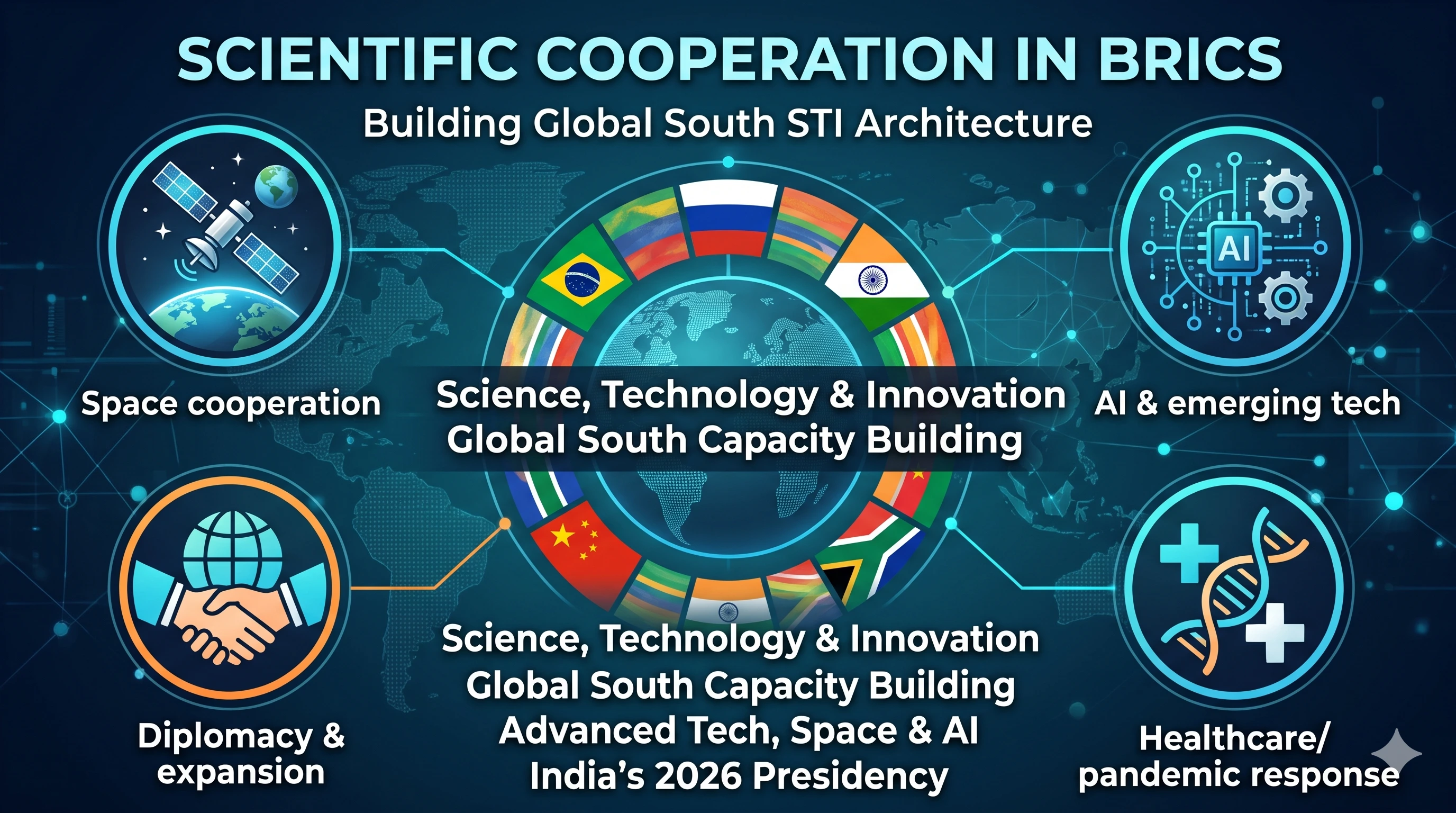
Scientific Cooperation in BRICS: Building Global South STI Architecture
As global geopolitics shifts toward techno-nationalism and export restrictions, BRICS has placed Science, Technology, and Innovation (STI) at the center of its agenda. This analysis examines the institutional mechanisms, major achievements, persistent structural challenges, and the strategic opportunities for India's 2026 BRICS Presidency.
Introduction
Context & Background
Key Points
- •Countering Techno-Nationalism: In an era of targeted sanctions and restricted technology transfers, BRICS offers a collaborative sanctuary for scientific research, demonstrated by shared vaccine platforms during COVID-19 and joint high-performance computing clusters.
- •From Fundamental to Applied Science: Research priorities have pivoted from purely theoretical science toward market-ready technologies in clean energy, water security, health, and climate adaptation.
- •Domestic Agency Linkages: National research agencies drive operational coordination—including India's Council of Scientific and Industrial Research (CSIR) and Department of Biotechnology (DBT)—aligning domestic priorities with joint calls.
- •Asymmetrical R&D Investment: Except for China, which spends over 2.4% of its GDP on research, Gross Expenditure on R&D (GERD) across most member nations remains below 1%, limiting parity in contribution.
- •Impact of BRICS+ Expansion: The entry of nations like Iran, Egypt, and the UAE broadens geographical reach and energy-transition research, but adds significant divergence in regulatory systems, scientific baselines, and geopolitical priorities.
Key STI Cooperation Frameworks within BRICS
| Mechanism / Pillar | Focus Area | Significance / Challenge | Bookmark |
|---|---|---|---|
| 2015 STI MoU | Institutional formalisation of STI agenda | Established annual ministerial tracks and coordinated multi-country funding | |
| STIEP Working Group | Innovation, entrepreneurship & incubators | Fosters cross-border startup networks and innovation ecosystems | |
| Technology Transfer Centre (TTC) | Commercialisation of applied research | Struggles with cross-border scaling and intellectual property harmonisation | |
| Satellite Constellation Agreement (2021) | Joint Earth observation and remote sensing | Enables shared remote-sensing data for disaster management and climate monitoring | |
| 2025 AI Declaration | Development-oriented AI governance | Counters Western regulatory dominance by emphasizing inclusive and ethical AI frameworks |
Comparative Analysis: Opportunities vs Bottlenecks in BRICS STI
| Dimension | Opportunities | Structural Bottlenecks | Bookmark |
|---|---|---|---|
| R&D Financing | Pooled funding pools for joint calls in energy and health | Low Gross Expenditure on R&D (GERD) across members, except China | |
| Institutional Continuity | Potential for an EU Horizon-style permanent secretariat | Rotational presidency model causes discontinuity in multi-year initiatives | |
| BRICS+ Expansion | Expanded regional reach into West Asia and Africa (UAE, Egypt, Iran) | Wide heterogeneity in scientific baseline and research infrastructure | |
| Research to Market | Shared incubation and tech transfer networks | Low translation rates from lab findings to commercial market products |
Related Entities
Impact & Significance
- •Strategic Autonomy for the Global South: Reduces dependence on Western proprietary platforms in critical dual-use areas like satellite observation, supercomputing, and telecom infrastructure.
- •Democratisation of Emerging Technologies: Prevents the monopolisation of artificial intelligence algorithms and standards by promoting shared frameworks under the 2025 AI Declaration.
- •Public Goods Delivery: Accelerates accessible solutions for common developing-world issues: vector-borne diseases, affordable biotechnology, groundwater recharge, and dryland agricultural resilience.
Challenges & Criticism
- •Lack of a Permanent Institutional Vehicle: Unlike the European Union's Horizon Programme, BRICS lacks a dedicated permanent executive secretariat, causing loss of momentum when presidencies rotate annually.
- •The Commercialisation Gap: While joint papers and bilateral patents have increased, conversion into scalable commercial enterprises via the BRICS Technology Transfer Centre (TTC) remains muted.
- •Internal Geopolitical & Structural Divergence: Deep variances in national data governance, export rules, and IP frameworks make collaborative data-sharing and open-source models complex.
- •Uneven Engagement from New Entrants: Disparity in funding capacity has led to uneven participation from newly admitted BRICS+ states in multilateral funding calls.
Future Outlook
- •Permanent BRICS STI Secretariat: Transitioning from ad-hoc rotational working groups to a centralized body capable of managing multi-year funding pipelines and oversight.
- •Consortium-Led Mega-Science Missions: Formulating multi-nation flagship missions in quantum communication, deep-sea exploration, and climate-resilient genomic crops.
- •Unified Technology Governance Frameworks: Developing common ethical standards, open-source AI repositories, and digital safety guidelines to counter restrictive global tech regimes.
- •India's 2026 Leadership Agenda: Using India's 2026 BRICS Presidency to anchor practical digital public infrastructure (DPI), frugal innovation scaling, and climate-resilient tech sharing across member states.
UPSC Relevance
- • GS-2 (International Relations): Bilateral, regional and global groupings; India's role in multipolar multilateralism; South-South scientific diplomacy.
- • GS-3 (Science & Technology): Indigenisation of technology, emerging tech governance (AI, supercomputing), and intellectual property rights (IPR).
- • Mains Focus: Analyzing the transition of BRICS from a geopolitical dialogue forum into a functional technology and economic bloc.
- • Essay Dimensions: 'Techno-Nationalism vs Scientific Globalism', 'The Global South as an Engine of Innovation'.
Sample Questions
Prelims
With reference to Science, Technology, and Innovation (STI) cooperation in BRICS, consider the following statements: 1. The formal institutional framework for STI cooperation among BRICS members was established via a Memorandum of Understanding in 2015. 2. BRICS has operationalised a permanent central executive secretariat modeled after the European Union's Horizon Programme to manage long-term research funding. 3. Member states have executed an agreement for joint cooperation and data-sharing in an Earth observation satellite constellation. Which of the statements given above are correct?
- (a)1 and 2 only
- (b)2 and 3 only
- (c)1 and 3 only
- (d)1, 2, and 3
Mains
“Scientific and technological cooperation under the BRICS framework provides a pathway to counter techno-nationalism, yet structural asymmetries among members limit its real-world translation.” Critically examine this statement and discuss how India can leverage its 2026 Presidency to bridge these gaps.
Introduction: Define techno-nationalism and state how BRICS STI cooperation emerged as an alternative model for scientific collaboration and technological sovereignty across the Global South.
Body:
• Countering Techno-Nationalism: Joint funding calls in energy and health; shared space assets (2021 Satellite Constellation); collaborative AI frameworks under the 2025 Declaration to counter Western monopoly.
• Structural Asymmetries and Constraints: GERD disparities (China vs other members); absence of a permanent executive secretariat causing project drift; sluggish tech commercialisation through the Technology Transfer Centre (TTC); regulatory divergence with BRICS+ expansion.
• Roadmap for India's 2026 Presidency: Institutionalise a permanent funding mechanism; champion open-source Digital Public Infrastructure (DPI) templates; launch Global South-centric mega-science missions in climate and public health.
Conclusion: Emphasize that transforming BRICS from a policy dialogue to an execution-driven technology bloc is essential for strategic autonomy and equitable technological governance in the 21st century.