
Sinking of Iranian Naval Ship IRIS Dena: Strategic Fallout and International Law
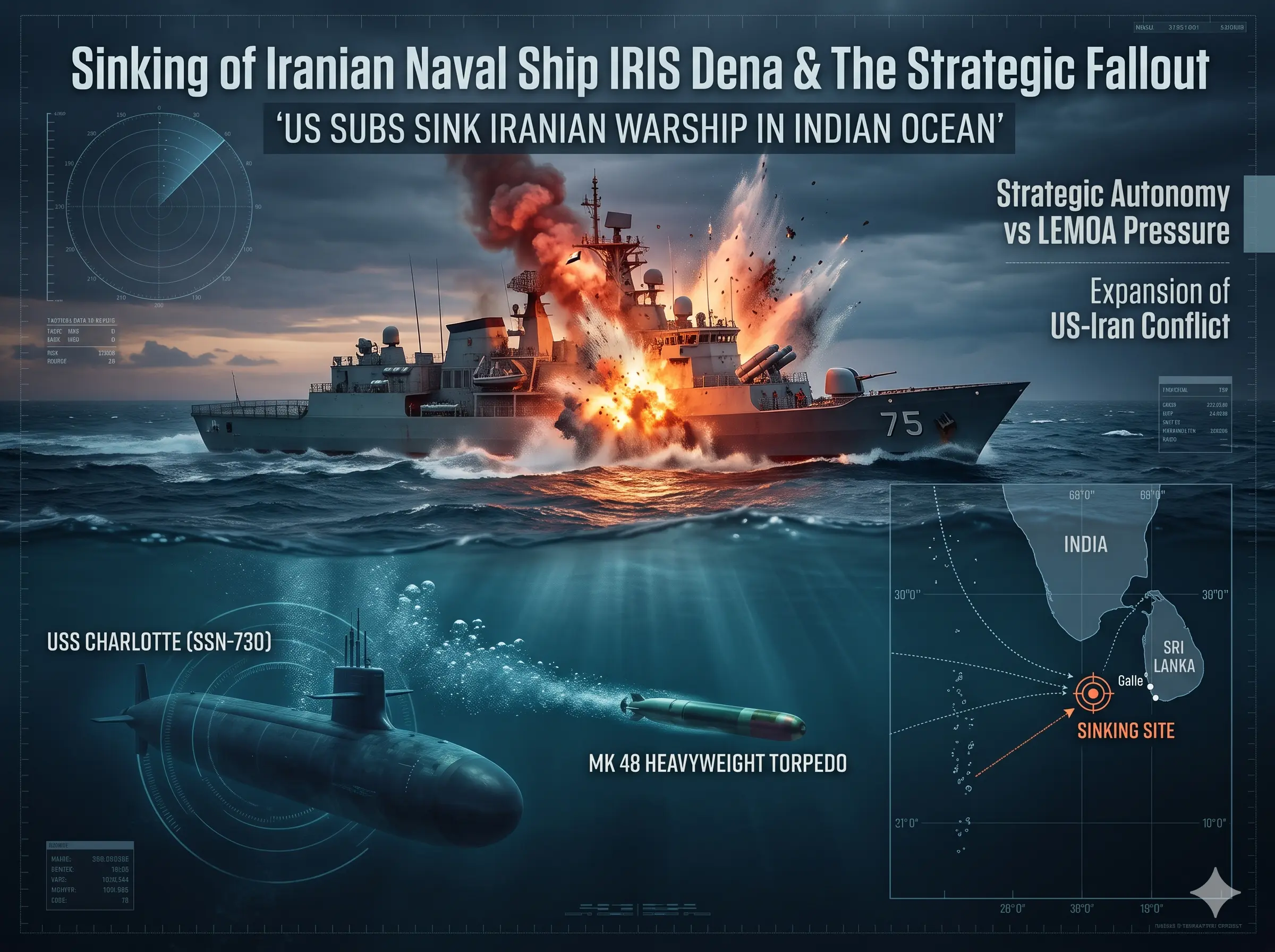
The sinking of the Iranian naval frigate IRIS Dena by a US torpedo attack near Sri Lanka has sharply escalated the US-Iran conflict, bringing naval warfare into the Indian Ocean Region. This event tests the limits of international maritime laws, challenges regional security frameworks, and places India in a delicate diplomatic balancing act regarding its strategic pacts like LEMOA.
Introduction
Context & Background
Key Points
- •Geographic Expansion of Hostilities: The torpedo attack on IRIS Dena off Sri Lanka expands the US-Iran conflict theater from West Asia directly into the Indian Ocean Region (IOR).
- •Display of Stand-Off Military Reach: The execution of the strike (utilizing advanced submarine-launched assets such as Mark-48 torpedoes) showcases high-end escalation dominance across global shipping corridors.
- •Erosion of International Norms: The action underscores a shift toward power politics over rules-based orders, echoing classical realist logic where military reach supersedes traditional Westphalian and UN Charter constraints.
- •Threat to Maritime Commons: Kinetic strikes along primary international Sea Lines of Communication (SLOCs) directly endanger energy transit, commercial shipping, and regional peace.
- •Pressure on Regional Neutrals: Hostilities spilling into South Asian littoral waters force regional powers like India to negotiate severe strategic trade-offs between existing defence pacts and sovereign non-alignment.
Legitimacy of Strike: Arguments vs Counter-Arguments
| Dimension | Arguments For the Strike | Counter-Arguments | Bookmark |
|---|---|---|---|
| Target Status | Active combat naval vessels are legitimate military targets during armed hostilities. | Reportedly on peaceful transit following naval drills; not engaged in active combat operations. | |
| Jurisdiction & Location | Warships situated in international waters can be targeted if armed conflict exists between states. | Under UN Charter Article 51, lawful force requires an actual or imminent armed attack. | |
| Legal & Warfare Norms | Enemy combat vessels qualify as lawful targets under customary laws of naval warfare. | A strike lacking a proven imminent threat acts as an unlawful, pre-emptive use of force. | |
| Authorization & Context | Targeting justified if the vessel supported ongoing hostile military operations. | Legitimate unilateral force is constrained; strongest legality stems from UNSC Chapter VII authorization. |
Legal Frameworks Governing Maritime Conflicts
| Framework / Instrument | Scope & Mandate | Key Limitation in Naval Warfare | Bookmark |
|---|---|---|---|
| UNCLOS (1982) | Regulates maritime zones, territorial waters, EEZs, and the high seas. | Primarily governs peacetime maritime conduct; lacks detailed codification for active naval warfare. | |
| Law of Naval Warfare | Customary international law governing belligerent conduct and combatant targeting at sea. | Ambiguity persists over thresholds of imminent threat versus preemptive attacks outside primary conflict zones. | |
| UN Charter (Art. 2(4) & Art. 51) | Prohibits unauthorized use of force (Art. 2(4)); recognizes self-defence against armed attack (Art. 51). | Requires stringent proof of necessity and proportionality, which is often contested by non-belligerents. |
Related Entities
Impact & Significance
- •Regional Security in South Asia: Conducting naval strikes near Sri Lanka introduces high-intensity military operations into the proximate maritime neighbourhood of South Asian states.
- •SLOC Vulnerability: The Indian Ocean accommodates major global trade and crude oil transit; military escalation directly increases maritime insurance premiums and shipping risk.
- •Erosion of Maritime Commons Governance: Unilateral military actions away from recognized conflict zones undermine collective maritime frameworks that protect innocent passage and freedom of navigation.
- •Strategic Dilemmas for Neutrals: Littoral nations face intense geopolitical pressure to choose between adhering to operational partnerships with global superpowers and preserving vital regional ties.
Challenges & Criticism
- •Ambiguity in Pre-Emptive Targeting: Striking a naval vessel on routine transit without demonstrable evidence of an active or imminent attack challenges Article 51 of the UN Charter.
- •LEMOA Operational Entanglement: Utilizing Indian logistics bases by US forces during ongoing hostilities could risk perceptions of India being an indirect co-belligerent, damaging ties with Tehran and Chabahar port interests.
- •Inadequacy of Peacetime Treaties: Reliance on UNCLOS to govern wartime disputes exposes substantial institutional gaps in handling naval strikes occurring outside declared war zones.
- •Threat to Multilateral Consensus: Unilateral force execution overrules collective security mechanisms envisioned under UN Security Council resolutions.
Future Outlook
- •Strengthening IOR Maritime Domain Awareness (MDA): Littoral states will increasingly step up surveillance through institutional setups like the Information Fusion Centre – Indian Ocean Region (IFC-IOR) to track foreign submarine movements.
- •Codification of Maritime Warfare Rules: International legal bodies may seek tighter definitions on the scope of peacetime transit versus belligerent engagement under UNCLOS and customary law.
- •Re-evaluation of Logistics Agreements: Neutral and non-belligerent nations are likely to add tighter conditional clauses to bilateral military logistics pacts to avoid involuntary entanglement in third-party strikes.
- •Enhanced Escort Missions: Escalated naval presence from littoral and extra-regional powers will likely increase operational friction along primary SLOCs connecting Malacca to the Persian Gulf.
UPSC Relevance
- • GS-2 (International Relations): India and its extended neighbourhood; effect of policies and politics of developed and developing countries on India's interests; bilateral defence agreements (LEMOA).
- • GS-2 (Global Treaties & Mandates): International law frameworks (UNCLOS, UN Charter Articles 2(4) and 51), law of naval warfare, and limits of international organizations.
- • GS-3 (Security & Defence): Maritime security challenges in the Indian Ocean, safeguarding SLOCs, and India's role as a net security provider.
- • Mains Dimensions: Strategic autonomy vs. bilateral defence obligations; security of energy routes; the weaponization of maritime chokepoints.
Sample Questions
Prelims
With reference to the legal frameworks governing maritime conflicts, consider the following statements: 1. The United Nations Convention on the Law of the Sea (UNCLOS) provides comprehensive codification for the conduct of naval warfare. 2. Under customary international law of naval warfare, active enemy warships are generally classified as legitimate military targets during armed conflict. 3. The Logistics Exchange Memorandum of Agreement (LEMOA) mandates automatic mutual military combat assistance between India and the United States. Which of the statements given above is/are correct?
- (a)1 and 3 only
- (b)2 only
- (c)2 and 3 only
- (d)1, 2 and 3
Mains
"The spillover of extra-regional maritime conflicts into the Indian Ocean tests India's strategic autonomy and its vision as a net security provider." Analyze this statement in the context of the recent military actions against naval assets in the region and discuss India's diplomatic options.
Introduction: Highlight the operational expansion of the US-Iran confrontation into the waters off Sri Lanka with the targeting of IRIS Dena, noting its breach of regional tranquility near India's immediate maritime perimeter.
Body:
• Strategic Autonomy Under Strain: Bilateral logistical mechanisms such as LEMOA create diplomatic dilemmas when an ally demands support for offensive operations against a key strategic and energy partner like Iran.
• Impact on Regional Roles: Undermines India's SAGAR doctrine and its aspiration to be a net security provider capable of insulating the Indian Ocean commons from external kinetic conflicts.
• Diplomatic & Security Way Forward: Strictly ring-fence LEMOA utilization for non-combat, HADR, and agreed multilateral operations; reinforce adherence to UN Charter norms; leverage the Indian Ocean Rim Association (IORA) for collective diplomatic de-escalation.
Conclusion: Reiterate that preserving strategic autonomy requires balanced diplomacy—upholding rules-based maritime transit without becoming a passive conduit for external great-power conflicts.