
Sixteenth Finance Commission: Recommendations, Federal Dynamics, and Systemic Fiscal Shifts
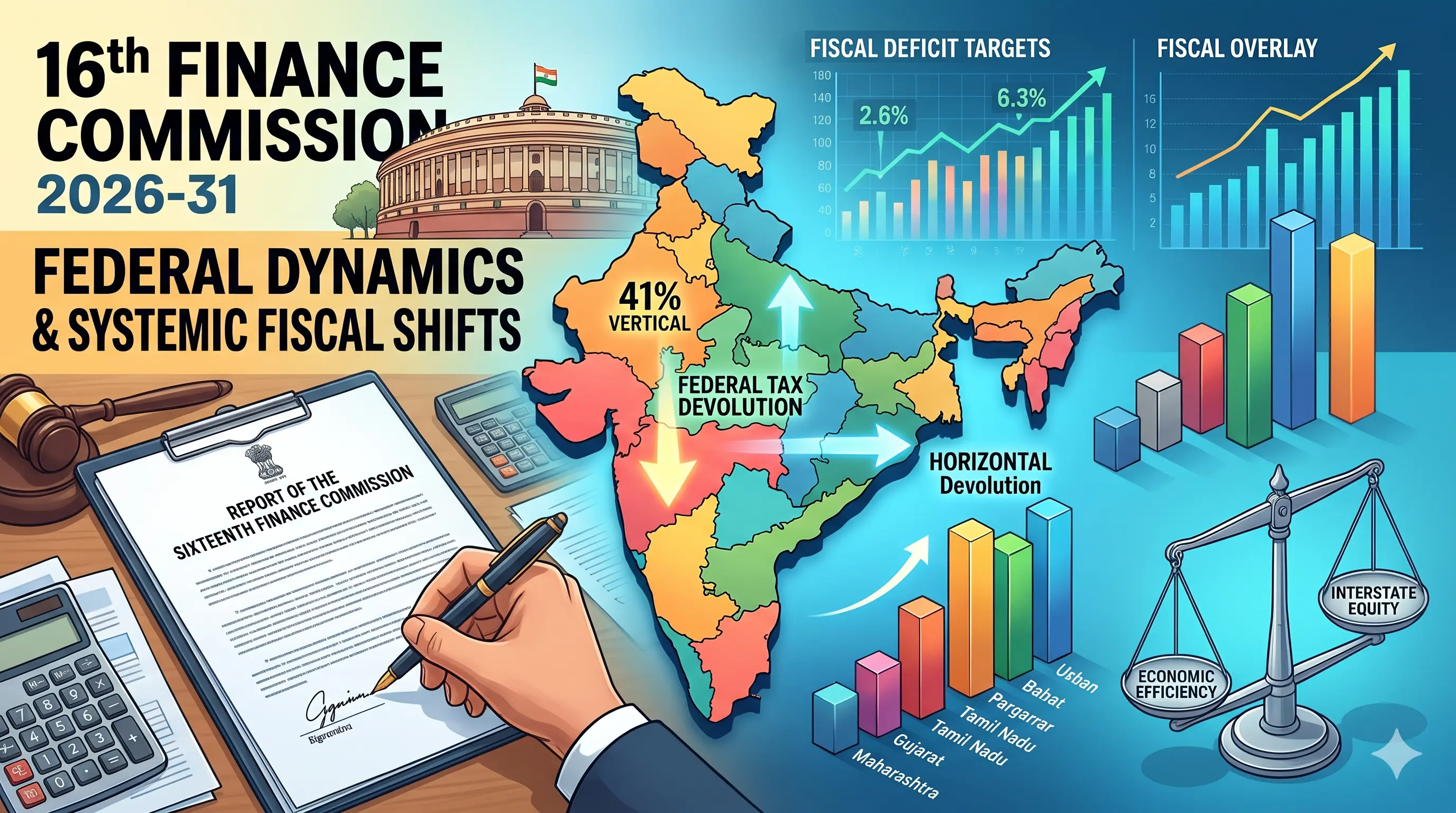
The Sixteenth Finance Commission, headed by Dr. Arvind Panagariya, submitted its report for 2026–31, maintaining vertical tax devolution at 41% while overhauling the horizontal formula with a 10% weightage for GDP contribution. The discontinuation of Revenue Deficit Grants and rising cesses and surcharges have sparked debates on cooperative federalism and interstate equity.
Introduction
Context & Background
Key Points
- •Status Quo in Vertical Devolution (41%): The 16th FC recommended retaining the States' share in the divisible tax pool at 41%, maintaining parity with the award of the 15th Finance Commission.
- •Introduction of GDP Contribution Criterion: A 10% weightage was introduced for a State's Contribution to national GDP (measured by the square root of GSDP), shifting focus toward economic efficiency alongside equity.
- •Formula Adjustments: The commission removed the 2.5% weight for Tax Effort, raised population share by 2.5 percentage points, and trimmed weights for income distance, area, and demographic performance.
- •Local Body Grants (₹7.9 Lakh Crore): Provided a predictable fiscal cushion for rural and urban local bodies, structured into 80% basic grants and 20% performance-linked grants.
- •Disaster Risk Management Corpus: Recommended a total outlay of ₹2.04 Lakh Crore across State Disaster Relief and Mitigation Funds under standard 75:25 (Centre:State) and 90:10 (Himalayan/NE) sharing formulas.
- •Fiscal Consolidation Roadmap: Mandated the Centre to lower its fiscal deficit to 3.5% of GDP by 2030–31 while maintaining a strict 3% GSDP borrowing limit for States.
Key Recommendations of the 16th Finance Commission (2026–31)
| Parameter / Allocation | Recommendation | Key Feature / Impact | Bookmark |
|---|---|---|---|
| Vertical Devolution | 41% of divisible pool | Maintains status quo from 15th FC for Union-to-State tax sharing. | |
| Horizontal Devolution Formula | GDP Contribution (10%) added | Replaced Tax Effort (2.5%); reduced weights for area, demographic performance, and income distance. | |
| Local Body Grants | ₹7.9 Lakh Crore | Allocated 80% as basic grants and 20% as performance-linked grants for urban and rural bodies. | |
| Disaster Management | ₹2.04 Lakh Crore corpus | State Disaster Relief and Mitigation Funds with 75:25 sharing (90:10 for Himalayan/NE states). | |
| Urbanisation Premium | ₹10,000 Crore grant | Incentivises the merger of peri-urban villages into larger urban local bodies. | |
| Fiscal Deficit Targets | Centre: 3.5% by 2030–31; States: 3% cap | Emphasises strict fiscal consolidation and transition of off-budget borrowings to main budgets. |
Horizontal Devolution Formula: Adjustments and Implications
| Indicator / Component | Nature of Change | Implication for States | Bookmark |
|---|---|---|---|
| Contribution to GDP (10%) | Newly introduced (measured via square root of GSDP) | Rewards economic efficiency; benefits industrialised states (e.g., Gujarat, Maharashtra, Tamil Nadu). | |
| Tax Effort (2.5%) | Removed | Eliminates explicit standalone criterion for state-level tax mobilisation efficiency. | |
| Population Share | Increased by 2.5 percentage points | Gives greater weight to demographic headcount using 2011 Census figures. | |
| Income Distance & Demographic Performance | Weightage decreased | Reduces equity-based compensation for economically lagging states (e.g., Bihar, Uttar Pradesh). |
Related Entities
Impact & Significance
- •Boost for Industrialised States: States with larger industrial and services bases (Maharashtra, Gujarat, Karnataka, Tamil Nadu, Andhra Pradesh) register an increased horizontal share through the 10% GDP contribution metric.
- •Shift to Performance-Driven Federalism: The fiscal framework pivots away from traditional unconditional 'gap-filling' transfers toward performance indicators and compliance metrics.
- •Pressure on Indebted States: Discontinuing Revenue Deficit Grants directly affects hill and revenue-stressed states (such as Himachal Pradesh and Punjab), compelling urgent fiscal restructuring.
- •Incentivising Systematic Urbanisation: The ₹10,000 Crore Urbanisation Premium acts as a dedicated financial trigger to consolidate peri-urban fringe areas into formal municipal jurisdictions.
Challenges & Criticism
- •Proliferation of Cesses and Surcharges: Non-shareable cesses and surcharges comprise roughly 20% of gross tax revenue, shrinking the divisible pool and depressing effective transfers below headline rates.
- •Abolition of Revenue Deficit Grants: Discontinuing Article 275 revenue deficit grants eliminates a long-standing fiscal buffer for structurally revenue-deficit states, worsening their debt vulnerabilities.
- •Horizontal Equity Concerns: Lowering the weight for Income Distance may disadvantage lower-income, highly populated states like Bihar and Uttar Pradesh in favour of high-GSDP states.
- •Growth and Revenue Assumptions: The projected 32.7% effective transfer ratio relies on an assumed 11% nominal GDP growth, which faces downside risks alongside the revenue impact of recent GST rate rationalisations.
- •Omission of Post-GST Cut Adjustment: The commission did not account for revenue reductions resulting from the moving of most 12% and 28% goods into the 5% and 18% GST brackets.
Future Outlook
- •Constitutional Amendment of Article 270: Deliberating an amendment to bring select cesses and surcharges into the divisible tax pool to uphold cooperative federalism.
- •Need-Based Equalisation Grants: Formulating targeted Article 275 grants to ensure minimum standard provision of essential merit public services (healthcare and primary education).
- •Off-Budget Borrowing Transparency: Institutionalising strict debt ceilings by transferring off-budget borrowings directly into visible fiscal accounts.
- •Independent Grant Monitoring: Deploying independent performance-tracking frameworks to audit the 20% performance component of local body grants.
- •Review of GST Revenue Protections: Reassessing potential state compensation buffers if post-reform revenues lag behind expected fiscal trends.
UPSC Relevance
- • GS-2 (Polity & Governance): Constitutional bodies (Article 280), fiscal federalism, Union-State financial relations, and local governance.
- • GS-3 (Indian Economy): Fiscal policy, fiscal deficit targets, taxation and divisible pool dynamics, and the impact of GST reforms.
- • Essay / Mains Themes: 'Cooperative vs. Competitive Federalism', 'Reconciling Equity and Efficiency in Interstate Transfers'.
Sample Questions
Prelims
With reference to the Finance Commission in India, consider the following statements: 1. It is a quasi-judicial body constituted by the President of India under Article 280 of the Constitution. 2. The recommendations made by the Finance Commission regarding tax devolution are legally binding on the Union Government. 3. The horizontal devolution formula of the 16th Finance Commission incorporates state Contribution to GDP as an explicit criterion.
- (a)1 and 2 only
- (b)1 and 3 only
- (c)3 only
- (d)1, 2 and 3
Mains
“The recommendations of the 16th Finance Commission signify a structural pivot from traditional equity-oriented gap filling to performance-led fiscal federalism.” Critically analyze the implications of these changes for interstate disparities and cooperative federalism.
Introduction: Briefly introduce the constitutional role of the Finance Commission (Article 280) and highlight the core baseline of the 16th FC report chaired by Dr. Arvind Panagariya (retaining 41% vertical devolution while restructuring horizontal parameters).
Body:
• Shift Toward Efficiency and Performance: Discuss the rationale behind introducing a 10% weight for Contribution to GDP, performance incentives in local body grants (20%), and fiscal deficit consolidation rules.
• Emerging Concerns for Horizontal Equity: Examine the discontinuation of Article 275 Revenue Deficit Grants and lower weights for income distance, which can exacerbate vulnerabilities in low-income and hill states.
• Challenges to Cooperative Federalism: Analyze the shrink in the effective divisible pool caused by non-shareable cesses and surcharges (~20% of gross tax revenue) and the lack of adjustment for recent GST rate rationalisation.
Conclusion: Emphasize that balancing macroeconomic efficiency with spatial equity requires reforming Article 270 (divisible pool), establishing targeted equalisation grants, and strengthening local fiscal governance.