
Sliding of the Indian Rupee: Causes, Implications, and the Way Ahead
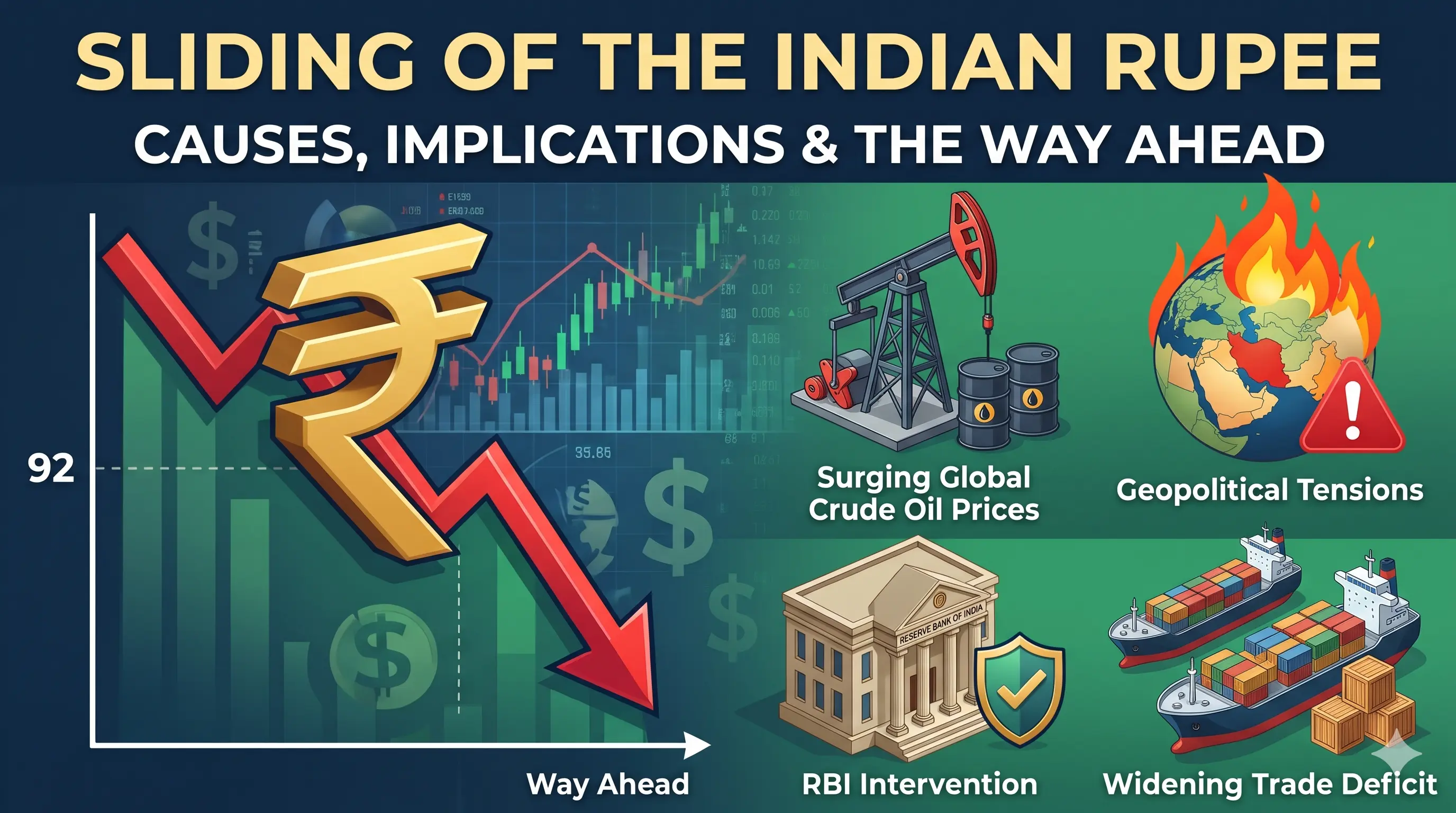
In March 2026, the Indian Rupee breached the psychologically crucial 92-mark against the US Dollar. Driven by geopolitical tensions in West Asia, surging global crude oil prices, and a widening Current Account Deficit (CAD), this depreciation threatens India’s inflation targets and current account stability.
Introduction
Context & Background
Key Points
- •Surging Global Crude Oil Prices: As India imports ~80% of its oil, rising prices significantly increase the demand for dollars. A 10% spike in Brent crude in early March 2026 (due to Strait of Hormuz closure fears) bloated India’s import bill.
- •Widening Current Account Deficit (CAD): The gap between export earnings and import spending has expanded. India’s CAD increased to $13.2 billion (1.3% of GDP) in Q3 of FY 2025-26, creating structural weakness.
- •Geopolitical Risk-Off Sentiment: The ongoing Iran-West Asia conflict has prompted global investors to pull out capital and seek safe-haven assets like the US Dollar and Gold.
- •Remittance Corridor Threats: Conflict in the GCC region threatens the steady flow of remittances from the Indian diaspora, which serves as a crucial source of dollar supply for the Indian economy.
- •The 'Managed Float' Reality: While the rupee operates on market forces, the RBI actively intervenes using its $600 billion+ forex reserves to prevent a free-fall.
Primary Factors Driving the Rupee's Slide
| Factor | Context / Data | Impact on Currency | Bookmark |
|---|---|---|---|
| Surging Global Crude Oil Prices | 10% spike in Brent crude; India imports ~80% of its oil. | Increases demand for dollars to settle trade, weakening the rupee. | |
| Widening Current Account Deficit | Increased to $13.2 billion (1.3% of GDP) in Q3 of FY 2025-26. | Creates a structural weakness due to higher import spending versus export earnings. | |
| Geopolitical Risk-Off Sentiment | Escalating Iran-West Asia conflict. | Global investors move capital to safe-haven assets like the US Dollar and Gold. | |
| Disrupted Remittance Corridors | Conflict in the Gulf Cooperation Council (GCC) region. | Threatens steady flow of remittances, a major source of dollar supply. |
How Rupee Valuation Works
| Mechanism | Description | Bookmark |
|---|---|---|
| Market Forces | Value is determined by the demand for dollars (imports, outbound investments) versus the supply of dollars (exports, FDI/FII). | |
| Current Account Balance | A higher trade deficit increases dollar demand, putting downward pressure on the rupee. | |
| Capital Flows | Inflow of foreign investment strengthens the rupee; capital flight weakens it. | |
| RBI Intervention | India uses a 'managed float' system. The RBI buys/sells dollars from its forex reserves to curb excessive volatility. |
Related Entities
Impact & Significance
- •Imported Inflation: Costlier crude oil and imported components raise manufacturing and transport costs, which are ultimately passed on to the everyday consumer.
- •Margin Compression in Key Sectors: Energy-intensive industries such as aviation, logistics, and paints face rapidly rising input costs, heavily denting their quarterly profitability.
- •Increased Cost of External Debt: Indian corporations held $44.36 billion in External Commercial Borrowings (ECBs) as of late 2025. A slide to 92+ increases the rupee-repayment burden by nearly 5-7% for these firms.
- •Silver Lining for Exporters: Sectors like Information Technology (IT) and Pharmaceuticals benefit, as their dollar-denominated billing translates into significantly higher domestic currency earnings.
Challenges & Criticism
- •Over-reliance on Oil Imports: The structural flaw in India's external sector remains its dependence on imported oil (~80%), leaving the economy highly vulnerable to West Asian instability.
- •Corporate Debt Exposure: High reliance on cheaper foreign debt (ECBs) by Indian corporates becomes a severe liability during currency depreciation cycles.
- •Limits of RBI Intervention: While India has substantial forex reserves, continuously burning through them to defend a specific currency level is unsustainable in the long run and can artificially warp market realities.
Future Outlook
- •RBI Market Intervention: The central bank must strategically deploy its $600 billion+ forex reserves to defend the 92-level and prevent panic-driven market volatility.
- •Monetary Policy Vigilance: The Monetary Policy Committee (MPC) may need to maintain an extended pause on rate cuts, or even hike interest rates, to anchor expectations if imported inflation rises.
- •Diversifying Energy Sourcing: Accelerating oil imports from non-conflict zones and aggressively increasing the share of renewable energy to reduce structural dollar demand.
- •Incentivizing Capital Inflows: Providing tax breaks or relaxing norms for Foreign Portfolio Investors (FPIs) in government bonds to attract stable dollar inflows.
- •Boosting Domestic Manufacturing: Reducing reliance on imported electronics and chemicals through targeted schemes like PLI 2.0 to permanently lower the trade deficit.
UPSC Relevance
- • GS-3 (Indian Economy): External Sector, Currency exchange rates, Current Account Deficit, and Forex Reserves.
- • GS-3 (Effects of Liberalization): Impact of global geopolitical crises on domestic markets.
- • Prelims Focus: Mechanisms of currency valuation, managed float system, components of CAD, and ECB regulations.
- • Interview/Personality Test: Defending the rupee vs letting it slide to boost exports; managing imported inflation.
Sample Questions
Prelims
Consider the following statements regarding the valuation and impact of the Indian Rupee:
- (a)A widening Current Account Deficit (CAD) generally leads to the appreciation of the domestic currency.
- (b)In a managed float exchange rate system, the central bank intervenes in the foreign exchange market to curb extreme volatility.
- (c)Depreciation of the rupee decreases the repayment burden of External Commercial Borrowings (ECBs) for Indian firms.
Mains
“The depreciation of the Indian Rupee is a double-edged sword for the economy.” Analyze this statement in the context of recent geopolitical tensions in West Asia and suggest measures the RBI and government can take to stabilize the external sector.
Introduction: Define currency depreciation. Provide recent context (Rupee crossing the 92-mark due to the Iran-West Asia conflict and rising Brent crude prices).
Body:
• Negative Impacts (One Edge): Imported inflation (costlier oil/components); Margin compression in energy-intensive sectors (aviation, logistics); Increased servicing cost of External Commercial Borrowings (ECBs).
• Positive Impacts (Other Edge): Export competitiveness; increased rupee-denominated earnings for IT and Pharma sectors.
• Measures to Stabilize: RBI intervention using forex reserves; hawkish stance by the MPC; diversifying energy imports; boosting PLI schemes to reduce import dependency.
Conclusion: Conclude that while short-term RBI intervention is necessary to prevent severe volatility, long-term stability relies on structurally reducing the Current Account Deficit through self-reliance in energy and manufacturing.