
Solar Sourcing Norms: Indigenizing India's Solar Supply Chain
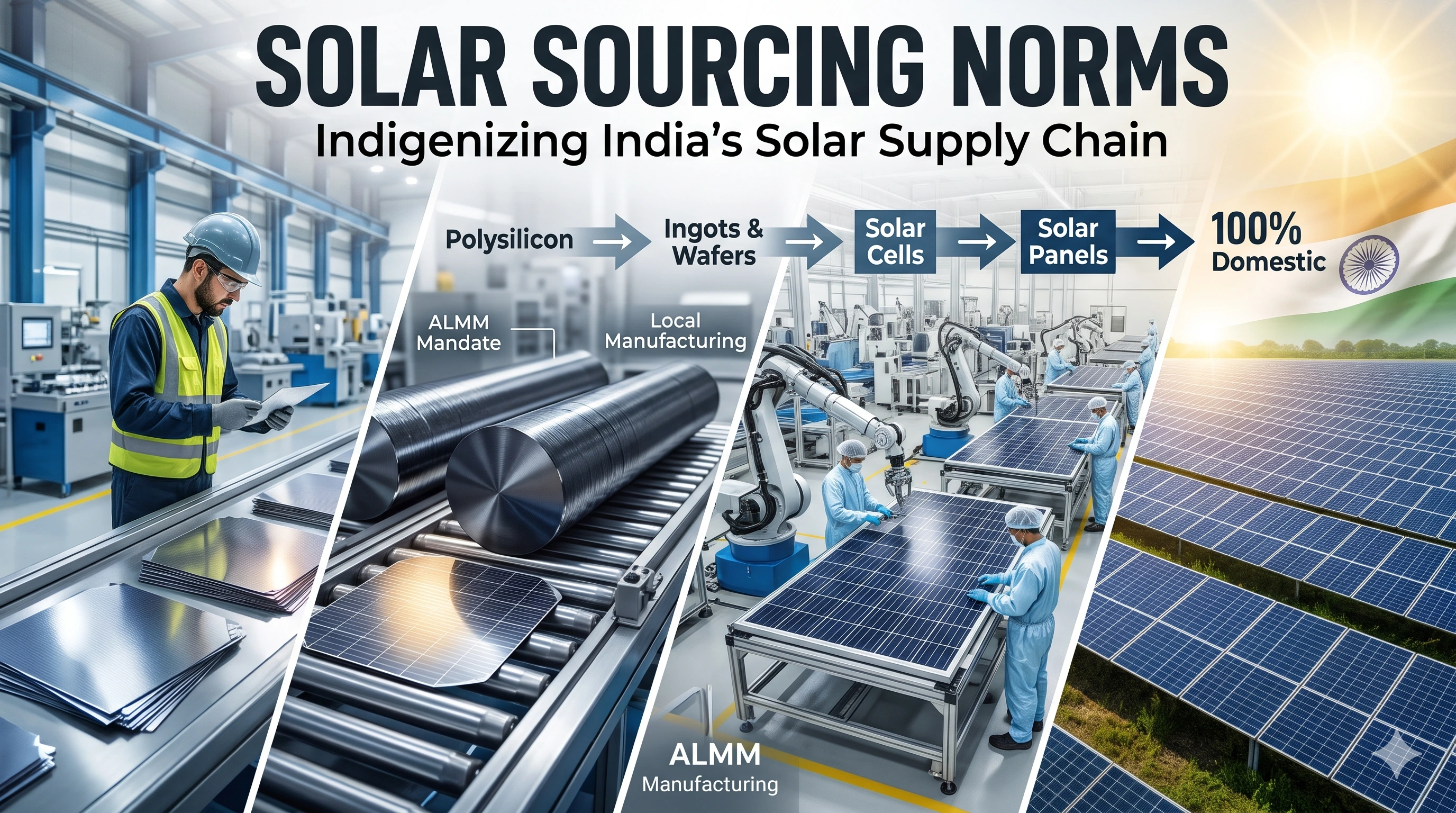
The Indian government has expanded its domestic sourcing mandate for solar equipment to include upstream components like wafers and ingots, effective from June 2028. Enforced via the ALMM framework, this mandate aims to cut extreme import reliance and build an end-to-end, self-reliant solar manufacturing ecosystem in India.
Introduction
Context & Background
Key Points
- •The Missing Upstream Link: While India has robust capacity in final assembly (172 GW for solar modules and 27.2 GW for cells), upstream segments like polysilicon, ingots, and wafers are severely underdeveloped, standing at merely 2 GW.
- •Strict Wafer Rollout Conditions: The MNRE will activate the domestic wafer manufacturers list only when at least three independent units exist with a combined capacity of 15 GW, alongside matching ingot production capacity.
- •Cascading Sourcing Requirement: Modules must be sourced from List-I, cells from List-II, and wafers from the newly created ALMM List-III. Tender documents for government and utility-scale projects must explicitly mandate these conditions.
- •ALMM as a Quality & Trade Barrier: The Approved List of Models and Manufacturers ensures rigorous performance standards via mandatory technical inspections by the National Institute of Solar Energy (NISE). It acts as a non-tariff barrier enforcing Domestic Content Requirements (DCR).
- •Exemptions and Grandfathering: Projects whose bids or PPAs are submitted before the cut-off date (7 days post List-III issuance) are exempted, protecting existing pipelines from sudden policy disruptions.
ALMM Framework: Phased Integration of Solar Components
| List Type | Component | Status / Implementation | Bookmark |
|---|---|---|---|
| List-I | Solar PV Modules | Currently operational | |
| List-II | Solar PV Cells | Mandatory effective June 2026 | |
| List-III | Solar Ingots and Wafers | New addition; effective June 2028 |
PLI Scheme Performance by Segment (As of June 2025)
| Manufacturing Segment | Awarded Capacity Achieved | FY25 Import Value | Bookmark |
|---|---|---|---|
| Solar Modules (Downstream) | 59% | N/A | |
| Solar Cells | 22% | $1,641 million | |
| Wafers / Ingots (Upstream) | 10% | $156 million | |
| Polysilicon (Upstream) | 14% | $0.03 million |
Related Entities
Impact & Significance
- •Supply Chain Security: Securing the upstream solar supply chain reduces India's vulnerability to geopolitical shocks and price manipulation by dominant global players.
- •Demand Creation: The cascading sourcing requirement guarantees demand for nascent Indian wafer and ingot manufacturers, incentivizing rapid scaling.
- •Quality Assurance: Rigorous NISE inspections ensure that the push for indigenization does not compromise the operational efficiency and lifespan of solar installations.
Challenges & Criticism
- •Massive Import Reliance: In FY25 alone, India imported $1,641 million in solar cells and $156 million in wafers, highlighting the immediate vulnerability of the sector.
- •Fierce Price Competition: Upstream manufacturing faces severe price competition from cheaper imports, making local production economically challenging without heavy subsidies.
- •PLI Execution Gaps: Despite a ₹24,000 crore PLI outlay aiming for 65 GW capacity, overall operational capacity achieved is only 29% (as of June 2025). Upstream progress in wafers/ingots (10%) severely lags behind downstream module assembly (59%).
- •High Capital Barriers: Polysilicon and ingot manufacturing are highly capital-intensive and require advanced metallurgical expertise, acting as massive entry barriers for domestic firms.
Future Outlook
- •Targeted Capital Subsidies: The government is exploring new capital subsidy schemes specifically tailored for wafers and ingots to offset the massive initial capital requirements.
- •Overcoming Upstream Bottlenecks: Focused policy support and sustained investments are urgently required to bridge execution gaps in upstream PLI segments, ensuring full self-reliance.
UPSC Relevance
- • GS-3 (Indian Economy & Energy): Indigenization of technology, developing new technology, and industrial policy.
- • GS-3 (Infrastructure): Energy transition, renewable energy targets, and supply chain resilience.
- • Mains Focus: Analyzing the performance of the PLI scheme and non-tariff barriers (ALMM) in reducing import dependencies.
Sample Questions
Prelims
With reference to the Approved List of Models and Manufacturers (ALMM) in the solar sector, consider the following statements: 1. It mandates the sourcing of solar modules, cells, and wafers exclusively from domestic manufacturers for all private off-grid projects. 2. Enlistment in ALMM requires a mandatory technical inspection by the National Institute of Solar Energy (NISE). 3. Under the expanded framework, a domestic manufacturer must have matching ingot production capacity to qualify for the wafer ALMM list. Which of the statements given above is/are correct?
- (a)1 and 2 only
- (b)2 and 3 only
- (c)1 and 3 only
- (d)1, 2, and 3
Mains
Despite a massive push through the PLI scheme, India's solar manufacturing ecosystem remains heavily import-dependent in upstream segments. Analyze the reasons for this gap and evaluate the role of the expanded ALMM framework in achieving end-to-end self-reliance.
Introduction: Highlight the recent MNRE mandate extending domestic sourcing to solar wafers and ingots (ALMM List-III) by June 2028. Mention India's uneven capacity (172 GW modules vs 2 GW wafers).
Body:
• Current Import Dependence: Huge reliance on Chinese solar cells ($1.64B) and wafers ($156M); lopsided PLI success (59% in modules vs. 10% in wafers).
• Reasons for the Gap: High capital intensity of upstream polysilicon/ingot plants; fierce price dumping by established Chinese manufacturers; lack of technological expertise.
• Role of Expanded ALMM: Acts as a non-tariff barrier (DCR); cascading sourcing (List I, II, III) creates guaranteed domestic demand; strict rollout norms (15GW capacity threshold) ensure scale and quality.
Conclusion: Conclude by emphasizing that while ALMM creates captive demand, it must be supplemented with targeted capital subsidies for wafers/ingots to make Indian manufacturers globally competitive.