
Stray Dog Issue in Telangana: Public Safety vs. Animal Rights
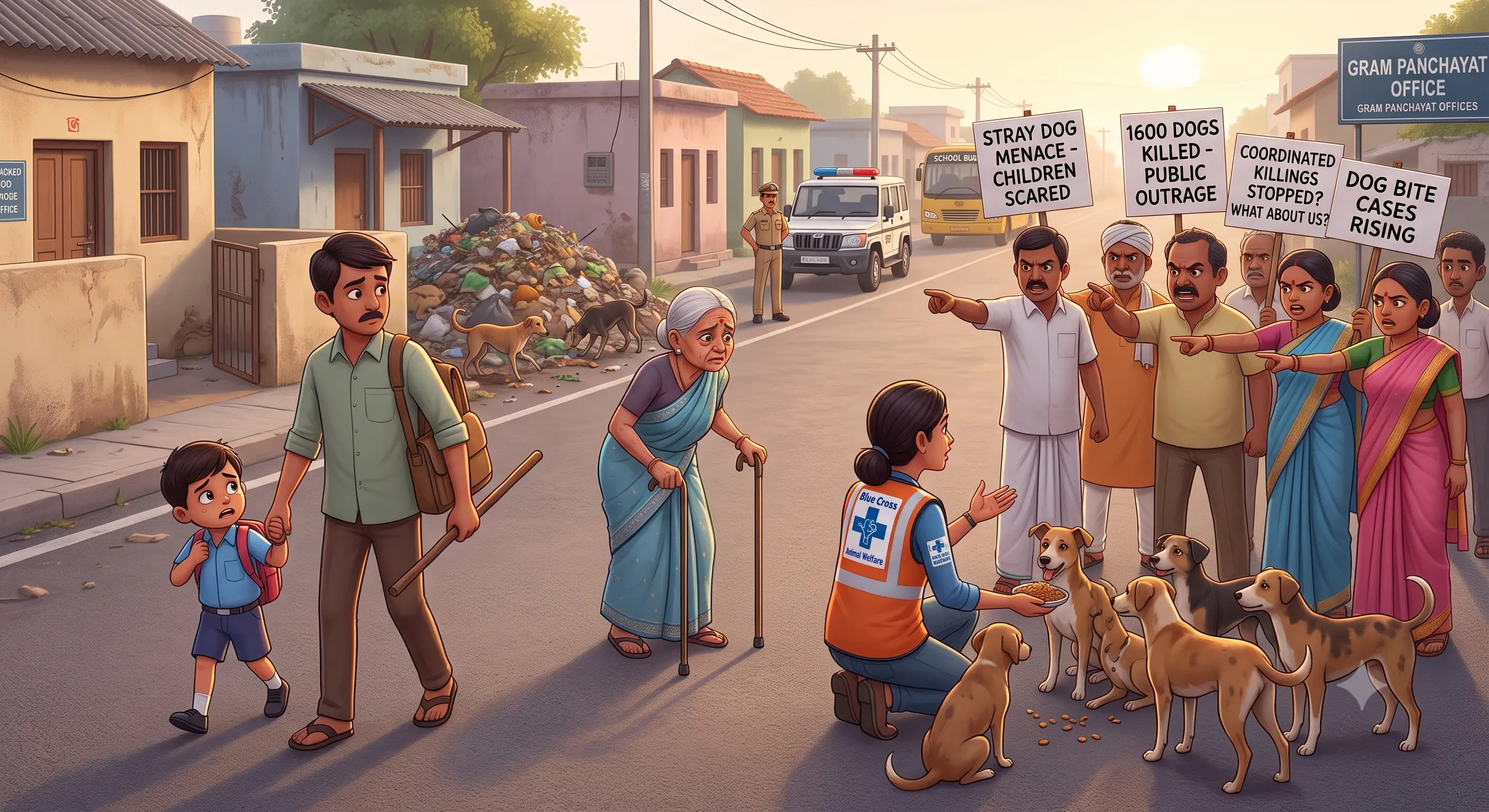
Recent mass killings of stray dogs across villages in Telangana have sparked a heated debate between animal rights and public safety. This issue exposes severe systemic gaps in rural waste management, legal ambiguities for local panchayats, and a stark urban-rural divide in animal population control funding and infrastructure.
Introduction
Context & Background
Key Points
- •Solid Waste Mismanagement: Open dumping, garbage burning, and a lack of scientific landfills or door-to-door waste collection in rural areas create massive feeding hotspots for strays.
- •Food Source Availability: The careless disposal of poultry waste, slaughter remnants, and discarded household food sustains and concentrates stray populations in specific areas.
- •Health & Population Control Gaps: Villages suffer from extremely limited sterilization coverage and anti-rabies vaccination due to the absence of dog-catching squads and mobile veterinary units.
- •Urbanization Pressures: Real estate expansion in peri-urban belts is displacing animal habitats, increasing the human-animal interface and subsequent conflicts.
- •Governance & Institutional Gaps: Panchayats face severe capacity constraints—lacking funds, trained staff, and SOPs for humane stray management. There is a glaring urban-rural policy divide where urban bodies like GHMC receive budgets for ABC-AR programs, while rural local bodies do not.
- •Legal Ambiguities: Overlapping rules between the Telangana Panchayat Raj Act, the PCA Act (1960), and AWBI guidelines leave local village authorities confused about their exact powers and permitted methods.
Key Legal Frameworks Governing Stray Management
| Law/Guideline | Core Provision | Implementation Limitations | Bookmark |
|---|---|---|---|
| Prevention of Cruelty to Animals (PCA) Act, 1960 | Prevents infliction of unnecessary pain; permits humane euthanasia when authorized. | Invoked differently: NGOs cite it against killings, authorities use it to justify population control. | |
| AWBI Rules / Guidelines | Mandates Animal Birth Control-Anti Rabies (ABC-AR) as humane population management. | Highly effective in cities with municipal backing, but lacks reach in rural areas due to poor funding. | |
| Telangana Panchayat Raj Act, 2018 | Permits Panchayats to 'restrain' strays in cases of public health threats. | Lacks clear SOPs for humane capture/sheltering, creating scope for extra-legal actions. | |
| GHMC Act, 1955 | Empowers Municipal Commissioner to destroy unclaimed or dangerous dogs. | Highlights the strong statutory and financial backing for urban bodies compared to rural panchayats. |
Scale of the Crisis & Health Data
| Data Figure | Metric/Area | Observation | Bookmark |
|---|---|---|---|
| 1,500–1,600 | Stray dogs killed in one month across over a dozen villages. | Allegedly via poisoned darts/hired squads. | |
| 1,21,997 | Reported dog-bite cases in the state in 2024. | A nearly 30% increase from 92,924 cases in 2022. | |
| 667 | Dog-bite cases since January 2025 in 19 villages of Yacharam mandal. | High incidence density; 109 cases from Yacharam village alone (pop. ~5,000). |
Related Entities
Impact & Significance
- •Human Health Risk: A severe spike in dog bites requires extensive stockpiles of Anti-Rabies Vaccines (ARV) and Human Rabies Immunoglobulin (HRIG), straining rural healthcare.
- •Livelihood & Economy: Packs of strays often attack livestock, including goats and poultry, dealing direct economic blows to small-scale and marginal farmers.
- •Social Cohesion & Mobility: The fear of attacks forces parents to escort children to schools and severely restricts the daily mobility of women and the elderly, fostering a climate of fear.
- •Moral Polarization: The crisis has sharply divided society into 'animal rights activists' and 'affected villagers', leading to social media clashes and a breakdown of community dialogue.
Challenges & Criticism
- •Urban-Rural Policy Divide: While cities have structured ABC-AR programs, rural areas are left to fend for themselves without financial grants or NGO networks.
- •Irresponsible Community Behavior: Unregulated feeding by residents without taking long-term responsibility for the animals’ sterilization or care exacerbates population clusters.
- •Inter-Departmental Silos: There is a severe lack of coordination between Panchayats, Health Departments, Police, and Animal Husbandry, resulting in ad-hoc crisis management rather than prevention.
- •NGO Limitations: Animal welfare NGOs operate mostly within city limits. Rural regions severely lack 24x7 emergency helplines, rescue units, and permanent animal shelters.
Future Outlook
- •Strengthen Village Waste Management: Enforcing strict door-to-door collection, waste segregation, and scientific disposal to eliminate the open feeding grounds that attract stray populations.
- •Legal Clarity for Panchayats: Issuing standardized model rules and SOPs that clearly define the legal and humane procedures for capture, sheltering, sterilization, and euthanasia at the village level.
- •Dedicated Rural Funding: Introducing a specific 'Rural Stray Animal Management Grant' under state or centrally sponsored schemes to mirror the funding urban municipalities receive.
- •Institutional Coordination: Establishing district-level task forces that connect Panchayats, Urban Local Bodies, NGOs, Health, Police, and Animal Husbandry departments for a unified approach.
UPSC Relevance
- • GS-2 (Polity & Governance): Issues arising out of the design and implementation of policies, devolution of powers and finances up to local levels (Panchayats vs Municipalities).
- • GS-2 (Social Justice/Rights Issues): Balancing human rights (right to safe public spaces) against animal rights/welfare.
- • GS-4 (Ethics): Ethical dilemmas involving humane treatment of animals vs. protecting vulnerable populations (children, elderly) from attacks.
- • Essay Topics: The urban-rural divide in governance; Balancing ecological ethics with human security.
Sample Questions
Prelims
Which of the following statements is/are incorrect regarding animal welfare and control laws in India?
1. The Prevention of Cruelty to Animals (PCA) Act, 1960 strictly prohibits the destruction of stray animals under any circumstances.
2. The Animal Welfare Board of India (AWBI) is a statutory advisory body.
3. The implementation of the Animal Birth Control (ABC) program is solely the responsibility of the Union Government.
Answer: Option 1
Explanation: Statement 1 is incorrect: The PCA Act permits humane euthanasia/destruction of strays when authorized by law. Statement 3 is incorrect: Local bodies (Municipalities/Panchayats) are responsible for implementing ABC programs, not the Union Government directly. Statement 2 is correct.
Mains
"The recurring conflict between animal welfare and public safety in India exposes the institutional and financial weaknesses of rural local bodies." Analyze this statement in the context of the recent stray dog crisis in Telangana, suggesting a viable way forward.
Introduction: Introduce the recent mass killings of strays in Telangana as a symptom of a larger governance failure. Briefly cite the scale (nearly 30% rise in state dog bites).
Body:
• The Conflict: Rising dog-bite cases, fatalities, and livelihood impacts (livestock deaths) vs. the prevention of animal cruelty and ethical treatment (PCA Act, AWBI rules).
• Institutional Weaknesses: Highlight the urban-rural divide. Urban bodies (GHMC) have funds, legal backing, and NGO support for ABC-AR. Panchayats lack funds, trained manpower, and clear SOPs, resorting to extra-legal culling.
• Root Causes: Poor solid waste management in rural areas; overlapping legal frameworks causing ambiguity; habitat displacement due to peri-urban expansion.
Conclusion: Conclude that a sustainable solution requires bridging the urban-rural policy gap through dedicated funding for rural panchayats, decentralized waste management, and bringing all stakeholders onto a unified district-level task force.