
Supreme Court Intervenes on Student Suicide Epidemic
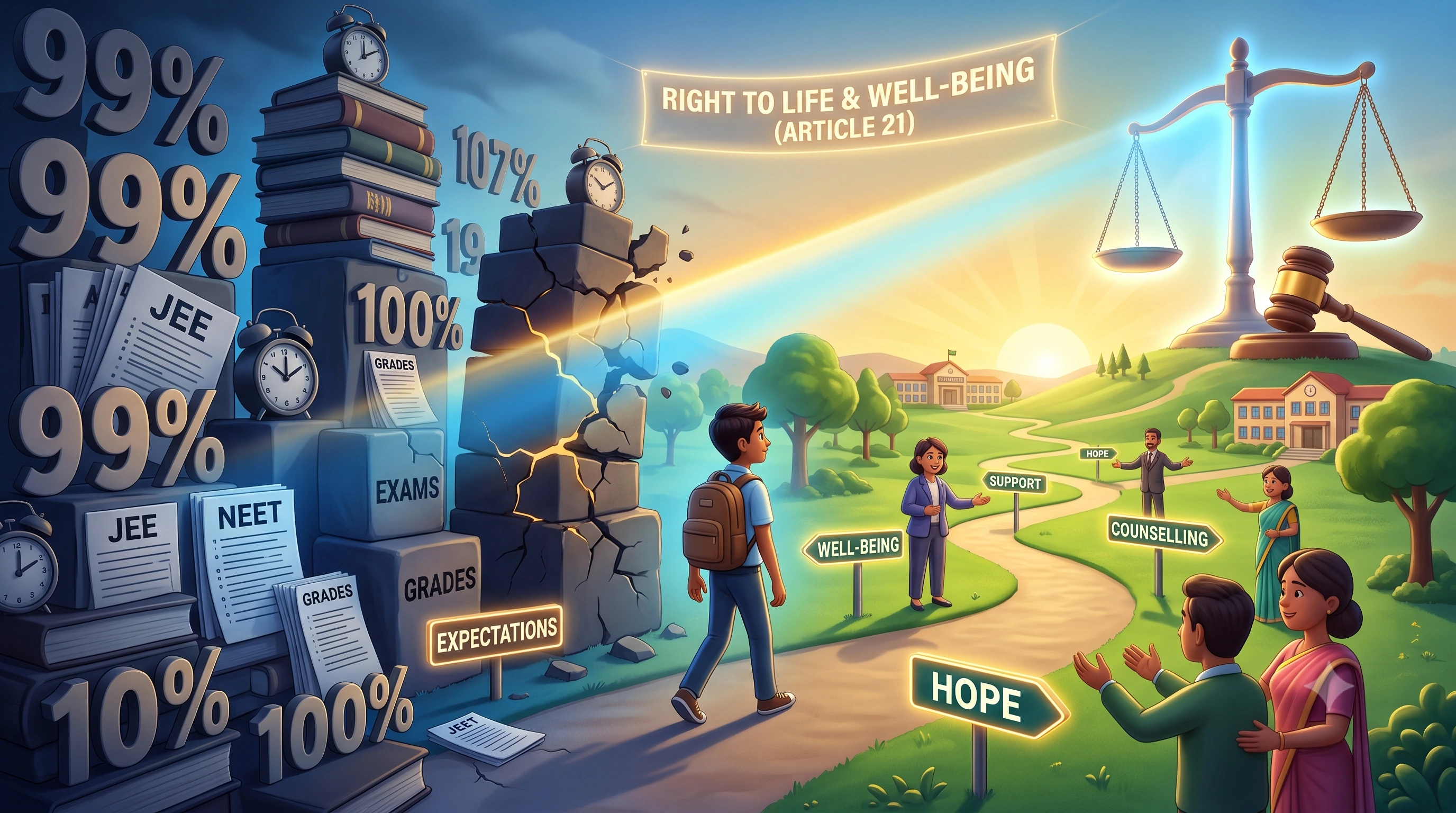
Following alarming reports of nearly 13,000 student suicides annually, the Supreme Court of India issued interim directions in Amit Kumar v. Union of India (2025). This article analyzes the structural causes behind the rising epidemic of student suicides, the gap between legal frameworks and execution, and the urgent systemic reforms required in educational institutions.
Introduction
Context & Background
Key Points
- •Faster Growth Rate: Student suicides are increasing at nearly 4% annually—double the pace of the overall national suicide rate (2%). Students constitute roughly 7.6% of all suicide deaths in India.
- •Regional & Gender Disparities: Maharashtra, Tamil Nadu, and Madhya Pradesh account for almost a third of student suicides. While male student suicides slightly declined, female student suicides rose by 7% recently.
- •Supreme Court Directives (Amit Kumar v. UoI): The SC ordered centralized data management, mandatory reporting of incidents by HEIs, filling of institutional vacancies within four months, and strict compliance with Anti-Ragging and Internal Complaints Committees.
- •Constitutional Right to Mental Health: In Sukdeb Saha vs. State of Andhra Pradesh (2025), the SC ruled that psychological health is an essential part of the Right to Life under Article 21, shifting the burden to a constitutional duty for the State.
- •Structural Implementation Failures: Despite guidelines, only 40-50% of schools have trained counselors. Coaching centers frequently bypass regulations, utilizing rigid batch segregation and public humiliation.
- •Resource Constraints: Mental health receives only about 0.5% of the total health budget, severely limiting the recruitment of qualified professionals and infrastructure development.
Major Factors Contributing to Student Suicides
| Factor | Description | Prominent Examples | Bookmark |
|---|---|---|---|
| Deficient Institutional Accountability | Treating suicides as individual failures rather than systemic shortcomings. | Prakriti Lamsal (KIIT Bhubaneswar, 2025) triggered protests over alleged negligence. | |
| Financial Burden | Stress caused by delays in scholarships, aid, or fee disputes. | Lucknow BPharma student (2025) denied exams over fee issues. | |
| Fragmented Regulation | Overlapping and poorly enforced policies (UGC, NEP 2020, Mental Healthcare Act). | SC noted scholarship delays and lack of mental health support. | |
| Mental Health Stigma | Social taboos discouraging students from seeking professional counseling. | IIT Kanpur PhD scholar (2026) suffered long-term stress without support. | |
| Social Bias & Discrimination | Caste-based mistreatment exacerbating vulnerability and distress. | Rohith Vemula and Payal Tadvi cases highlighted academic inequality. |
Major Global Frameworks for Suicide Prevention
| Framework | Key Features | Context / Application | Bookmark |
|---|---|---|---|
| WHO LIVE LIFE Framework | Promotes safety measures (reducing access to lethal means), responsible media reporting, and building life competencies. | Emphasizes the 'Papageno Effect' (recovery-focused reporting) over the sensationalized 'Werther Effect'. | |
| UN Sustainable Development Goals (SDG 3.4) | Aims to cut early deaths from non-communicable conditions, including suicide, by one-third (33%) by 2030. | India's NSPS target of 10% reduction is less ambitious and requires higher resource commitment. | |
| WHO–UNICEF Collaborative Program | Helps strengthen schools and health systems to address adolescent mental health and reduce self-harm risks. | Addresses the lack of school-level implementation and emotional coping skills. |
Related Entities
Impact & Significance
- •Loss of Human Capital: India loses nearly 38 promising young lives every day to this preventable tragedy, severely impacting the nation's future potential.
- •Threat to Demographic Dividend: If left unaddressed, this crisis could shrink India’s demographic dividend window by 8–10 years, undermining national economic goals and the vision of Viksit Bharat @2047.
- •Erosion of Social Trust: Repeated institutional negligence and high-profile tragedies (like those linked to caste discrimination) erode public trust in the higher education system's ability to foster safe, equitable environments.
Challenges & Criticism
- •Governance and Execution Gap: There is a stark disconnect between Supreme Court directives or national policies and grassroots application, plagued by weak oversight and limited financial backing.
- •Normalization of Toxic Pedagogy: Harsh disciplinary methods, public humiliation in coaching centers, and extreme academic pressure are often falsely justified as necessary 'character-building' exercises.
- •Media Sensationalism: The 'Werther Effect' caused by sensationalist media reporting often triggers cluster suicides, whereas responsible, recovery-focused reporting (the 'Papageno Effect') is rarely practiced.
- •Siloed Bureaucracy: Sustained prevention requires integrated action between Health, Education, and Social Justice ministries; however, inter-departmental fragmentation hampers a unified response.
Future Outlook
- •Accountability & Legal Oversight: Higher Educational Institutions (HEIs) must face strict penalties for failing to appoint qualified counselors or enforce mandated safeguards like the Coaching Centre Regulation Guidelines (2024).
- •Replicating Successful State Models: Wider adoption of regional initiatives such as Tamil Nadu’s Happiness Curriculum and Kerala’s Student Police Cadet / Operation Sukoon, which have reportedly lowered distress levels by 10-15%.
- •Community Gatekeepers: Training educators in Psychological First Aid and empowering parents, ASHA workers, and Anganwadi staff as community 'gatekeepers' to identify early warning signs.
- •Digital & AI Integration: Leveraging CSR funding to deploy AI-driven chatbots and predictive systems to flag distress early, alongside MeitY guidelines to manage screen exposure and online academic stress.
UPSC Relevance
- • GS-1 (Society): Issues relating to youth, education, and the impacts of urbanization and globalization on societal mental health.
- • GS-2 (Social Justice & Health): Issues relating to development and management of Social Sector/Services relating to Health and Education; Mechanisms, laws, and institutions for the vulnerable sections.
- • GS-4 (Ethics): Institutional accountability, ethical governance in educational bodies, and the moral responsibility of society towards young citizens.
- • Essay Topics: 'Education: A source of empowerment or a pressure cooker?', 'The silent epidemic of mental health in India'.
Sample Questions
Prelims
Consider the following statements regarding the regulatory and legal framework addressing student suicides in India: 1. The National Suicide Prevention Strategy (NSPS) aims to achieve a 33% decline in suicide deaths by 2030, mirroring the UN SDG Target 3.4. 2. In the Sukdeb Saha vs. State of Andhra Pradesh case, the Supreme Court affirmed that psychological well-being is a fundamental right under Article 21. 3. According to NCRB data, the growth rate of overall national suicides is substantially higher than the growth rate of student suicides.
1. 1 and 2 only
2. 2 only
3. 1 and 3 only
4. 1, 2, and 3
Answer: Option 2
Explanation: Statement 1 is incorrect: India's NSPS aims for a 10% reduction by 2030, which is lower than the UN SDG 3.4 target of 33%. Statement 2 is correct: The SC elevated mental health protection to a constitutional duty under Article 21. Statement 3 is incorrect: Student suicides are growing at ~4%, double the pace of overall national suicides (~2%).
Mains
"The escalating rate of student suicides in India points to severe systemic and regulatory failures rather than mere individual distress." Analyze the structural obstacles in India's mental health support system and suggest measures based on recent judicial directives.
Introduction: Start with alarming statistics (NCRB/IC3 data showing 4% annual growth in student suicides) and briefly mention the Supreme Court's recognition of the crisis as an 'epidemic' and a violation of Article 21 (Sukdeb Saha case).
Body:
• Systemic and Regulatory Failures: Highlight the fragmented regulatory framework (UGC, NEP), deficient institutional accountability (treating suicides as isolated cases), and the 'exam-centric' environment (NEET, JEE) that normalizes extreme pressure.
• Structural Obstacles: Discuss chronic resource constraints (~0.5% health budget for mental health), non-compliance by private coaching centers, lack of centralized data, and intersectional vulnerabilities (social bias against SC/ST/OBC students).
• Measures & Judicial Directives: Mention SC interim directions (Amit Kumar v. UoI) like mandatory reporting and filling vacancies. Suggest incorporating WHO's LIVE LIFE framework, Tamil Nadu's Happiness Curriculum, and utilizing community 'gatekeepers'.
Conclusion: Conclude by asserting that preventing this loss of human capital—nearly 38 lives daily—is crucial for realizing India's demographic dividend and the vision of Viksit Bharat @2047, requiring a shift from a competitive paradigm to a holistic, empathetic educational ecosystem.