
Supreme Court Upholds the Right to Die with Dignity
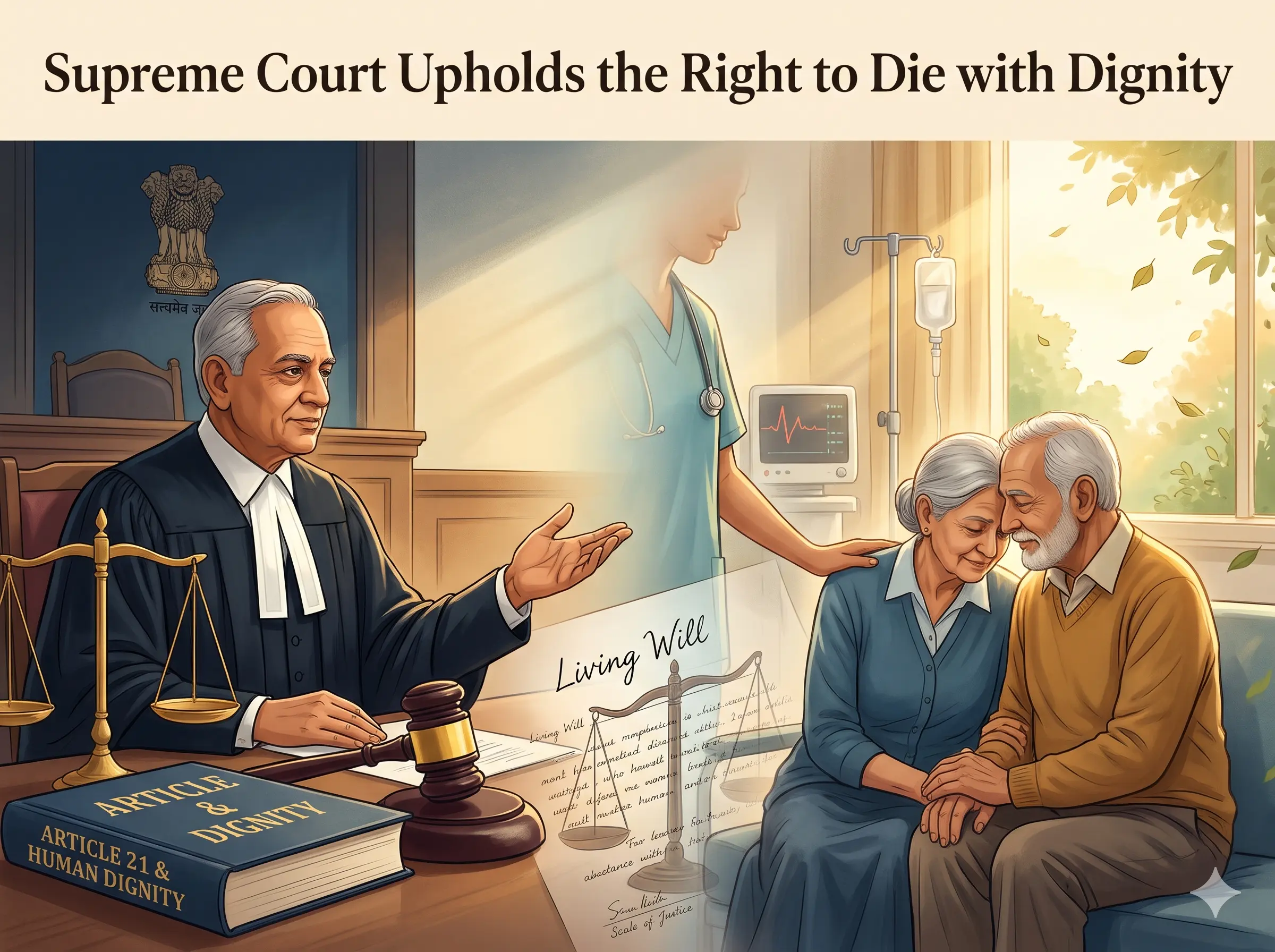
The Supreme Court of India has reaffirmed that the right to die with dignity is a fundamental right under Article 21, allowing the withdrawal of life support for a patient in a Persistent Vegetative State (PVS) for over a decade. The ruling clarifies procedures for passive euthanasia and living wills, emphasizing palliative care and strict medical safeguards.
Introduction
Context & Background
Key Points
- •Constitutional Principle: The Supreme Court affirmed that the right to die with dignity is intrinsically linked to the right to life and personal liberty under Article 21 of the Indian Constitution.
- •Terminology Shift: The Court recommended replacing the term 'passive euthanasia' with 'withdrawal or withholding of medical treatment' to emphasize allowing a natural death rather than actively causing one.
- •Strict Safeguards for Withdrawal: Clinically Assisted Nutrition and Hydration (CANH) can be withdrawn only following strict medical protocols and ethical reviews, preventing sudden or arbitrary decisions.
- •Procedure for Passive Euthanasia: The process involves a medical recommendation by the attending team, approval from a multi-specialty Hospital Medical Board, and permission from the High Court for patients unable to express their wishes.
- •Living Will Recognition: The legal validity of a Living Will (Advance Medical Directive) enables individuals to document in advance their refusal of extraordinary, life-prolonging medical procedures if they lose the capacity to communicate.
Active and Passive Euthanasia
| Basis | Active Euthanasia | Passive Euthanasia | Bookmark |
|---|---|---|---|
| Meaning | A deliberate medical act to cause death, such as administering a lethal injection. | Withdrawal or non-initiation of life-support treatment. | |
| Nature | Direct intervention intended to end life. | Allows natural death by discontinuing extraordinary medical treatment. | |
| Legal Status in India | Illegal. | Permitted under strict safeguards. | |
| Judicial Position | Not allowed by the Supreme Court of India. | Recognised and permitted by the Court in Aruna Ramchandra Shanbaug v. Union of India (2011) and reaffirmed in Common Cause v. Union of India (2018). | |
| Example | Giving a patient a fatal dose of medication to cause death. | Removing ventilator or life-support systems when treatment is medically futile. | |
| Countries | Netherlands, Belgium, Canada, Spain | India, USA, UK, Germany, Japan |
Key Supreme Court Judgments on Euthanasia in India
| Case | About the case | Judicial interpretation | Bookmark |
|---|---|---|---|
| Aruna Shanbaug (2011) | Aruna Shanbaug, a Mumbai nurse, remained in a persistent vegetative state since 1973 after a violent assault. | First recognition of passive euthanasia; withdrawal of life support permitted in exceptional cases with High Court approval and strict medical safeguards. | |
| Common Cause (2018) | The Constitution Bench considered the right to die with dignity under Article 21; introduced the concept of living wills/advance directives. | Recognised withdrawal of life-sustaining treatment; detailed procedural safeguards established to prevent misuse. | |
| Rabies Patients’ Petition (2019) | Filed by All Creatures Great and Small seeking recognition of rabies as an extreme medical condition causing severe suffering. | Petition sought guidelines for death with dignity in such cases; matter is pending before the Supreme Court. | |
| Modification of Guidelines (2023) | The Constitution Bench revised Common Cause guidelines to simplify end-of-life procedures. | Streamlined passive euthanasia process, fixed timelines for medical boards, and reduced judicial involvement for practicality. |
Related Entities
Impact & Significance
- •Upholding Personal Autonomy: Recognizes the fundamental right of individuals to make choices regarding their own life and body, extending personal liberty to the end-of-life stage.
- •Relief from Intractable Suffering: Provides a compassionate, humane option for terminally ill patients experiencing extreme physical and emotional distress that cannot be alleviated by medical science.
- •Preservation of Human Dignity: Prevents individuals from being forced into conditions of complete dependence, severe pain, or loss of bodily control, allowing them to retain self-respect until the end.
- •Resource Allocation: In strained healthcare systems, allowing voluntary end-of-life choices under strict laws can help redirect vital medical resources to patients with a chance of recovery.
Challenges & Criticism
- •The Slippery Slope Risk: Critics fear that allowing end-of-life procedures could gradually expand eligibility criteria beyond terminal illnesses, as observed in some European nations.
- •Vulnerability to Abuse: Elderly, disabled, or economically disadvantaged patients might face subtle coercion or pressure from relatives and society to choose death due to financial or caregiving concerns.
- •Conflict with Medical Ethics: Withdrawing treatment challenges the traditional medical principle of 'do no harm', potentially altering the inherent trust in the doctor-patient relationship.
- •Sanctity of Life vs. Palliative Care: Many religious and ethical traditions consider human life sacred. Opponents argue the focus should instead be squarely on improving palliative and hospice care rather than ending life.
Future Outlook
- •Integration with Palliative Care: The withdrawal of life support must be seamlessly integrated into comprehensive palliative care, focusing strictly on pain reduction and quality of life in final moments rather than hastening death.
- •Streamlining Legal Processes: Following the 2023 modifications, ongoing efforts are needed to ensure the streamlined procedures and fixed timelines for medical boards are effectively implemented on the ground to reduce agony for families.
- •Expanding Awareness of Living Wills: Broader public education is necessary to encourage individuals to draft Advance Medical Directives, ensuring their end-of-life preferences are legally documented and respected.
UPSC Relevance
- • GS-2 (Polity & Governance): Fundamental Rights (Article 21), Judicial interventions, and the evolving interpretation of the Right to Life and Liberty.
- • GS-4 (Ethics, Integrity, and Aptitude): Bioethics, medical ethics, sanctity of life vs. quality of life, and the moral dilemmas surrounding euthanasia.
- • Essay Topics: 'The right to life includes the right to die with dignity', 'Medical ethics in the 21st century: Balancing Science and Compassion'.
Sample Questions
Prelims
Consider the following statements regarding the legal position on Euthanasia in India:
- (a)Both active and passive euthanasia are legally permitted under strict safeguards in India.
- (b)The withdrawal of life support for a patient unable to express their wishes requires permission from the High Court.
- (c)The concept of a 'Living Will' was legally recognized for the first time in the Aruna Shanbaug case (2011).
Mains
The Supreme Court's recognition of the 'right to die with dignity' under Article 21 is a landmark step, yet it brings forth complex ethical and procedural challenges. Discuss the evolution of passive euthanasia in India and the safeguards required to prevent its misuse.
Introduction: Define passive euthanasia and mention the Supreme Court's constitutional interpretation of Article 21, highlighting the recent Harish Rana case to set the context.
Body:
• Evolution: Trace the journey from Aruna Shanbaug (2011)—which first permitted passive euthanasia—to the recognition of Living Wills in Common Cause (2018), and the streamlining of guidelines in 2023.
• Ethical & Procedural Challenges: Discuss the slippery slope argument, the risk of coercion of vulnerable groups, conflict with medical ethics, and procedural delays causing prolonged suffering.
• Safeguards: Detail the mandatory multi-tiered approval process (Medical Board, High Court), strict medical protocols, and the crucial integration of palliative care.
Conclusion: Conclude by emphasizing the need for a balanced approach that respects individual autonomy and human dignity while maintaining robust institutional safeguards to protect the vulnerable.