
TFFF: Transformative Climate Finance or Market-Driven Conservation?
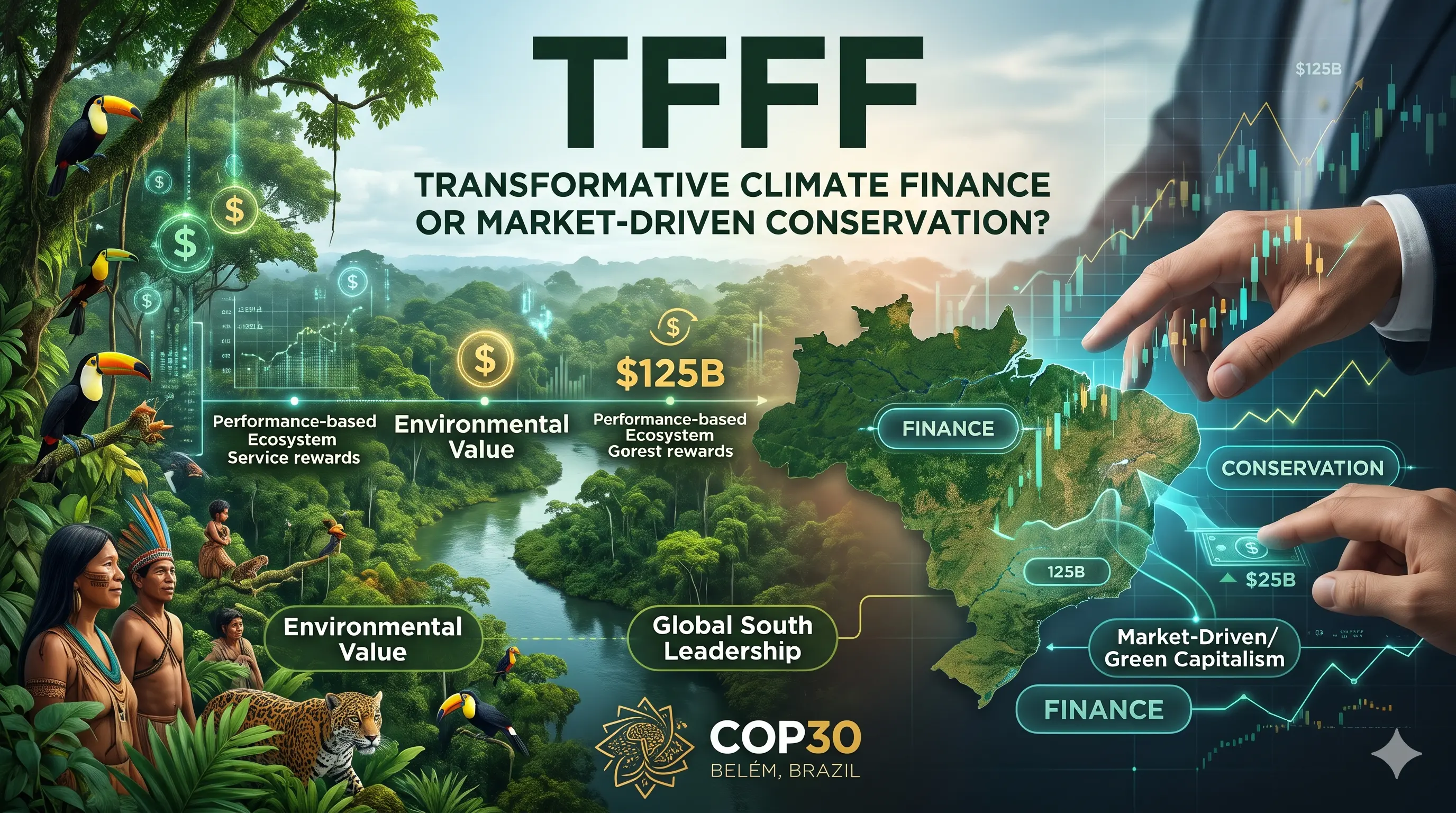
Introduced at COP 30 in Brazil (November 2025), the Tropical Forest Forever Facility (TFFF) is a $125 billion mechanism designed to reward tropical countries for conserving standing forests. While it marks a paradigm shift from traditional climate finance, it faces criticism over its market-driven approach and potential risks of greenwashing.
Introduction
Context & Background
Key Points
- •Valuing Ecosystem Services: TFFF assigns an economic value to standing and restored tropical forests, compensating countries for the carbon storage, biodiversity, and rainfall regulation they provide.
- •Performance-Based Payments: The facility pays Tropical Forest Countries (TFCs) for actively reducing deforestation and increasing forest cover.
- •Locally Driven Implementation: Each participating country and community decides how to use the generated payments for conservation and sustainable development.
- •Inclusive Benefit Sharing: A core mandate ensures that at least 20% of payments go to Indigenous Peoples and Local Communities (IPLCs), who are the frontline custodians of these forests.
- •Sustainable Financing Model: Unlike traditional donor grants, TFFF attracts sovereign and institutional investors to invest in the main fund, creating self-sustaining returns.
Eligibility Criteria for TFFF Participation
| Condition | Requirement / Detail | Bookmark |
|---|---|---|
| Deforestation Rate | Must be below 0.5% and not rise above entry level. | |
| Monitoring Systems | Must maintain transparent and auditable monitoring systems. | |
| Benefit Distribution | Guarantee fair distribution of benefits to local and Indigenous communities. | |
| Compliance | Sign and comply with the TFFF Charter ensuring transparency and accountability. | |
| Exclusions | High-income countries and monoculture plantation areas are strictly not eligible. |
Related Entities
Impact & Significance
- •Shift to Positive Incentives: Replaces the traditional damage-control approach (avoiding deforestation) with proactive rewards for ecosystem protection.
- •Long-Term Scalable Financing: Operates as a self-sustaining investment fund, drastically reducing the dependency on uncertain donor grants.
- •Natural Capital Accounting: Integrates ecological value into economic decision-making by recognizing the financial worth of carbon sequestration and rainfall regulation.
- •Empowering Indigenous Custodians: The 20% mandatory benefit-sharing empowers Indigenous and local communities as vital stakeholders in climate action.
- •Global South Leadership: Led by Brazil, it enhances developing countries' leadership and strengthens the climate justice narrative in global governance.
- •Performance-Based Accountability: Ensures transparency by linking payments to verified outcomes like reduced deforestation.
Challenges & Criticism
- •Market-Centric Vulnerabilities: Termed 'Green Capitalism', critics argue it commodifies nature and may prioritize investor returns over ecological justice.
- •Underpricing of Services: The proposed valuation of roughly $4 per hectare drastically undervalues ecosystem services, leading to minimal compliance.
- •Exclusionary Criteria: Strict eligibility conditions (like a <0.5% deforestation rate) might exclude the very countries that desperately need conservation funding.
- •Risk of Greenwashing: There are concerns that countries might display statistical gains or promote monoculture plantations without genuine ecological restoration.
- •Neglect of Structural Drivers: The mechanism fails to curb root causes of deforestation such as agribusiness expansion, mining, and unsustainable global consumption.
- •Monitoring Deficits: A lack of technical capacity in tropical countries could result in flawed data, poor verification, and eventual failure of the performance-based model.
Future Outlook
- •Fair Valuation: Moving beyond the criticized $4 per hectare rate to ensure the true economic value of ecosystem services is reflected.
- •Securing Land Rights: Strengthening Indigenous land rights to prevent displacement and ensure equitable conservation outcomes.
- •Capacity Building: Improving technical monitoring and verification capabilities in tropical countries to prevent flawed data implementation.
- •Holistic Governance: Aligning financial incentives with long-term ecological sustainability to prevent the facility from becoming a purely market-centric tool.
UPSC Relevance
- • GS-3 (Environment): Conservation, environmental pollution and degradation, climate finance, and natural capital accounting.
- • GS-2 (International Relations): Important International institutions, agencies, and global governance led by the Global South.
- • Mains Focus: Analyzing the shift in global climate finance (from mitigation to positive incentivization) and assessing the pros and cons of 'Green Capitalism'.
Sample Questions
Prelims
Consider the following statements regarding the Tropical Forest Forever Facility (TFFF): 1. It is a Brazil-led mechanism that rewards tropical countries for conserving standing forests. 2. High-income countries with tropical forests are eligible to participate and receive funds. 3. It mandates that a minimum of 20% of the payments must go to Indigenous Peoples and Local Communities (IPLCs). Which of the statements given above is/are correct?
- (a)Only 1 and 2
- (b)Only 2 and 3
- (c)Only 1 and 3
- (d)All of the above
Mains
“The Tropical Forest Forever Facility (TFFF) marks a paradigm shift in global forest conservation, yet it is not immune to the pitfalls of green capitalism.” Analyze this statement.
Introduction: Introduce TFFF launched at COP 30 in Brazil. Highlight its core philosophy: shifting from penalizing deforestation to financially rewarding standing forests.
Body:
• The Paradigm Shift: Shift from 'avoidance' to 'positive incentives'; treats standing forests as natural capital; creates a sustainable investment model ($125 billion) instead of relying on donor grants; mandates 20% benefits to IPLCs.
• Pitfalls (Green Capitalism): Commodification of nature; underpricing of services ($4/hectare); strict eligibility excluding high-deforestation nations; risk of monoculture 'greenwashing' and market volatility.
• Way Forward: Address root structural drivers (agribusiness, mining); ensure robust land tenure for Indigenous groups; enhance technical monitoring for verified outcomes.
Conclusion: Conclude that while TFFF is a bold Global South-led initiative, its ultimate success hinges on prioritizing long-term ecological and community welfare over mere investor returns.