
The Transgender Persons (Protection of Rights) Amendment Bill, 2026: Balancing Rights and Regulation
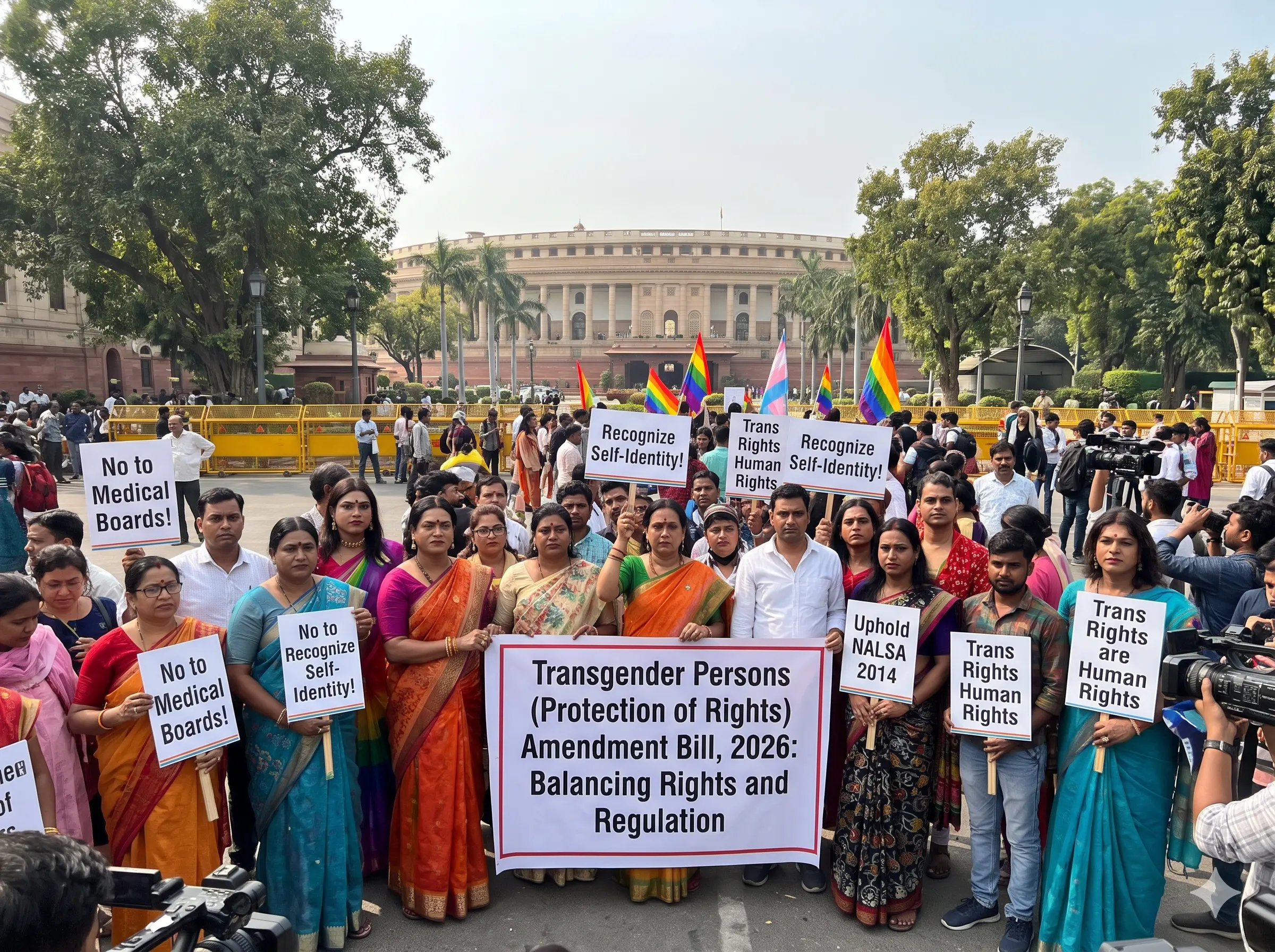
The Union Government has introduced the Transgender Persons (Protection of Rights) Amendment Bill, 2026 in the Lok Sabha. The proposed legislation seeks to alter the definition of a transgender person, eliminate the right to self-perceived gender identity, mandate medical board evaluations, and formalize reporting requirements for sex reassignment surgeries.
Introduction
Context & Background
Key Points
- •Narrowing the Definition: The 2026 Bill narrows the legal definition of transgender persons to socio-cultural identities (such as hijra, kinner, aravani, jogta, eunuch), persons with intersex variations, and individuals with congenital biological differences, leaving gender-fluid and non-binary individuals outside statutory recognition.
- •Inclusion of Coerced Alterations: A distinct clause brings individuals subjected to forced gender alterations—including non-consensual surgeries, castration, hormonal interventions, or physical mutilation—under protective statutory coverage.
- •Institutional Medical Screening: The Bill establishes a statutory Medical Board chaired by a Chief Medical Officer (CMO) to evaluate applications, removing the direct, paperless verification model administered by the District Magistrate.
- •Mandatory SRS Oversight: Individuals undergoing Sex Reassignment Surgery (SRS) are now legally mandated to apply for revised certification, and healthcare facilities performing SRS must formally notify the District Magistrate.
- •Enhanced Penal Framework: Strengthens penal deterrents with fines up to ₹5 lakh and imprisonment for denying access to public spaces, subjecting individuals to forced labor, or causing unlawful expulsion from households.
Comparative Analysis: 2019 Act vs. 2026 Proposed Amendment
| Parameter | Transgender Persons Act, 2019 | Proposed Amendment Bill, 2026 | Bookmark |
|---|---|---|---|
| Self-Identification | Recognises the right to self-perceived gender identity under Section 4(2). | Proposes the deletion of Section 4(2); eliminates pure self-identification. | |
| Scope of Definition | Broad umbrella definition covering trans men/women, genderqueer, non-binary, and socio-cultural identities. | Narrowed to socio-cultural identities, intersex variations, congenital differences, and victims of forced alterations. | |
| Certification Mechanism | District Magistrate issues certificate directly based on application and self-perception. | Mandatory evaluation by a CMO-headed Medical Board before DM issuance. | |
| Post-Surgery Revision | Optional application for a revised gender certificate after SRS. | Mandatory application for revision; hospitals obligated to report SRS procedures to the DM. | |
| Penal Provisions | Imprisonment ranging from 6 months to 2 years with nominal fines. | Graded penalties, including imprisonment and enhanced fines of up to ₹5 lakh for violations. |
Key Government Initiatives for Transgender Welfare
| Initiative / Scheme | Core Focus Area | Key Objective | Bookmark |
|---|---|---|---|
| SMILE Scheme | Rehabilitation and Health | Provides comprehensive welfare, livelihood support, and medical coverage for SRS. | |
| National Portal for Transgender Persons | Digital Governance | Enables paperless applications for ID cards and certificates without physical bureau visits. | |
| Garima Greh | Shelter and Social Security | Safe shelter homes offering food, accommodation, healthcare, and skill development. | |
| Inclusive Education Modules (NCERT) | Sensitization | Training school teachers to foster gender diversity and anti-discrimination environments. |
Related Entities
Impact & Significance
- •Constitutional Jurisprudence: Tests the limits of the State's regulatory authority against Fundamental Rights guaranteed under Articles 14, 19(1)(a), and 21.
- •Public Policy & Governance: Impacts the efficiency and uptake of social safety nets, welfare distribution, and identity documentation across federal schemes.
- •Global Human Rights Alignment: Diverges from international progressive standards, contrasting with statutes like Ireland's Gender Recognition Act and Argentina's self-determination framework.
- •Sports and Institutional Repercussions: Mirrors emerging international shifts toward biological essentialism, as seen in the International Olympic Committee (IOC) 2028 policy restricting women's categories to biological females.
Challenges & Criticism
- •Conflict with Judicial Precedent: Critics highlight that deleting self-perceived identity directly counters the Supreme Court's landmark ruling in NALSA v. Union of India (2014), which established that self-determination of gender identity without medical intervention is integral to Article 21.
- •Compromise of Bodily Autonomy: Compulsory physical examinations by a clinical board infringe upon fundamental privacy and expose vulnerable individuals to intrusive, degrading evaluations.
- •Exclusion of Queer and Fluid Identities: By prioritizing visible physical variations and socio-cultural lineages, individuals identifying as genderqueer, agender, or gender-fluid face statutory exclusion.
- •Administrative Red Tape: Adding institutional layers through medical boards and bureaucratic inquiries risks procedural delays and administrative exploitation.
- •Reinforcing Pathologization: Grounding legal recognition in clinical gatekeeping reinforces societal biases that transgender identity is an abnormality requiring diagnostic validation.
Future Outlook
- •Affirming Self-Declaration: Policy frameworks should align with global best practices (e.g., Argentina's Gender Identity Law, Ireland's Gender Recognition Act 2015) by maintaining administrative self-declaration without medical coercion.
- •Multi-Disciplinary Oversight: If evaluation boards are retained, they must emulate inclusive state models (such as Kerala's Transgender Policy) featuring civil society representatives, mental health professionals, and community peers.
- •Horizontal Affirmative Action: Granting explicit horizontal reservations across higher education and public employment (modeled after initiatives in Tamil Nadu) to remedy systemic socioeconomic deprivation.
- •Participatory Pre-Legislative Consultation: Conducting structured stakeholder consultations with grassroots queer, intersex, and trans organizations to reconcile executive governance with civil liberties.
UPSC Relevance
- • GS-2 (Polity & Governance): Vulnerable sections, mechanisms, laws, and institutions; balancing individual rights with state regulation.
- • GS-2 (Judiciary & Fundamental Rights): Enforcing Article 21 (Dignity and Autonomy), judicial review of parliamentary legislation, and compliance with the NALSA (2014) and Puttaswamy (2017) verdicts.
- • GS-4 (Ethics): Ethical dilemmas concerning medical paternalism vs. personal autonomy, empathy toward marginalized communities, and social equity.
- • Essay Themes: 'Inclusivity vs. Biological Essentialism', 'Dignity as the Bedrock of Fundamental Rights'.
Sample Questions
Prelims
With reference to transgender rights and governance in India, consider the following statements: 1. The Supreme Court in NALSA v. Union of India (2014) ruled that medical certification is an indispensable prerequisite for legal gender recognition. 2. Under the SMILE scheme, the Ministry of Social Justice and Empowerment provides comprehensive welfare, rehabilitation, and medical support for transgender persons. 3. The National Portal for Transgender Persons was set up to enable paperless issuance of identity certificates based on self-declaration. Which of the statements given above are correct?
- (a)1 and 2 only
- (b)2 and 3 only
- (c)1 and 3 only
- (d)1, 2, and 3
Mains
“The tension between state-mandated biological verification and personal bodily autonomy lies at the core of the Transgender Persons (Protection of Rights) Amendment Bill, 2026.” Critically examine this statement in light of constitutional guarantees and international best practices.
Introduction: Introduce the context of the 2026 Amendment Bill introduced in Lok Sabha, which seeks to delete Section 4(2) of the 2019 Act and replace self-identification with CMO-led medical scrutiny.
Body:
• Constitutional Conflicts: Examine how mandatory medical examinations challenge Article 21 (Right to Privacy, Bodily Autonomy, Human Dignity) and Article 14 (Arbitrary classification excluding non-binary and fluid identities), contravening the core mandates of the NALSA (2014) and Puttaswamy (2017) judgments.
• Administrative Rationale vs. Ground Realities: Analyze the state's intent to regulate documentation integrity against the risk of bureaucratic harassment, clinical pathologization, and systemic gatekeeping.
• Global Frameworks & Balanced Reform: Contrast with self-declaration paradigms (Argentina, Ireland) and propose decentralized, peer-represented verification boards alongside horizontal reservations.
Conclusion: Conclude by emphasizing that genuine legislative reform must reconcile administrative due diligence with constitutional humanism, ensuring that identity certification respects individual dignity.