
UGC Equity Guidelines 2026: Mechanisms Against Discrimination in Higher Education
The UGC notified the Promotion of Equity in Higher Education Institutions Regulations, 2026, creating enforceable mechanisms to prevent discrimination across universities. While aimed at systemic inclusion, it has attracted protests by students over concerns of potential misuse and criminalization.
Introduction
Context & Background
Key Points
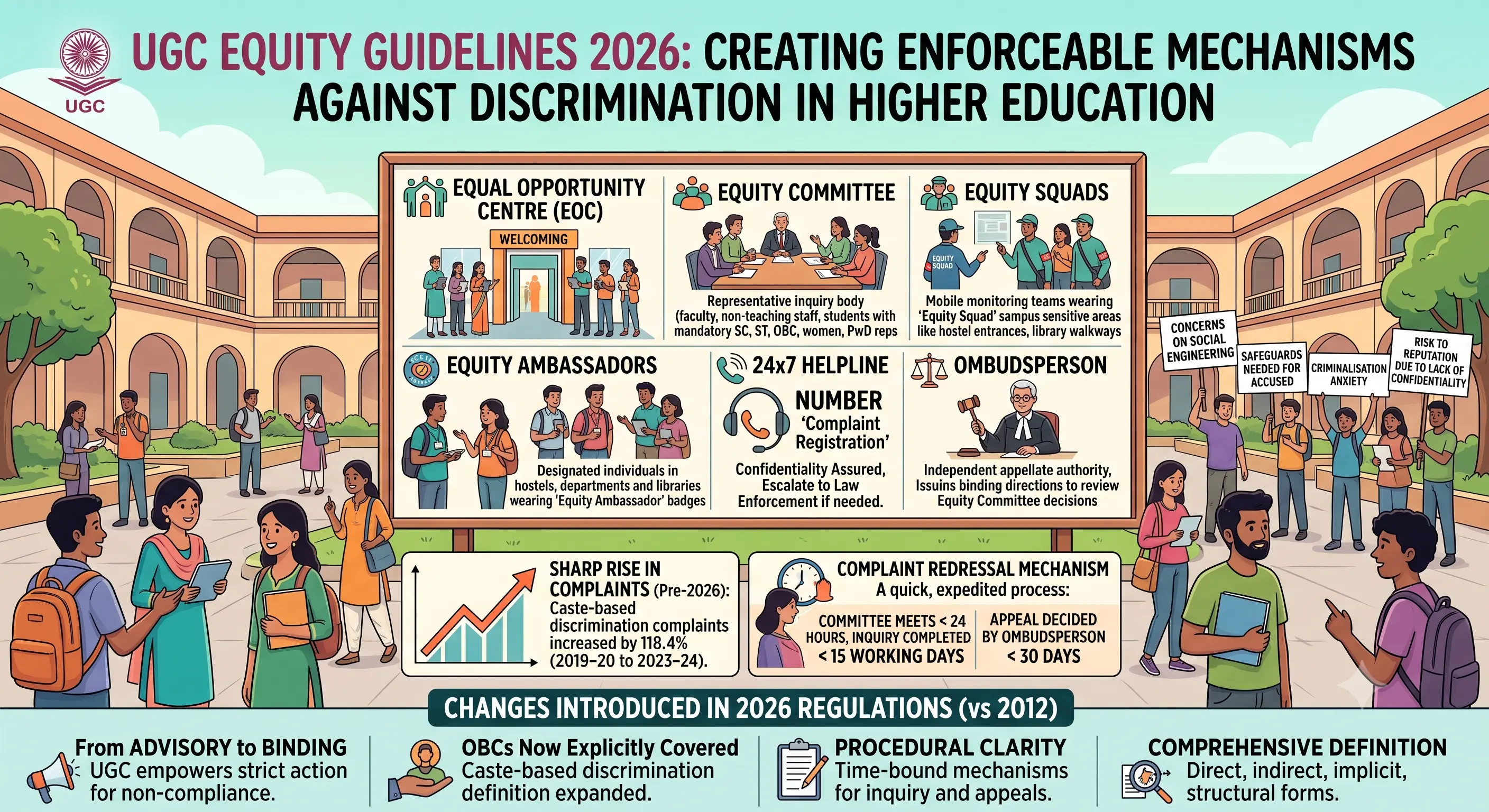
- •Institutional Architecture: Mandates an Equal Opportunity Centre (EOC) in every Higher Education Institution (HEI), led by an Equity Committee with mandatory representation for SC, ST, OBC, women, and persons with disabilities.
- •Vigilance and Support: Introduces mobile 'Equity Squads' to survey sensitive campus spaces, 'Equity Ambassadors' in hostels and libraries, and an independent Ombudsperson for appeals.
- •Expedited Redressal: A 24×7 Equity Helpline will be set up. The Equity Committee must convene within 24 hours of receiving a complaint and conclude its inquiry within 15 working days.
- •Rising Campus Discrimination: Reported cases of caste-based discrimination have surged by 118.4% (from 173 in 2019–20 to 378 in 2023–24), with pending cases rising from 18 to 108.
- •UGC's Mandate: The University Grants Commission (UGC) is India's sole statutory body (under the UGC Act, 1956) tasked with disbursing grants and maintaining higher education standards under the Ministry of Education.
Changes Introduced in UGC Regulations, 2026 (Earlier 2012 Framework)
| Parameter | 2012 Framework | 2026 Regulations | Bookmark |
|---|---|---|---|
| Enforceability | Earlier guidelines were largely advisory in nature. | Binding regulations empowering UGC to initiate strict action for non-compliance. | |
| Procedural Clarity | Lacked defined timelines for resolving grievances. | Time-bound mechanisms laid down for complaint inquiry and appeals. | |
| Scope of Inclusion | Limited caste definitions. | OBCs are now explicitly covered within the definition of caste-based discrimination. | |
| Definition of Discrimination | Narrowly defined. | Comprehensive scope covering direct, indirect, implicit, and structural forms. |
Related Entities
Impact & Significance
- •Accountability for Institutions: By making the regulations binding, universities can no longer brush discrimination under the rug without facing strict actions from the UGC, including potential loss of funding or recognition.
- •Broader Protective Net: By explicitly including OBCs and recognizing structural and implicit forms of discrimination, the policy addresses micro-aggressions that were previously ignored.
- •Rapid Intervention: The mandated 24-hour response time and 15-day inquiry window ensure that students in distress receive immediate institutional attention, potentially saving lives.
- •Continuous Oversight: Equity Squads and 24x7 helplines move the system from a reactive approach to a proactive, continuously monitored campus environment.
Challenges & Criticism
- •Absence of Defenses: The framework currently lacks explicit safeguards to filter out or penalize false and malicious complaints.
- •Due Process Concerns: There are no robust confidentiality protections for the accused during the initial inquiry stages, risking permanent reputational damage before guilt is established.
- •Criminalization of Campuses: Linking the 24x7 equity helpline directly to law enforcement for penal provisions has sparked anxiety that it will deter open intellectual and academic dialogue.
- •Rushed Investigations: A strict 15-day timeline, while good for speed, may compromise the thoroughness and fairness of fact-finding in complex cases.
Future Outlook
- •Defined Evidentiary Standards: Issuing detailed guidelines on proof thresholds and interpretative limits, similar to existing civil service conduct rules.
- •Confidentiality Protocols: Ensuring the anonymity of respondents during inquiries through sealed or restricted proceedings to prevent reputational damage before a verdict.
- •Capacity Building: Strengthening Equity Committees through structured training programmes, drawing from established institutional models like the IIIDEM.
- •Flexible Timelines: Introducing graded inquiry durations for complex cases to ensure a balance between rapid redressal and procedural fairness.
UPSC Relevance
- • GS-2 (Statutory Bodies): Mandate, structure, and powers of the University Grants Commission (UGC).
- • GS-2 (Social Justice): Mechanisms, laws, and institutions constituted for the protection and betterment of vulnerable sections.
- • Essay Topics: 'Systemic Discrimination in Higher Education', 'Balancing Regulation and Academic Freedom in Universities'.
- • Mains Focus: Analyzing the shift from advisory to binding guidelines and assessing the challenges in implementing the 2026 UGC Regulations.
Sample Questions
Prelims
Consider the following statements regarding the University Grants Commission (UGC) and its Promotion of Equity Regulations, 2026:
1. The 2026 Regulations explicitly cover OBCs within the definition of caste-based discrimination.
2. The University Grants Commission (UGC) is a constitutional body established under Article 338.
3. Under the new regulations, the Equity Committee is given a maximum of 60 days to complete a complaint inquiry.
Answer: Option 1
Explanation: Statement 1 is correct. Statement 2 is incorrect; the UGC is a statutory body established by the UGC Act, 1956. Statement 3 is incorrect; the Equity Committee must complete its inquiry within 15 working days, not 60.
Mains
The UGC Promotion of Equity in Higher Education Institutions Regulations, 2026 mark a shift from advisory guidelines to an enforceable framework. Discuss the key provisions of these regulations and evaluate the concerns raised against their implementation.
Introduction: Provide context by citing the 118.4% rise in caste-based discrimination cases on campuses. Briefly introduce the 2026 regulations as a statutory intervention by the UGC.
Body:
• Key Provisions: Establishment of Equal Opportunity Centres (EOC), Equity Committees with marginalized representation, Equity Squads, 24x7 helplines, and an independent Ombudsperson. Strict timelines (15 days for inquiry).
• Shift to Enforceability: UGC now has powers to take strict action for non-compliance. Expansion of scope to explicitly include OBCs and structural/implicit discrimination.
• Concerns & Criticisms: Absence of safeguards against malicious complaints; risk of reputational damage due to lack of confidentiality; fear that police linkage might stifle open academic dialogue; time constraints affecting fair inquiries.
Conclusion: Conclude by emphasizing the need for procedural safeguards, such as defined evidentiary standards and confidentiality protocols, to ensure the regulations achieve social justice without compromising academic freedom or natural justice.