
UGC (Promotion of Equity in Higher Education Institutions) Regulations, 2026
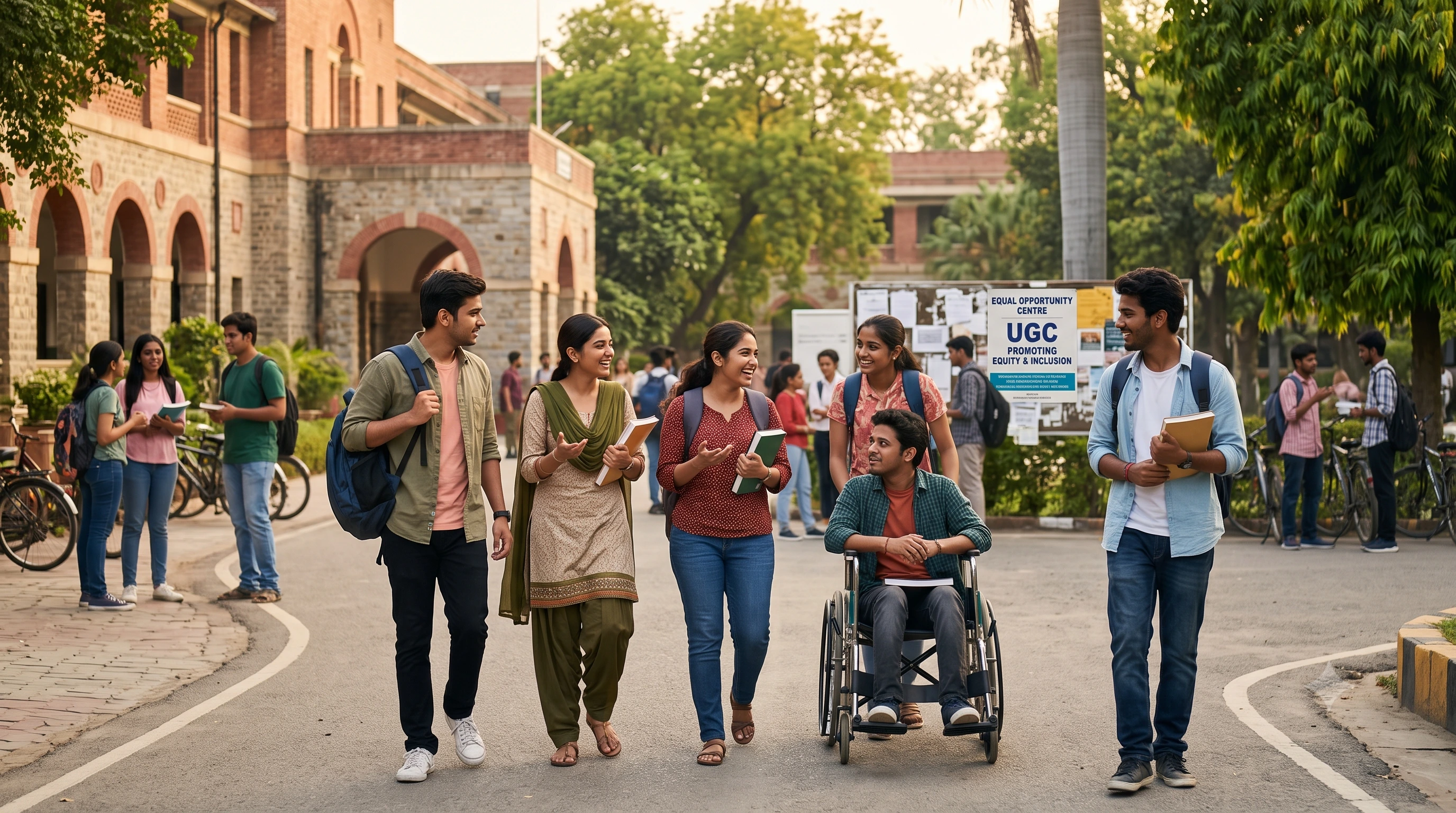
The Supreme Court has granted an interim stay on the UGC (Promotion of Equity in Higher Education Institutions) Regulations, 2026, temporarily reinstating the 2012 guidelines. These regulations aim to combat caste-based and intersectional discrimination in higher education through mandatory Equity Committees but have faced concerns regarding institutional autonomy, administrative burden, and potential misuse.
Introduction
Context & Background
Key Points
- •Expanded Scope of Discrimination: Defines discrimination as any unfair, differential, or biased treatment (explicit or implicit) covering grounds of religion, race, caste, gender, place of birth, and disability.
- •Inclusion of OBCs: Explicitly brings Other Backward Classes (OBCs) within the ambit of caste-based discrimination, addressing a key omission in previous draft rules.
- •Mandatory Equity Committees: Requires every Higher Education Institution (HEI) to establish an Equity Opportunity Centre (EOC), chaired by the head of the institution, to meet at least twice a year.
- •Strict Penalties for Non-compliance: Introduces graduated punishments for institutions, including being barred from offering degrees or facing the withdrawal of UGC recognition.
- •Shift to Substantive Equality: By recognizing unequal starting points, the Regulations move away from mere formal equality (like the advisory 2012 guidelines) toward enforceable constitutional values of justice and social transformation.
Key Committees and Legislative Proposals on Campus Equity
| Committee/Act | Year | Key Finding / Purpose | Bookmark |
|---|---|---|---|
| Thorat Committee | 2007 | Reported that SC/ST students faced avoidance and differential treatment from faculty. | |
| Mungekar Committee | 2012 | Documented systemic exclusion and discrimination faced by marginalized students. | |
| Rohith Act | Proposed 2016 | Unpassed bill aimed at preventing caste-based discrimination against Dalit students. |
India's Academic Access & Financial Support Initiatives
| Scheme | Target Group | Purpose | Bookmark |
|---|---|---|---|
| SHRESHTA | Meritorious SC students | Access to quality residential education in reputed private schools. | |
| National Fellowship for SC/ST | M.Phil. & Ph.D. scholars | Financial support to enhance academic independence and research. | |
| PM-AJAY | SC students | Construction of hostels to improve safety, inclusion, and retention. | |
| Top Class Education Scheme | SC/ST students | Full funding for students in premier institutions like IITs and IIMs. |
Related Entities
Impact & Significance
- •Mental and Emotional Strain: Persistent exclusion and harassment place a heavy psychological burden on marginalized students, significantly increasing the risk of anxiety, depression, and self-harm.
- •Barriers to Academic Progress: Unequal evaluation, social isolation, and limited access to mentorship restrict learning opportunities and career advancement for SC, ST, and OBC groups.
- •Deepening Inequality: Unfair practices reinforce underrepresentation in higher education and professional fields, perpetuating intergenerational cycles of disadvantage.
- •Global Benchmarking: Implementing strict equity, diversity, and inclusion (EDI) frameworks aligns Indian universities with global academic governance norms, potentially improving international credibility.
Challenges & Criticism
- •Due Process Deficit: The regulations lack clear procedural safeguards for inquiry and evaluating complaints, raising fears of misuse, malicious complaints, and unfair targeting of faculty.
- •Threat to Institutional Autonomy: Critics contend that mandatory compliance extends regulatory control too deeply into internal governance, potentially diluting academic freedom and institutional autonomy.
- •Administrative Burden: Establishing Equal Opportunity Centres, helplines, and rapid-response systems demands financial and human resources that smaller and private institutions may lack.
- •Exclusionary Scope: The Supreme Court observed that the framework does not explicitly address discrimination based on region, language, or intra-caste dynamics, nor does it cover harassment faced by general category students.
Future Outlook
- •Capacity Building over Compliance: UGC should prioritize providing grants and training modules to help institutions build effective Equity Cells, rather than solely focusing on punitive measures.
- •Independent Oversight: Grievance committees must include external experts and civil society members to guarantee impartiality and protect complainants from institutional backlash.
- •Bridging the Digital & Language Divide: True equity requires addressing the 'Digital Gap' and providing robust bilingual support so first-generation learners are not excluded by the medium of instruction.
- •Mental Health Integration: Equity cells must work closely with campus counseling centers, recognizing that systemic discrimination frequently triggers severe mental health crises among marginalized students.
- •Bottom-Up Sensitization: Fostering 'Voluntary Inclusion' through student-led diversity clubs and peer-mentorship to make equity a cultural movement rather than just a top-down mandate.
UPSC Relevance
- • GS-2 (Social Justice): Mechanisms, laws, institutions, and bodies constituted for the protection and betterment of vulnerable sections.
- • GS-2 (Governance): Issues relating to the development and management of Social Sector/Services relating to Education.
- • Essay Topics: 'Merit versus Equity in Higher Education', 'The Persistence of Caste in Modern Indian Institutions'.
- • Mains Focus: Analyzing the tension between institutional autonomy and state-mandated social justice regulations.
Sample Questions
Prelims
Consider the following statements regarding the UGC (Promotion of Equity in Higher Education Institutions) Regulations, 2026: Which of the statements given above are correct?
1. It explicitly brings Other Backward Classes (OBCs) within the ambit of caste-based discrimination.
2. It mandates that the Equity Opportunity Centre (EOC) in every institution be chaired by the UGC Chairman.
3. The Supreme Court has placed an interim stay on these regulations, temporarily reinstating the 2012 rules.
4. It restricts the definition of discrimination solely to the admission process, excluding classroom and hostel dynamics.
Answer: Option 3
Explanation: Statement 1 is correct. Statement 2 is incorrect; the EOC is chaired by the head of the respective institution. Statement 3 is correct. Statement 4 is incorrect; the regulations cover everyday systemic exclusion including hostel segregation, classroom participation, and evaluation bias. Therefore, options 1 and 3 are correct.
Mains
The UGC (Promotion of Equity in Higher Education Institutions) Regulations, 2026 mark a shift from formal to substantive equality in Indian universities. Critically analyze the significance of these regulations and the concerns that have led to judicial scrutiny.
Introduction: Briefly introduce the UGC 2026 Regulations, their context (sharp rise in campus discrimination cases), and mention the Supreme Court's recent interim stay under Article 142.
Body:
• Significance: Replaces the toothless 2012 advisory with binding obligations and penalties; expands discrimination scope to include OBCs; addresses everyday exclusions (hostel segregation, mentoring biases); aligns with Article 15(4), 15(5), and 46.
• Concerns & Judicial Scrutiny: Lack of procedural safeguards against false/malicious complaints; heavy administrative and financial burden on smaller institutions; threat to academic freedom and institutional autonomy; exclusionary scope that ignores regional or linguistic discrimination.
• Way Forward: Integrating independent oversight in grievance redressal; standardizing definitions of harassment; combining compliance with capacity building and mental health support.
Conclusion: Conclude by emphasizing that while dismantling entrenched academic hierarchies requires strong regulations, such frameworks must balance social justice with procedural fairness and institutional autonomy to be sustainable.