
From UGC to VBSA: Rethinking Higher Education Regulation in India
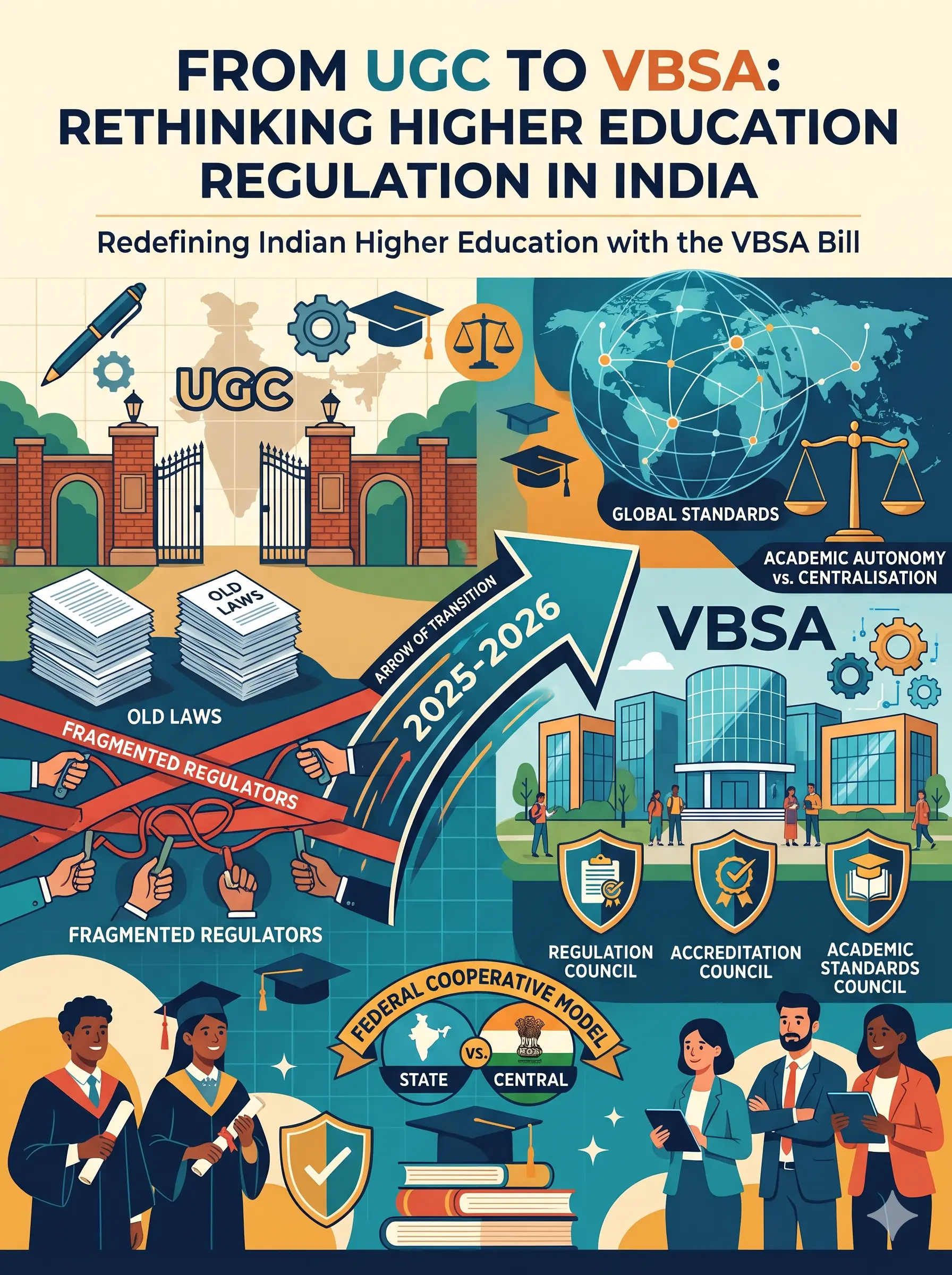
The proposed Viksit Bharat Shiksha Adhishthan (VBSA) Bill, 2025 seeks to replace existing fragmented higher education regulators like the UGC and AICTE with a single, unified apex body. While it aims to streamline approvals and promote multidisciplinary education, it faces criticism over potential over-centralisation and threats to academic autonomy.
Introduction
Context & Background
Key Points
- •Constitutional Backing: The Bill is based on Entry 66 of the Union List, which empowers the Central Government to coordinate and determine standards in higher education and research institutions.
- •Repeal of Legacy Laws: The Bill marks a paradigm shift by proposing to repeal outdated legislations, specifically the University Grants Commission (UGC) Act, 1956, the AICTE Act, 1987, and the NCTE Act, 1993.
- •Separation of Powers: By creating distinct bodies for regulation, accreditation, and standard-setting, the VBSA attempts to remove the overlapping jurisdictions that currently plague the higher education system.
- •Strict Penal Provisions: The regulatory body is equipped with powers to penalize institutions that violate rules, aimed at ensuring strict compliance. Appeals against VBSA decisions will lie directly with the Central Government.
- •Exemptions: Specialized fields like medical and legal education are kept entirely outside the scope of the VBSA Bill and will continue to be governed by their respective statutory bodies.
- •Focus on Multidisciplinary Growth: A core function of the VBSA will be to develop concrete plans to transition siloed colleges into comprehensive multi-disciplinary universities.
Key Bodies Proposed Under the VBSA Bill
| Proposed Body | Primary Function | Objective | Bookmark |
|---|---|---|---|
| Viksit Bharat Shiksha Adhishthan (VBSA) | Central apex regulator | Provides overall strategic direction and policy guidance (does not handle funding). | |
| Regulation Council | Regulatory oversight | Oversees compliance and the day-to-day functioning of institutions. | |
| Accreditation Council | Quality assessment | Assesses the quality, performance, and outcomes of institutions. | |
| Academic Standards Council | Standard setting | Sets academic benchmarks, curriculum guidelines, and quality standards. |
Global Best Practices in Higher Education Governance
| Country | Governance Model | Key Takeaway for India | Bookmark |
|---|---|---|---|
| United Kingdom | Office for Students | Separates funding, regulation, and quality assurance to avoid overlap. | |
| United States | Decentralized Autonomy | High academic autonomy in curriculum and research fosters global rankings. | |
| Australia | Multidisciplinary Focus | Integrates STEM, humanities, and vocational courses under one framework. | |
| Germany | Federal Cooperative Model | States (Länder) play a major role in education governance, reflecting regional diversity. |
Related Entities
Impact & Significance
- •Eradication of Red Tape: Consolidating multiple regulators into one will drastically reduce the compliance burden on universities, allowing them to focus on teaching and research rather than paperwork.
- •Outcome-Based Evaluation: By dividing responsibilities among specialized councils, the system aims to shift focus from input metrics (like campus size) to output metrics (like research quality and employability).
- •Integration of Disciplines: The unified structure breaks down the silos between technical and general education, paving the way for holistic, multidisciplinary learning as envisioned in the NEP 2020.
Challenges & Criticism
- •Hyper-Centralisation: Critics argue that placing the VBSA and its appellate mechanisms entirely under Central Government control undermines institutional independence and creates a monopoly on educational policy.
- •Erosion of Academic Freedom: The broad powers to penalize institutions or cancel degrees could foster a culture of fear, actively discouraging universities from making independent or unorthodox academic decisions.
- •Federal Friction: Education is a shared responsibility, yet State governments—which fund and manage the vast majority of state universities and colleges—are largely sidelined in this new centralized governance model.
- •Risk of Commercialisation: The Bill's silence on public funding mechanisms raises fears of reduced state investment, potentially pushing the sector towards profit-driven models that neglect equity and access for marginalized students.
Future Outlook
- •Independent Coordination: To succeed, the VBSA must function as an independent coordinating facilitator rather than a centralized controller, separating the powers of funding, regulation, and accreditation.
- •Linking Autonomy to Performance: India must emulate the US model by granting universities full academic and administrative autonomy, linking regulatory freedom strictly to performance, research output, and employability metrics.
- •Strengthening Public Funding: The government must commit to the NEP 2020 recommendation of raising education spending to 6% of GDP, ensuring transparent funding mechanisms similar to Finland's model.
- •Cooperative Federalism: A formalized cooperative governance structure must be established to ensure State governments have a meaningful voice in higher education policy, akin to Germany's federal model.
UPSC Relevance
- • GS-2 (Social Justice & Governance): Issues relating to the development and management of Social Sector/Services relating to Education; Statutory, regulatory, and various quasi-judicial bodies.
- • GS-2 (Polity): Issues and challenges pertaining to the federal structure (Centre-State relations in concurrent subjects vs Union List Entry 66).
- • Essay Topics: 'Autonomy vs Accountability in Higher Education', 'The corporatization of Indian Universities'.
- • Mains Focus: Critical analysis of the VBSA Bill, comparing it with global best practices and historical committee recommendations.
Sample Questions
Prelims
With reference to the proposed Viksit Bharat Shiksha Adhishthan (VBSA) Bill, 2025, consider the following statements: 1. It seeks to bring all higher education streams, including medical and legal education, under a single regulatory umbrella. 2. It derives its legislative competence from Entry 66 of the Union List. 3. The overarching VBSA body will handle both the strategic regulation and the financial funding of universities. Which of the statements given above is/are correct?
- (a)1 and 2 only
- (b)2 only
- (c)2 and 3 only
- (d)1, 2 and 3
Mains
“The transition from multiple regulatory bodies to a single apex authority under the Viksit Bharat Shiksha Adhishthan (VBSA) Bill is a double-edged sword for India’s higher education.” Critically analyze this statement in the context of academic autonomy and federalism.
Introduction: Introduce the VBSA Bill, 2025, detailing its objective to replace the UGC, AICTE, and NCTE to create a unified regulatory architecture under Entry 66 of the Union List.
Body:
• The Need for VBSA (The Positive Edge): Discuss the fragmented structure (UGC, AICTE overlaps), excessive bureaucratic delays, lack of multidisciplinary coordination, and the need to shift from input-based compliance to outcome-based performance.
• Threat to Autonomy and Federalism (The Negative Edge): Highlight concerns regarding extreme centralisation, the Central government's absolute control over appeals and penalties, and the marginalization of State governments who run the majority of higher education institutions.
• Way Forward: Suggest international best practices like the UK's Office for Students (separation of powers), the US model of academic autonomy, and Germany's cooperative federal governance to balance regulation with freedom.
Conclusion: Conclude that while unifying the regulatory framework is a necessary step, the VBSA must act as a facilitator of excellence rather than an instrument of bureaucratic control, ensuring adequate public funding and equitable access.