
Visit of Canadian Prime Minister to India: Strategic Reset and Multilateral Engagement
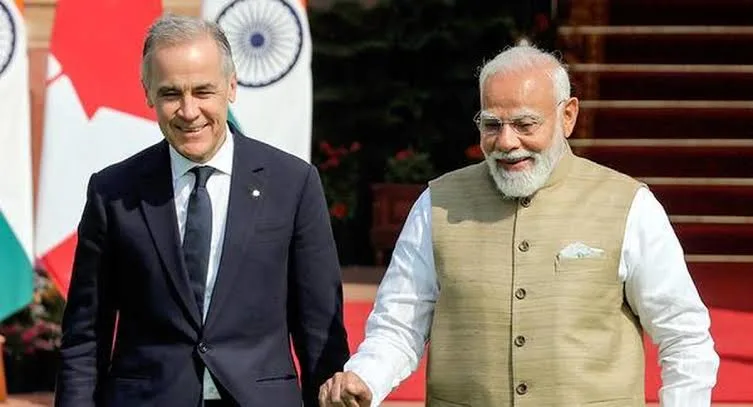
The visit of the Canadian Prime Minister to India in early 2026 marked a pivotal diplomatic reset following years of strained ties. The summit yielded major outcomes across bilateral trade, including the finalization of the CEPA framework targeting $50 billion by 2030, a long-term Cameco uranium supply deal, critical mineral partnerships, and Canada joining key Indian-led multilateral initiatives.
Introduction
Context & Background
Key Points
- •Diplomatic Reset & Political Engagement: The visit signaled a transition from ideological friction toward economic and strategic pragmatism, institutionalized through the revived India–Canada CEO Forum and a newly established Parliamentary Friendship Group.
- •Uranium Supply Agreement (Cameco): Canada signed a long-term commercial agreement to supply uranium ore concentrates, directly reinforcing India's target of reaching 100 GW nuclear capacity by 2047 and insulating against single-supplier geopolitical disruptions.
- •Comprehensive Economic Partnership Agreement (CEPA): Both nations finalized the Terms of Reference to initiate CEPA negotiations, targeting USD 50 billion in two-way trade by 2030.
- •Critical Minerals & Renewable Energy: Signed an MoU for joint exploration, mining, and processing of critical minerals for clean tech, alongside collaborations in solar, wind, biomass, and energy storage.
- •Multilateral & Indo-Pacific Convergence: Canada officially joined the Indian-led International Solar Alliance (ISA) and Global Biofuels Alliance (GBA), while India extended support for Canada’s entry as an IORA (Indian Ocean Rim Association) Dialogue Partner.
- •Talent Mobility & Education: Launched the AICTE–Mitacs Internship MoU providing up to 300 Indian STEM students funded research internships in Canada annually, complemented by a Universities Canada Joint Talent and Innovation Strategy.
- •Food Security Synergy: Established the Pulse Protein Centre of Excellence at NIFTEM-K, linking Canadian agricultural pulse exports with India’s domestic processing and nutritional security needs.
Major Agreements and Institutional Outcomes
| Sector | Key Agreement / Outcome | Strategic Significance | Bookmark |
|---|---|---|---|
| Trade & Investment | CEPA Terms of Reference Finalized | Launches formal negotiations across goods, services, and investments targeting $50B bilateral trade by 2030. | |
| Civil Nuclear Energy | Cameco Uranium Supply Contract | Secures high-grade fuel supply to support India’s target of 100 GW nuclear capacity by 2047. | |
| Strategic Resources | Critical Minerals MoU | Cooperation in mining and processing to build resilient supply chains for clean tech, EVs, and advanced manufacturing. | |
| Technology & Innovation | ACITI Trilateral (India–Canada–Australia) | Promotes research collaboration and innovation ecosystems in emerging and strategic technologies. | |
| Multilateral Alignments | Canada joins ISA & GBA | Enhances clean energy governance and aligns Indo-Pacific maritime interests via IORA Dialogue Partnership support. |
Strategic Imperatives of India's Uranium Diversification
| Supplier Nation | Role in Supply Chain | Strategic Advantage | Bookmark |
|---|---|---|---|
| Canada (Cameco) | Commercial contract for high-grade uranium ore concentrates | Ores with up to 15% concentration offer cost-effective fuel and reduce financing risks. | |
| Kazakhstan & Uzbekistan | Long-term natural uranium supply | Reliable Central Asian supply corridors insulating against maritime export disruptions. | |
| Russia | Enriched fuel assemblies for Kudankulam Nuclear Power Plant | Sustained technical and reactor-specific fuel continuity. |
Related Entities
Impact & Significance
- •Civil Nuclear Fuel Security: Long-term uranium procurement from Canada complements domestic supplies and existing contracts with Kazakhstan, Uzbekistan, and Russia, lowering geopolitical vulnerabilities.
- •Clean Technology Supply Chains: Cooperation in critical minerals strengthens India's industrial manufacturing ecosystem for electric vehicles and renewable energy storage.
- •Bilateral Trade Acceleration: The framework for CEPA offers a definitive roadmap to expand trade from current levels to $50 billion by 2030.
- •Educational and Research Synergy: Funded AICTE–Mitacs internships and university partnerships expand high-skill STEM pathways between Indian academia and Canadian research labs.
Challenges & Criticism
- •Domestic Political Sensitivities: Addressing underlying political and security concerns regarding separatist groups and diaspora activities remains essential to prevent future friction.
- •Negotiation Hurdles in CEPA: Tariff reductions on agricultural items, stringent rules of origin, and services sector mobility may pose complex bargaining challenges during trade negotiations.
- •Implementation Latency: Past bilateral mechanisms have occasionally suffered from slow follow-through; operationalizing the Critical Minerals MoU and ACITI trilateral will require sustained bureaucratic momentum.
Future Outlook
- •Fast-Tracking CEPA Negotiations: Ensuring timely finalization of the trade pact to tap unhindered market access in services, agriculture, and high-value manufacturing.
- •Securing Resilient Supply Chains: Operationalizing critical mineral corridors to counter concentrated global supply dependencies in green energy and semiconductor ecosystems.
- •Institutional Defense Dialogue: Utilizing the newly established India–Canada Defence Dialogue to deepen maritime domain awareness and counter-terrorism coordination in the Indo-Pacific.
- •Managing Domestic Political Sensitivities: Relying on parliamentary channels and institutional mechanisms to insulate long-term economic and strategic pacts from periodic domestic political volatility.
UPSC Relevance
- • GS-2 (Bilateral Relations & Agreements): India–Canada diplomatic trajectory, CEPA negotiations, institutional dialogue mechanisms, and diaspora/political dynamics.
- • GS-2 (Global Groupings & Multilateralism): Indo-Pacific alignments, IORA dialogue partnership, and India-led global initiatives (ISA, GBA).
- • GS-3 (Energy Security & Nuclear Energy): Diversification of civilian nuclear fuel supplies, 100 GW by 2047 goal, and Cameco commercial contracts.
- • GS-3 (Science & Tech / Supply Chains): Critical minerals supply chains, ACITI trilateral framework, and STEM talent mobility.
Sample Questions
Prelims
Consider the following statements regarding the recent developments in India–Canada bilateral relations: 1. The Cameco contract ensures a commercial supply of uranium ore concentrates to support India's civil nuclear energy expansion. 2. Canada has officially joined both the International Solar Alliance (ISA) and the Global Biofuels Alliance (GBA). 3. The ACITI trilateral technology partnership comprises India, Canada, and the United States. Which of the statements given above are correct?
- (a)1 and 2 only
- (b)2 and 3 only
- (c)1 and 3 only
- (d)1, 2 and 3
Mains
“India’s renewed engagement with Canada highlights a transition from ideological divergence to economic and strategic pragmatism.” Analyze this statement in the context of recent bilateral agreements in energy, critical minerals, and trade.
Introduction: Highlight the significance of the Canadian Prime Minister's visit as a structured diplomatic reset following recent bilateral chill, underscoring the shift toward strategic economic interests.
Body:
• Economic & Strategic Drivers: Finalization of CEPA Terms of Reference ($50B target by 2030); revival of the CEO Forum; Critical Minerals MoU addressing green transition dependencies.
• Energy & Clean Governance Synergy: High-grade uranium supply contract with Cameco supporting the 100 GW nuclear roadmap; Canada joining ISA and Global Biofuels Alliance.
• Institutionalizing Ties & Overcoming Friction: Launch of ACITI trilateral, formal Defence Dialogue, and Parliamentary Friendship Group to create shock absorbers against political turbulence.
Conclusion: Conclude that sustained institutional dialogue, mutual respect for core sensitivities, and supply chain convergence will determine the stability and long-term trajectory of the India–Canada partnership.