
The Washington Consensus: From Dominance to a Post-Consensus Multipolar Order
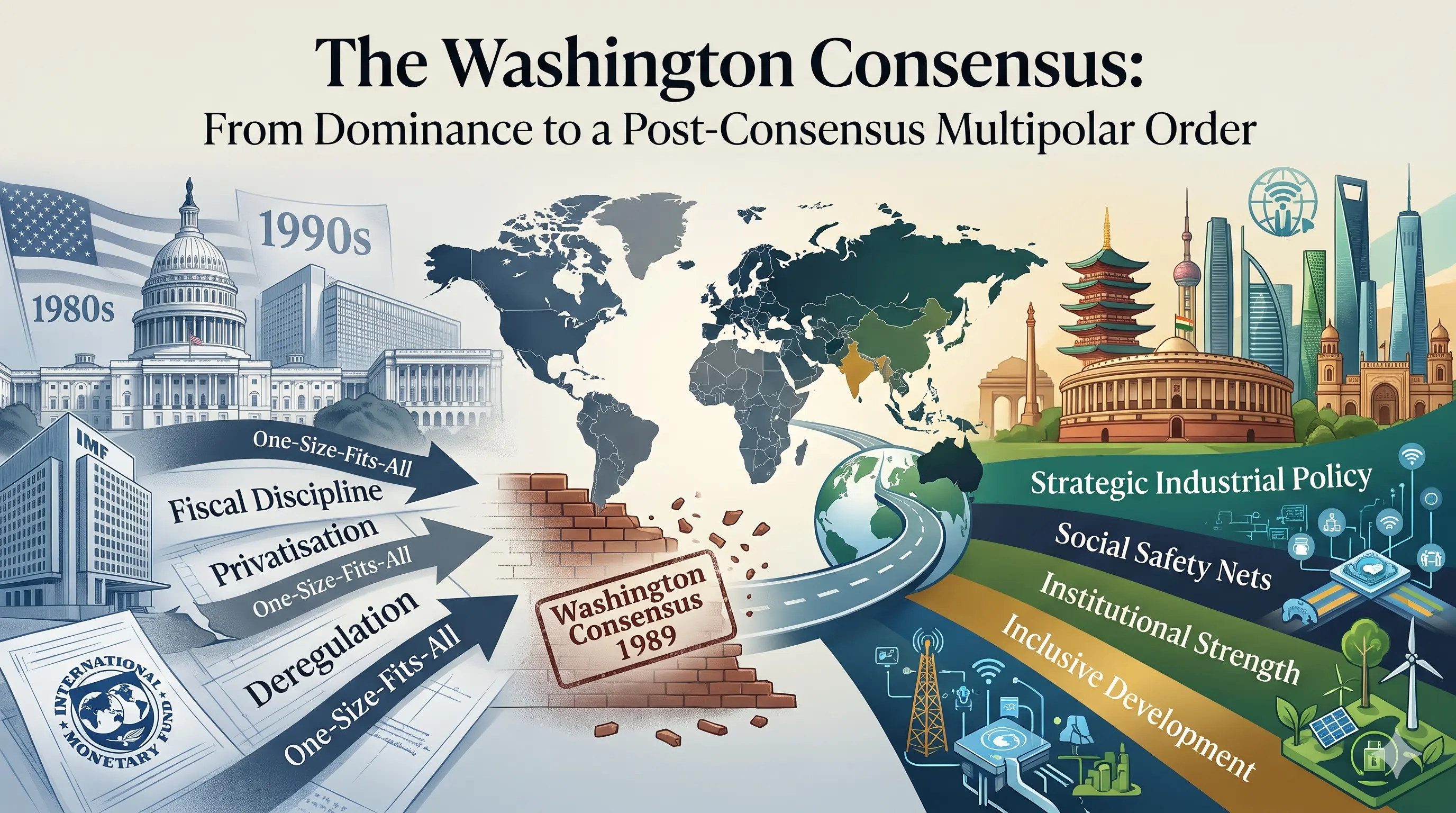
This article traces the birth, legacy, and decline of the Washington Consensus—a 10-point neoliberal policy framework coined in 1989. It examines the systemic failures of these policies, the ensuing political backlash, and the global shift towards a more context-sensitive, pragmatic post-Washington Consensus in a multipolar world.
Introduction
Context & Background
Key Points
- •The Genesis: Coined by John Williamson in 1989, the Washington Consensus was a set of ten neoliberal policy prescriptions promoted by institutions like the IMF and World Bank to resolve severe debt crises, primarily in Latin America.
- •Core Philosophy: The framework heavily emphasized macroeconomic stability and market-driven growth through fiscal discipline, privatisation, deregulation, and trade liberalisation.
- •Rejection of Industrial Policy: A defining and controversial feature of the consensus was its active discouragement of state support for strategic domestic industries—a tool successfully used by nations like South Korea and Japan.
- •Emergence of a Post-Washington Consensus: Modern economic governance recognizes that markets alone cannot ensure inclusive growth. There is a renewed focus on institutional strength, public investment, social safety nets, and redistributive policies.
- •Rise of Alternative Strategies: State-led development models, most notably associated with China, have demonstrated that a mix of state intervention, industrial strategy, and controlled liberalisation can drive rapid economic transformation.
Core Tenets of the Washington Consensus
| Policy Area | Key Prescriptions | Observed Limitations | Bookmark |
|---|---|---|---|
| Fiscal & Monetary Policy | Fiscal discipline, reordering public expenditure, tax reform, and interest rate liberalisation. | Often led to cuts in critical public spending and weakened social safety nets. | |
| Trade & Foreign Investment | Competitive exchange rates, trade liberalisation, and FDI liberalisation. | Exposed domestic industries to unequal competition; restricted strategic subsidies. | |
| State & Market Role | Privatisation of state enterprises and widespread market deregulation. | Increased economic inequality and neglected the need for targeted industrial policy. |
Evolution of Global Development Models
| Economic Model | Core Philosophy | Era / Prominent Adopters | Bookmark |
|---|---|---|---|
| Washington Consensus | Market-driven, deregulation, minimal state intervention. | Late 20th Century (Latin America, Global South) | |
| East Asian State-Led Model | Strategic state intervention, targeted industrialisation, protectionism. | Japan, South Korea, Taiwan | |
| Post-Washington Consensus | Context-sensitive eclecticism, institutional strength, public investment. | 21st Century Multipolar World |
Related Entities
Impact & Significance
- •Global Inequality and Poverty: The structural adjustment programs often mandated severe cuts in public spending, which weakened healthcare, education, and public services, ultimately intensifying poverty in developing regions.
- •Sovereignty vs. Global Rules: Trade rules enforced by the WTO restricted the sovereignty of developing nations to use subsidies or tariffs to nurture their own emerging sectors, creating an uneven global playing field.
- •Western Disillusionment: Following the 2008 financial crisis, the negative impacts of unchecked liberalisation reached advanced economies, sparking populist, anti-globalisation movements like Brexit and 'Make America Great Again'.
Challenges & Criticism
- •Rejection of Industrial Strategy: The framework's biggest flaw was its ideological opposition to state-led industrial policies, willfully ignoring that successful economies like Japan, South Korea, and Taiwan relied heavily on state protection during their formative years.
- •The 'One-Size-Fits-All' Fallacy: The consensus assumed that policies suited for specific crises could be universally applied, failing to account for the diverse historical, social, and institutional realities of different nations.
- •Widespread Political Backlash: Dissatisfaction led to major global resistance, visibly exploding during the 1999 Seattle WTO protests and the 2003 Cancún WTO Ministerial Conference, highlighting the deep divide between developed and developing nations.
Future Outlook
- •A New Development Consensus: Future global economic frameworks must be inclusive, bottom-up, and context-sensitive. Nations should selectively adopt successful elements from various models, such as South Korea’s industrial policy, Nordic social protection, and China’s infrastructure-led growth.
- •Advocacy by India: India must leverage platforms like the G20, BRICS, and WTO to advocate for flexibilities that permit developing nations to pursue tailored, strategic industrial policies.
- •Regulating New Frontiers: The emerging consensus must look beyond traditional trade to establish equitable frameworks for digital trade governance, climate finance, and AI regulation.
UPSC Relevance
- • GS-3 (Economic Development): Impact of economic reforms, liberalization, industrial policy, and planning models.
- • GS-2 (International Relations): Role of global economic institutions (IMF, World Bank, WTO) and India's interests in multipolar groupings.
- • Essay Topics: 'The limits of globalization', 'State vs. Market in economic development', and 'The rise of a multipolar world order'.
Sample Questions
Prelims
Consider the following statements regarding the 'Washington Consensus': 1. It strongly advocated for state-led strategic industrial policies to protect domestic markets. 2. The term was coined by John Williamson in 1989. 3. The policy framework primarily aimed to resolve the severe debt crises in Latin America during the late 20th century. Which of the statements given above is/are correct?
- (a)1 and 2 only
- (b)2 and 3 only
- (c)1 and 3 only
- (d)1, 2, and 3
Mains
“The decline of the Washington Consensus marks not the end of globalisation, but the end of the belief in a single universal model of development.” Analyze this statement in the context of the structural limitations of the Washington Consensus and the emergence of a multipolar economic order.
Introduction: Define the Washington Consensus (coined in 1989 by John Williamson) and outline its core tenets of liberalisation, privatisation, and deregulation promoted by the IMF and World Bank.
Body:
• Structural Limitations: Discuss the rejection of industrial policy, the social costs of structural adjustments (cuts in public spending, rising inequality), and how WTO rules restricted the developmental tools of the Global South.
• Political Backlash: Highlight the resulting dissatisfaction, from the 1999 Seattle protests in the Global South to the post-2008 anti-globalisation movements in the West (e.g., Brexit, MAGA).
• The Post-Washington Consensus: Explain the shift towards context-sensitive policies, institutional strength, state-led models (like China/East Asia), and renewed focus on social safety nets and strategic industrial policy.
Conclusion: Conclude that globalisation is evolving to be more pragmatic and policy-diverse. Emphasize India's role in advocating for flexible, inclusive policies in forums like G20 and BRICS to address new frontiers like digital trade and climate finance.