
West Asia Conflict: Strategic Logic, Iran's Fortress State, and Expanding Implications
The ongoing Iran–Israel–U.S. conflict has expanded regional tensions across West Asia, raising concerns over regional stability, energy security, and wider geopolitical escalation. This analysis examines the strategic logic behind the conflict, Iran's defensive 'fortress state' architecture, and the potential post-war scenarios.
Introduction
Context & Background
Key Points
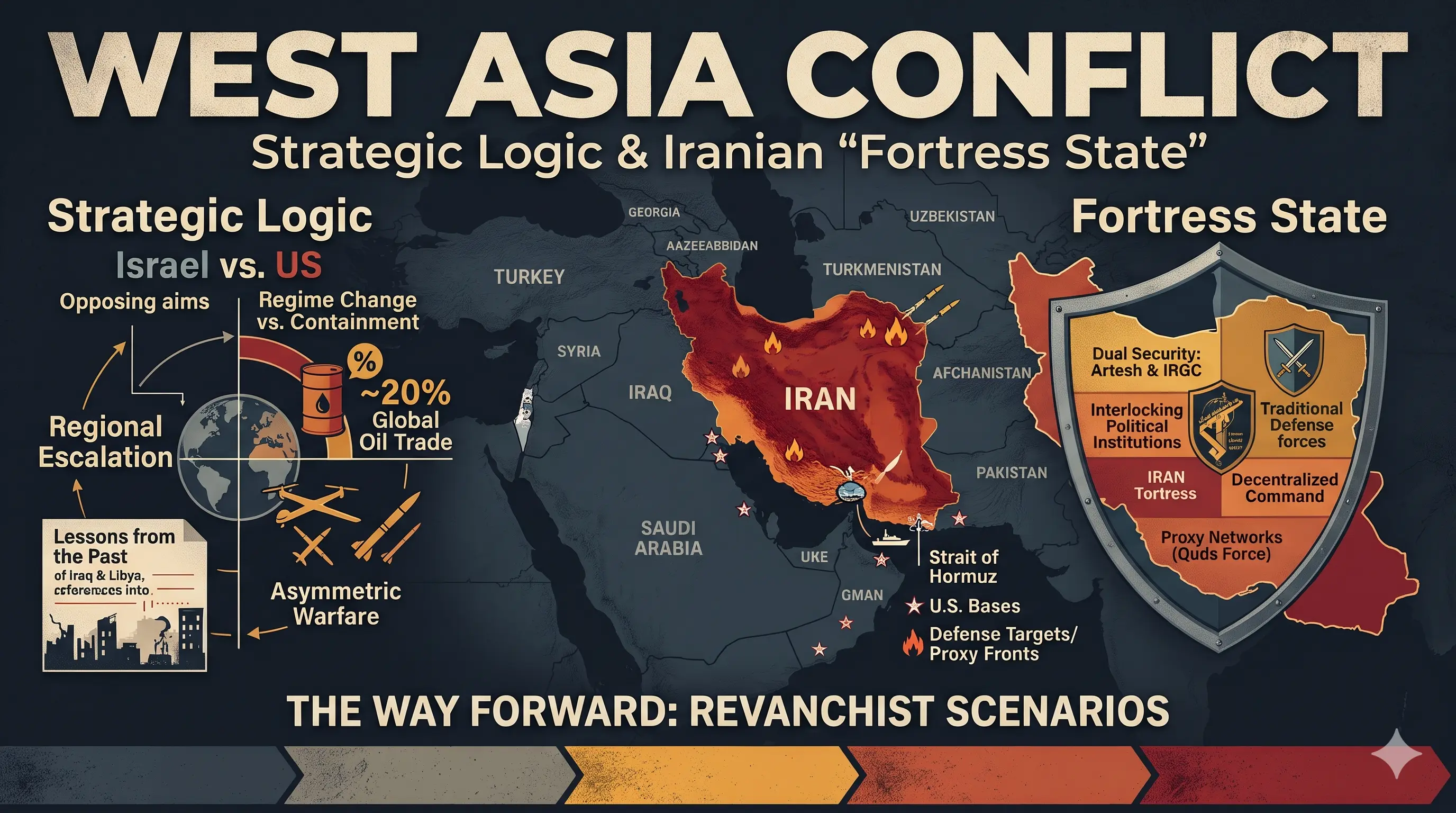
- •Geostrategic Objectives of the West: Reduce Russia’s energy leverage over Europe and dilute China’s clout in the region by pulling Iran and its energy resources into the West’s orbit, while crippling Iran's nuclear and missile infrastructure.
- •Iran’s Cost-Imposition Strategy: Iran’s primary goal is survival over victory. It aims to make the war economically, politically, and militarily costly through asymmetric warfare (missiles/drones) and leveraging regional chokepoints so adversaries prefer containment.
- •Iran's 'Fortress State' Architecture: Iran utilizes interlocking political institutions and a dual security architecture (Artesh for traditional defense and the IRGC for revolutionary protection and proxy networks) to prevent total state collapse.
- •Exploiting Minority Divisions: The U.S. attempted to exploit Iran’s ethnic diversity (Kurds, Baloch, Arabs, Azerbaijanis) to encourage fragmentation. However, strong national identity and a divided opposition make this strategy prone to failure.
- •The Strait of Hormuz Leverage: As a key energy chokepoint carrying ~20% of global crude oil, Iran can disrupt global energy markets, driving up inflation and forcing economic coercion on Western economies.
- •Lessons from Iraq (2003): Removing Iranian leadership without preserving state institutions could create a dangerous security vacuum, leading to sectarian conflict, extremist uprisings, and widespread regional destabilization.
Difference in War Aims: Israel vs United States
| Aspect | Israel | United States | Bookmark |
|---|---|---|---|
| Core Objective | Regime change in Iran: Aims to end the Islamic Republic system completely. | Mixed and shifting goals: Focus ranges from nuclear rollback to limited military success. | |
| Strategic Clarity | Clear and consistent strategy: Sees Iran as an existential threat that must be eliminated. | Lack of coherence: Strategy fluctuates between military pressure and diplomatic engagement. | |
| Approach to Conflict | Long-term transformation: Seeks fundamental political change in Iran. | Short-term outcomes: May aim for quick exit with a claim of victory. | |
| View on Regime Survival | Regime must not survive: Believes deterrence is insufficient. | Regime survival acceptable: If nuclear threat is reduced, regime continuity may be tolerated. | |
| Post-War Vision | End of Islamic Republic: Advocates a new political order in Iran. | Unclear endgame: No clear plan for post-conflict governance or stability. |
Related Entities
Impact & Significance
- •Global Energy Markets: Any disruption in the Strait of Hormuz leads directly to soaring global oil and LNG prices, triggering worldwide inflation and elevating transport and production costs.
- •Regional Instability: The expansion of the conflict activates Iran's widespread proxy network (Lebanon, Iraq, Yemen), turning localized friction into a wider Middle Eastern war.
- •Gulf States' Dilemma: GCC nations face severe strategic risks, having to balance neutrality while hosting US military bases that fall squarely within the range of Iranian retaliatory missiles.
- •Nuclear Proliferation: The existential threat posed by US and Israeli military campaigns incentivizes Iran to abandon restraint and rapidly pursue a nuclear deterrent.
Challenges & Criticism
- •Flawed Regime Change Logic: Historical precedents in Iraq, Libya, and Afghanistan demonstrate that external decapitation of leadership results in security vacuums and the rise of extremist militias, rather than democratic stability.
- •Divergent Adversary Goals: The US and Israel lack a unified endgame. Israel seeks the total destruction of the Islamic Republic, whereas the US fluctuates between seeking military pressure and settling for nuclear rollback.
- •Unintended Nationalist Backlash: Military strikes often backfire by generating domestic sympathy for the regime. National humiliation provides military elites the mandate to establish a deeply revanchist, anti-Western government.
Future Outlook
- •Scenario 1 – Political Chaos: Internal power struggles may emerge, though a weak and fragmented organized opposition reduces the likelihood of a full state collapse.
- •Scenario 2 – Regime Survival: Complete regime change is unlikely due to the absence of a ground invasion, the resilience of strong state institutions like the IRGC, and Iran’s large population.
- •Scenario 3 – Revanchist Leadership: A highly probable outcome is the rise of a revanchist, nationalist regime led by military elites (IRGC figures). Fueled by national humiliation and anti-Western sentiment, this leadership would seek long-term retaliation.
- •Accelerated Nuclear Ambitions: Post-war Iran may significantly accelerate its nuclear proliferation as an ultimate deterrent against future foreign interventions.
UPSC Relevance
- • GS-2 (International Relations): Extended Neighbourhood, Bilateral, regional and global groupings and agreements involving India and/or affecting India's interests.
- • GS-2 (Effect of Policies): Effect of policies and politics of developed and developing countries on India's interests, diaspora (Energy Security).
- • GS-3 (Internal Security): Implications of asymmetric warfare, drone technologies, and maritime chokepoints on global and national security.
Sample Questions
Prelims
Consider the following statements regarding the strategic geography and security architecture of West Asia: 1. The Strait of Hormuz connects the Persian Gulf to the Gulf of Oman and is a crucial chokepoint for global LNG shipments. 2. In Iran's dual security architecture, the 'Artesh' is responsible for managing regional proxy networks, while the IRGC handles traditional border defense. 3. The Baloch ethnic minority in Iran predominantly resides in the southwestern borderlands near Iraq. Which of the statements given above is/are correct?
- (a)1 only
- (b)1 and 2 only
- (c)2 and 3 only
- (d)1, 2 and 3
Mains
“Military success does not ensure political stability in West Asia.” Analyze this statement in the context of the recent Iran-Israel-U.S. conflict, highlighting Iran's 'Fortress State' strategy and the potential regional implications of a forced regime change.
Introduction: Introduce the context of the ongoing Iran-Israel-U.S. conflict. Define Iran's status as a 'Fortress State' and briefly outline the strategic objectives of the Western coalition (regime change, nuclear rollback).
Body:
• Iran's Fortress State Strategy: Explain the interlocking political institutions, the dual security architecture (Artesh and IRGC), and decentralized command structures that make the regime highly resilient to external shocks.
• Limits of Military Victory: Draw parallels with the Iraq (2003) and Libya (2011) interventions. Discuss how destroying leadership without institutional preservation leads to security vacuums, insurgencies, and sectarian chaos.
• Regional Implications (The Fallout): Detail the potential consequences, including disruptions in the Strait of Hormuz (~20% global oil), activation of proxy networks (Hezbollah, Houthis), and the risk of a revanchist, nuclear-armed Iran.
Conclusion: Conclude that a purely military approach to Iran is fraught with unpredictable outcomes. Long-term stability in West Asia requires diplomatic engagement and acknowledging that a fragmented Iran poses a greater threat to global security than a contained one.