
Women’s Political Participation in India: Bridging the Turnout and Representation Divide
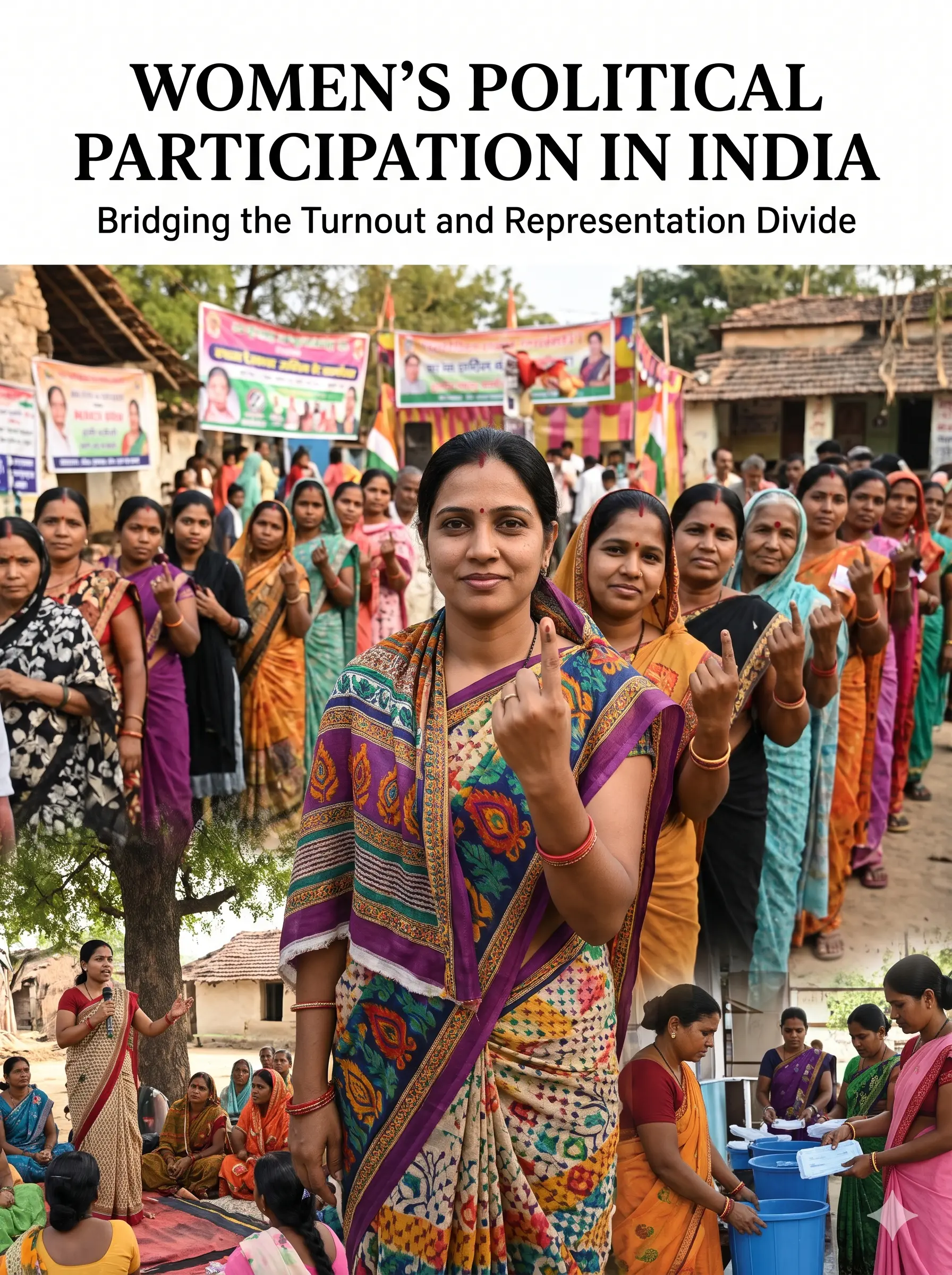
While India has witnessed near parity in voter turnout between men and women in recent general elections, female representation in Parliament and State Assemblies remains disproportionately low. This analysis explores the key dimensions of women's political participation, persistent structural challenges, and systemic reforms required to achieve meaningful representation.
Introduction
Context & Background
Key Points
- •The Silent Revolution in Turnout: The historic gender gap in Indian voter turnout has nearly collapsed from 11.2% in 1967 to parity in the 2019 and 2024 general elections, with women exceeding male turnout in multiple state assembly polls.
- •Autonomous and Issue-Based Voting: Women are moving away from proxy voting dictated by family heads; surveys from 2024 reveal nearly half of female voters made autonomous voting choices driven by targeted welfare measures like cash-transfers (e.g., Mukhyamantri Ladli Behna Yojana).
- •Grassroots Pipeline: The 73rd and 74th Constitutional Amendment Acts have institutionalized over 1.4 million women as elected representatives in Panchayats and Urban Local Bodies, creating an organic pipeline of governance leadership.
- •The Electability Paradox: Despite higher winnability metrics (9% win rate for women vs 6% for men in 2024), political parties allocated only around 10% of total contestable tickets to female aspirants.
- •Legislative Guarantee: The passage of the 106th Constitutional Amendment Act (Nari Shakti Vandan Adhiniyam) provides a 33% reservation framework for women in the Lok Sabha and State Legislative Assemblies, subject to delimitation.
Key Indicators of Women's Electoral Representation (2024 Lok Sabha)
| Indicator | Metric / Trend | Significance / Implication | Bookmark |
|---|---|---|---|
| Voter Turnout Parity | Gender gap declined from ~11.2% (1967) to near 0% | Reflects growing political agency and a 'silent revolution' among women. | |
| Lok Sabha Seats Held | 74 seats (~13.6%) in 2024 (down from 78 in 2019) | Highlights ongoing underrepresentation despite high electoral turnout. | |
| Candidate Share | ~10% of total candidates (~800 women contested) | Parties remain hesitant to field women due to perceived lower electability. | |
| Electoral Strike Rate | ~9% for women candidates vs ~6% for men | Proves women have higher relative success rates despite fewer tickets. | |
| Grassroots Representation | Over 1.4 million elected women representatives | Direct outcome of 73rd and 74th Constitutional Amendment reservations. |
Grassroots Women Leadership: Local Governance Best Practices
| Elected Leader (Mukhiya) | Location | Key Initiative / Impact | Bookmark |
|---|---|---|---|
| Sushumlata Kushwaha | Bhojpur (Bihar) | Established low-cost 'Sangini' sanitary pad unit, boosting menstrual hygiene and livelihoods. | |
| Prema Devi | Samastipur (Bihar) | Promoted biogas units for 200+ households and developed Amrit Sarovars for clean water. | |
| Julie Devi | Lakhisarai (Bihar) | Facilitated daily village-girl-led yoga sessions, promoting leadership and community health. | |
| Baby Devi | Samastipur (Bihar) | Conducted Mahila Sabhas and skill development programmes to boost financial autonomy. |
Related Entities
Impact & Significance
- •Deepening Democratic Legitimacy: Substantive female representation ensures laws and fiscal budgets integrate gender-responsive lenses (e.g., healthcare, safety, and care infrastructure).
- •Role-Model and Aspiration Effects: Visible female lawmakers inspire educational, civic, and professional investments among adolescent girls and young women.
- •Policy Reorientation: Increased presence of elected women representatives correlates with higher resource allocation toward basic public goods, clean drinking water, sanitation, and child health.
Challenges & Criticism
- •The Electability Myth: Institutionalized political gatekeeping where parties distribute fewer tickets to female aspirants on the false pretext of low winnability.
- •Patriarchal and Caregiver Penalties: Disproportionate distribution of domestic care responsibilities and requirement of family consent restrict flexible campaign schedules.
- •Electoral Criminality and Capital: Astronomical costs of electioneering alongside muscle power make competitive politics hostile for first-generation female entrants.
- •Digital Violence & Harassment: Severe online abuse, coordinated trolling, and defamation campaigns deliberately deployed to discourage women politicians from public discourse.
Future Outlook
- •Early Delimitation & Implementation: Swift operationalization of the Nari Shakti Vandan Adhiniyam post-delimitation to establish mandatory legislative quotas.
- •Internal Party Democracy: Voluntary quotas for women candidates on high-winnability tickets and leadership representation inside party executive councils.
- •Panchayat-to-Parliament Pipeline: Structured incubation, leadership mentoring, and training modules to enable grassroots Panchayat leaders to step into State and national contests.
- •Safe Political Workplaces: Institution of strict fast-track accountability against digital abuse, character assassination, and gender-based intimidation targeting female politicians.
- •Electoral Finance Reform: Dedicated public campaign funding pools and party subsidies to help women candidates navigate the distortive effects of money and muscle power.
UPSC Relevance
- • GS-2 (Polity & Governance): Parliament and State Legislatures, representation of vulnerable sections, and electoral reforms.
- • GS-1 (Society): Role of women and women's organizations, patriarchy, and empowerment.
- • Essay Topics: 'From Ballot Box to Parliament: The Unfinished Journey of Indian Women', 'Grassroots Democracy as a Catalyst for Social Transformation'.
Sample Questions
Prelims
With reference to women's political participation in India, consider the following statements: 1. The 106th Constitutional Amendment Act provides immediate reservation for women in the Lok Sabha without requiring a census or delimitation. 2. The gender gap in voter turnout during general elections has narrowed significantly compared to the 1960s. 3. The 73rd and 74th Constitutional Amendment Acts mandate a minimum of 50% reservation for women in all local bodies across every Indian state.
- (a)1 and 2 only
- (b)2 only
- (c)2 and 3 only
- (d)1, 2 and 3
Mains
“The narrowing of the gender turnout gap in Indian elections has not translated into equitable representation in legislatures.” Examine the structural barriers limiting women's political representation and evaluate the potential of the Nari Shakti Vandan Adhiniyam in bridging this deficit.
Introduction: Highlight the contrast between near-parity voter turnout in 2024 and women's low seat-share (13.6%) in the 18th Lok Sabha.
Body:
• Structural Barriers: Disproportionate burden of unpaid care work, lack of independent campaign finance, muscle-and-money dominance, and party leadership bias against women's electability.
• Agency at Grassroots: Success of 1.4 million women leaders under the 73rd/74th Amendments demonstrating local administrative acumen.
• Critical Evaluation of 106th CAA: Institutionalizes 33% reservation to dismantle entry barriers, though post-delimitation implementation timelines remain a challenge.
Conclusion: Conclude that legislative quotas must be matched with internal party reforms, financial backing, and social safety nets for substantive democratic deepening.